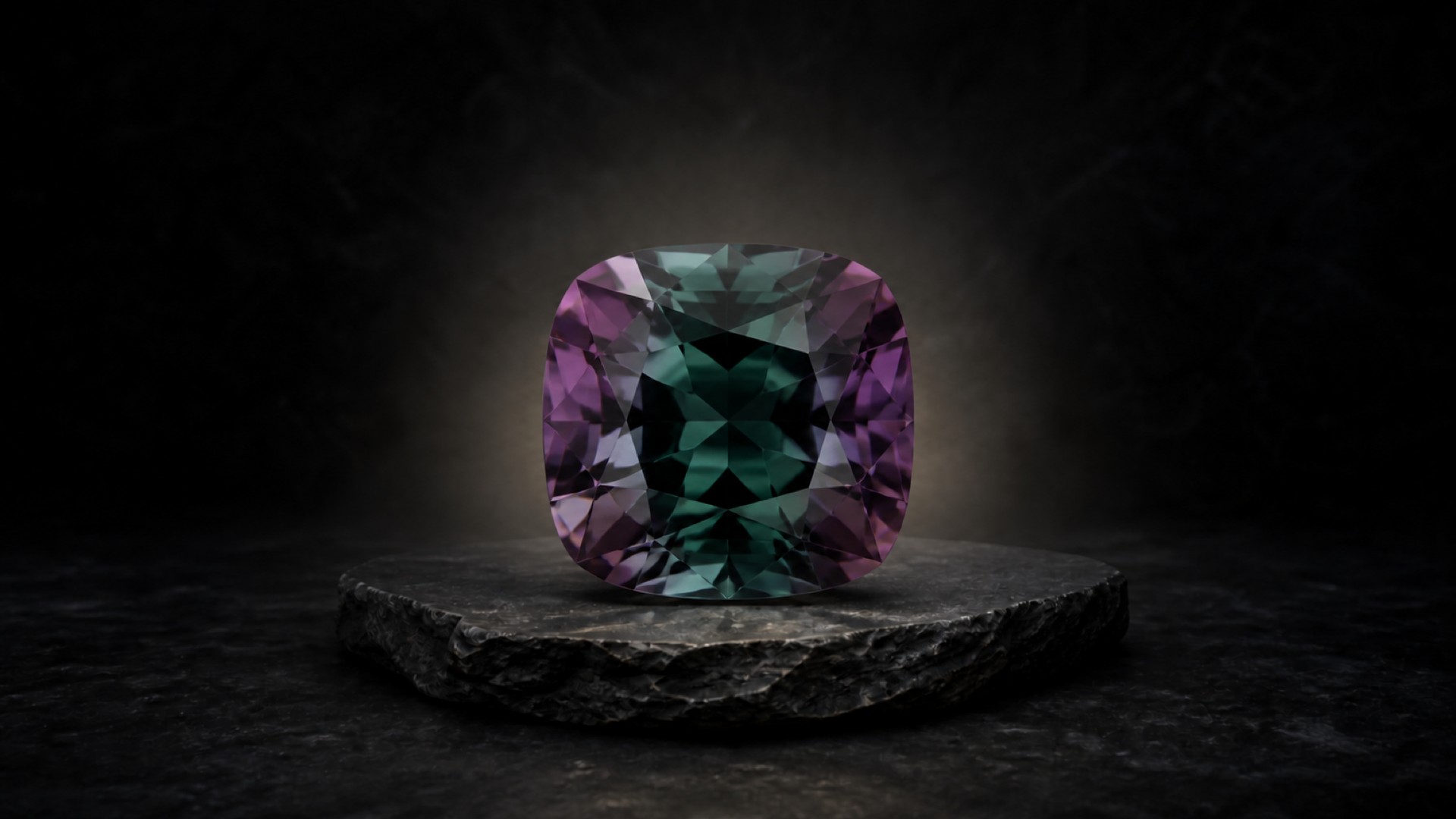
Cornerstone gemstone profile
Alexandrite
Color-change Chrysoberyl governed by chromium, spectrum, lighting, and orientation
AI-created master image · AI-generated editorial reference illustration
Explore this profile
Definition
What is Alexandrite?
Alexandrite is a chromium-bearing color-change variety of Chrysoberyl, BeAl₂O₄. Its daylight-to-incandescent appearance results from selective absorption interacting with the spectral power distribution of the light source, while orthorhombic pleochroism changes color with viewing direction. These are distinct effects. Natural, flux-grown, and pulled synthetic material and color-change synthetic corundum sold under misleading names require laboratory separation. [1]
At a glance
Gemological properties
Measured values and species-level properties are linked to their evidence. “Pending” means the value has not cleared review.
| Gemstone | Alexandrite | Mineral species | Chrysoberyl |
|---|---|---|---|
| Mineral group | Oxides | Family | Chrysoberyl |
| Chemical formula | BeAl₂O₄[1] | Crystal system | Orthorhombic[1] |
| Mohs hardnessMohs hardnessA comparative scale of scratch resistance from 1 to 10; it does not measure toughness.Learn more | 8.5[2] | Specific gravitySpecific gravityThe ratio of a material’s density to the density of water under defined conditions.Learn more | 3.7–3.78[1] |
| Refractive indexRefractive indexA measurement describing how light changes speed and direction as it enters a material.Learn more | 1.74–1.758[1] | BirefringenceBirefringenceThe numerical difference between a doubly refractive material’s principal refractive indices.Learn more | 0.007–0.011[1] |
| Optic character | Biaxial positive (doubly refractive)[1] | DispersionDispersionThe separation of white light into spectral colors because refractive index varies with wavelength.Learn more | 0.015[1] |
| Primary color | Color-changing[4] | PleochroismPleochroismDifferent body colors seen in some anisotropic gems when viewed along different crystallographic directions.Learn more | Strong trichroism; green, orange-yellow, and red to purple-red directions may contribute to face-up appearance[3] |
| LusterLusterThe character of light reflected from a material’s surface.Learn more | Vitreous[1] | Transparency | Transparent to translucent[1] |
| CleavageCleavageA mineral’s tendency to split along specific crystallographic planes.Learn more | Distinct to imperfect; parting may occur[1] | Fracture | Conchoidal to uneven[1] |
| TenacityTenacityA material’s response to bending, breaking, crushing, or tearing.Learn more | Brittle but generally tough for a faceted colored stone[1] | Fluorescence | Variable, commonly weak to moderate red; response is not diagnostic[4] |
| Streak | White[1] | Availability | Natural · Laboratory-grown |
| Jewelry suitability | Very good for jewelry, including rings, when sound and protected from sharp impact and extreme heat[2] | ||
Scope note: some physical properties describe corundum as a mineral species; ruby-specific claims are identified separately in the citations.
Mineralogy
Mineralogy & classification
Alexandrite is orthorhombic Chrysoberyl, not Beryl, Emerald, Corundum, or a separate mineral species.
Its ideal formula is BeAl₂O₄. Aluminum occupies distinct structural sites, and chromium substitution helps create the absorption pattern responsible for color change. Chrysoberyl also includes yellow-to-green transparent stones and chatoyant Cat's-eye Chrysoberyl.
The similarity between the words Beryl and Chrysoberyl is historical, not structural identity. Their formulas, crystal systems, refractive indices, densities, and optical characters differ.
Mineral species
Chrysoberyl (BeAl₂O₄)Alexandrite is its color-change variety. [1]
Chrysoberyl is not Beryl.
Chemistry
Chemistry & composition
Cr³⁺ substituting for Al³⁺ is the principal color contributor, with iron and other trace components modifying spectra and appearance.
Chromium absorption removes portions of visible light while leaving transmission bands that can favor green-blue wavelengths under daylight-rich sources and red wavelengths under incandescent-rich sources. The observed result depends on defect chemistry, concentration, path length, transparency, and the lamp spectrum.
Chromium detection alone does not define quality or prove natural origin; synthetic Chrysoberyl can use the same chromophore.
Beryllium is an essential Chrysoberyl lattice constituent. [1]
Aluminum occupies structural sites and may be substituted by chromium. [1]
Oxygen is an essential lattice constituent. [1]
Cr³⁺ is the principal contributor to Alexandrite color change. [3]
Iron can modify absorption and endpoint colors in natural Alexandrite populations. [5]
Principal chromophore
Cr³⁺ substituting for Al³⁺Selective absorption enables the change. [3]
Chromium does not prove natural origin or high quality.
Color
Color science
Alexandrite changes because its transmission spectrum is sampled by light sources with different spectral power distributions.
Daylight and many LEDs contain different wavelength balances from incandescent lamps. A stone cannot display wavelengths absent from the illumination, so a photographed or remembered “percentage change” is not universal without specifying sources, geometry, adaptation, and method.
Strong change involves both contrast and desirable colors; muddy, brown, gray, or weak endpoints can reduce appeal even when a measurable shift exists. Mixed lighting often produces mixed face-up color.
Cause
Stone transmission × lamp spectrumBoth the material and illumination control appearance. [3]
State the light sources behind endpoint claims.
Optics
Optical properties
Color change varies with illumination spectrum; pleochroism varies with crystal direction. Alexandrite displays both, and they must not be treated as synonyms.
Orthorhombic Chrysoberyl is biaxial and can show three directional colors. Cut orientation blends those directions into the face-up appearance and can strengthen or weaken the observed change. Rotating a stone under one fixed lamp demonstrates pleochroic contributions, not the same experiment as switching lamps.
Accurate evaluation controls both variables: compare standardized light sources while maintaining orientation, then investigate directional color separately.
Pleochroism vs color change
Direction vs illuminationCut orientation blends strong trichroic directions. [3]
The effects are related in appearance but not synonymous.
Durability
Hardness & durability
At 8.5 Mohs, Alexandrite resists scratching well and generally has very good jewelry durability, but it remains brittle.
Hardness does not prevent chipping at facet edges or fracture under a sharp blow. Cleavage or parting, existing fissures, inclusions, thin girdles, and exposed points affect risk. Protective settings are sensible for active ring wear.
Warm soapy water is the safest general cleaning choice. Sound material may tolerate some machine cleaning, but fractures, uncertain treatment, and antique settings justify conservative care.
Hardness means scratch resistance. It is not a universal durability score and does not equal toughness.
Mohs hardness
8.5Good scratch resistance for frequent wear. [2]
It remains brittle and can chip under impact.
Formation
Geology & formation
Alexandrite requires beryllium-rich processes to meet chromium-bearing rocks—elements that are not commonly concentrated together.
Important occurrences are associated with pegmatitic or hydrothermal fluids interacting with ultramafic, mafic, or metamorphic rocks. Primary crystals may weather into alluvial gravels, obscuring their original bedrock source.
Different deposits can produce overlapping chemistry and inclusions. A simplified “one locality, one color” model is not scientifically defensible.
Unusual geochemistry
Beryllium-rich fluids meeting chromium-bearing rockThis geologic meeting helps explain scarcity. [5]
Deposit models vary by locality.
Locations
Where Alexandrite occurs
Documented Alexandrite sources include the Urals, Hematita in Brazil, Sri Lanka, Tanzania, Madagascar, and India; each origin contains internal variation.
Russian material established the historical ideal, while Brazilian production changed market awareness in the late twentieth century. Sri Lankan stones may be larger but can show different color balance; East African and Indian deposits broaden the known range.
Origin is not a quality grade. Laboratory opinions compare inclusions, spectra, and trace-element populations and may remain inconclusive when fields overlap.
Laboratory opinion
Inclusions + spectra + trace chemistrySome origin fields overlap. [5]
Country is not a quality grade.
Ural Alexandrite Region
Historic source importance documented; current production not asserted. [5]
- Production
- Historic production documented
- Coordinates
- Not published
Hematita Alexandrite District
Historic production and origin reference documented; current status not asserted. [5]
- Production
- Historic production documented
- Coordinates
- Not published
Sri Lanka Alexandrite Deposits
Documented origin reference; current mine status not asserted. [5]
- Production
- Production not assessed
- Coordinates
- Not published
Tanzania Alexandrite Deposits
Documented origin reference; current mine status not asserted. [5]
- Production
- Production not assessed
- Coordinates
- Not published
Madagascar Alexandrite Deposits
Documented origin reference; current mine status not asserted. [5]
- Production
- Production not assessed
- Coordinates
- Not published
India Alexandrite Deposits
Documented origin reference; current mine status not asserted. [5]
- Production
- Production not assessed
- Coordinates
- Not published
Origin caution: locality relationships do not by themselves prove geographic origin for an individual stone.
Inclusions
Inclusions & internal features
Natural Alexandrite may show twinning, growth zoning, mineral crystals, fluid inclusions, needles, healed fissures, and other Chrysoberyl features.
Microscopy contributes to natural-versus-synthetic separation and origin interpretation. Flux residues, seed-related structures, curved or angular growth features, and characteristic inclusions may support a synthetic method, but production changes over time.
Parallel inclusions can produce chatoyancy in Cat's-eye Alexandrite. The eye and the color change are separate phenomena that depend on inclusion orientation, cutting, and lighting.
Twinning and growth structures
Natural or synthetic growth features requiring contextual interpretation. [5]
- Identification
- Supports Chrysoberyl growth interpretation.
- Treatment context
- Treatment significance is limited without associated evidence.
- Origin caution
- Patterns can contribute to origin analysis but overlap.
Mineral crystals
Solid inclusions requiring identification and contextual interpretation. [5]
- Identification
- Assemblages support natural growth and geologic context.
- Treatment context
- Treatment interpretation is sample-specific.
- Origin caution
- Some assemblages contribute to origin opinion.
Fluid inclusions
Fluid-bearing cavities whose form and context may record growth or healing. [5]
- Identification
- Record natural growth or later healing.
- Treatment context
- Heating effects require sample-specific evidence.
- Origin caution
- Origin populations overlap.
Needles and platelets
Elongate or platy inclusions that may contribute to chatoyancy when oriented. [5]
- Identification
- Can create chatoyancy when dense, aligned, and properly cut.
- Treatment context
- Treatment significance is sample-specific.
- Origin caution
- Not a stand-alone locality marker.
Flux residues
Residual flux features associated with some flux-grown synthetics. [7]
- Identification
- Residual flux may support laboratory growth interpretation.
- Treatment context
- Not a treatment indicator after growth.
- Origin caution
- Not a locality indicator.
Treatments
Treatments & disclosure
Alexandrite is not generally expected to need routine color improvement, but treatment cannot be dismissed by reputation.
Fracture filling, coating, and other interventions must be considered when condition or appearance suggests them. Ordinary heat is not presented here as a universal commercial Alexandrite treatment, and prevalence claims require current market evidence.
A report should state observed treatment findings within the laboratory's capabilities. “Usually untreated” is not evidence that an individual stone is untreated.
Usually untreated is not evidence
Assess the individual stoneFilling or coating cannot be excluded by reputation. [2,8]
Request specific laboratory findings.
Fracture filling
- Purpose
- Improve apparent clarity
- Detection
- Microscopy and spectroscopy may reveal filler.
- Permanence
- Stability depends on filler and exposure.
- Care effect
- Use warm soapy water and avoid heat or machine cleaning.
Surface coating
- Purpose
- Modify apparent color
- Detection
- Magnification and spectroscopy can support detection.
- Permanence
- May abrade or be damaged by heat and chemicals.
- Care effect
- Use conservative cleaning and avoid bench heat.
Natural vs synthetic
Natural, laboratory-grown & simulant
Synthetic Alexandrite is laboratory-grown Chrysoberyl, commonly produced by flux or crystal-pulling methods; it is not the same as a simulant.
Flux-grown material may contain flux residues or growth features; Czochralski-pulled crystals can show different growth structures and chemistry. Microscopy, infrared and visible spectroscopy, trace chemistry, fluorescence behavior, and growth evidence support separation.
Color-change synthetic corundum is not synthetic Alexandrite because its mineral species is Corundum. A trade name containing “Alexandrite” must not override tested identity.
Identification
How gemologists identify Alexandrite
Identification combines refractive index, birefringence, biaxial optics, specific gravity, pleochroism, spectrum, microscopy, and advanced analysis when needed.
First establish Chrysoberyl identity, then document color change under defined illumination. Natural-versus-synthetic interpretation may use growth features, inclusions, FTIR, Raman, UV-Vis-NIR, fluorescence imaging, and trace chemistry.
Color change alone cannot distinguish Alexandrite from synthetic Chrysoberyl, color-change Corundum, Garnet, Glass, or other look-alikes. Scratch testing is damaging and inconclusive.
Value factors
Value factors
Fine natural Alexandrite value reflects color-change quality, endpoint colors, transparency, cut, size, treatment, report, condition, origin evidence, and provenance.
Material described as Alexandrite ranges from weak or brownish change to exceptional transparent stones with strong contrasting colors. That range makes blanket “rarest gem” claims unhelpful. Fine large examples are scarce, but scarcity must be scoped to quality, size, and evidence.
Origin may influence collector interest, yet a Russian attribution cannot rescue weak quality and must be supported. No investment return is guaranteed.
Buying guide
How to buy Alexandrite
View the same stone under controlled daylight-equivalent and incandescent-rich sources, then check mixed everyday lighting, cut, clarity, report, disclosure, and return terms.
Ask whether it is natural Chrysoberyl, synthetic Chrysoberyl, or another color-change material; whether treatments were detected; which laboratory issued the report; and how origin was determined. Compare face-up size as well as carat.
Require paired photographs to identify illumination and avoid images captured with auto white balance as proof of grade. For significant purchases, independent laboratory confirmation is central.
Collector guide
Collector’s guide to Alexandrite
Collectors may pursue strong paired colors, large transparent stones, documented Russian or Brazilian provenance, twinned crystals, specimens, or simultaneous chatoyancy and color change.
Preserve old labels, mine or district records, invoices, reports, spectrum data, and photographs under defined lighting. Historic labels can be valuable evidence but should be reconciled with modern identification.
A cat's-eye should show a distinct mobile band with appropriate cabochon orientation. The phenomenon does not prove natural origin or locality.
Cat's-eye Alexandrite
Chatoyancy plus color changeParallel inclusions and cabochon orientation create the eye. [6]
The eye does not prove natural origin.
Preserve lighting context
Reports, locality records, paired images, lamp dataDocumentation is central to rare-origin claims. [5]
Do not convert an old label into an untested conclusion.
Care
Alexandrite care card
Use warm water, mild soap, a soft brush, and careful rinsing as the safest routine cleaning method.
Store Alexandrite away from Diamond and other hard gems that can scratch it. Avoid sharp impacts, high heat, rapid temperature change, and machine cleaning when fractures, filling, or setting condition are uncertain.
Provide the jeweler with laboratory reports and disclose uncertainty before repair. Inspect prongs and vulnerable facet junctions regularly.
Sources [2]
Safest method
Warm soapy water and a soft brushA conservative default for uncertain condition. [2]
Avoid sharp impacts and unassessed machine cleaning.
History
History & etymology
Alexandrite was described from nineteenth-century Ural discoveries and named in association with the future Russian emperor Alexander II.
The red-and-green association encouraged national symbolism, but historical storytelling should not replace mineral evidence. Later finds in Sri Lanka, Brazil, East Africa, Madagascar, and India expanded the range of sizes and color behavior recognized in the market.
Old “Alexandrite” labels may refer to color-change synthetic Corundum or glass. Preserve the label as provenance while testing the object under modern nomenclature.
Ural discovery and royal name
Nineteenth-century Russian contextLater sources expanded the recognized range. [4]
Historical symbolism is not mineral science.
Famous gems
Famous & historic specimens
Alexandrite's appearance changes with lamp spectrum, camera processing, viewing direction, and cut, so documentary media must record its conditions.
A defensible specimen record needs tested identity, natural or synthetic status, weight or dimensions, locality basis, custodian, photographer, license, and paired-light method. One attractive green-red composite is not sufficient evidence.
This batch leaves named-stone records for future rights and provenance research rather than copying unsupported lists.
Short answers
Alexandrite questions, answered
What is Alexandrite?+
Alexandrite is the color-change variety of Chrysoberyl, BeAl₂O₄. Its classic appearance shifts from greenish in daylight-rich illumination toward reddish in incandescent-rich illumination. [4]
Alexandrite is the color-change variety of Chrysoberyl, BeAl₂O₄. Its classic appearance shifts from greenish in daylight-rich illumination toward reddish in incandescent-rich illumination.
Is Alexandrite a type of Beryl?+
No. Alexandrite is Chrysoberyl. Despite the similar names, Beryl and Chrysoberyl have different formulas, structures, optical properties, and densities. [1]
No. Alexandrite is Chrysoberyl. Despite the similar names, Beryl and Chrysoberyl have different formulas, structures, optical properties, and densities.
Why does Alexandrite change color?+
Chromium-related selective absorption leaves transmission regions that are weighted differently by daylight-rich and incandescent-rich spectra. The lamp spectrum, stone chemistry, thickness, cut, and adaptation all influence the result. [3]
Chromium-related selective absorption leaves transmission regions that are weighted differently by daylight-rich and incandescent-rich spectra. The lamp spectrum, stone chemistry, thickness, cut, and adaptation all influence the result.
Is color change the same as pleochroism?+
No. Color change varies when the illumination spectrum changes. Pleochroism varies with viewing direction in an anisotropic crystal. Alexandrite shows both, and cut orientation mixes them face-up. [3]
No. Color change varies when the illumination spectrum changes. Pleochroism varies with viewing direction in an anisotropic crystal. Alexandrite shows both, and cut orientation mixes them face-up.
What colors can Alexandrite show?+
Examples can appear bluish green, green, or yellowish green in daylight-rich light and red, purplish red, purple, or brownish red in incandescent-rich light. Quality depends on more than naming endpoints. [6]
Examples can appear bluish green, green, or yellowish green in daylight-rich light and red, purplish red, purple, or brownish red in incandescent-rich light. Quality depends on more than naming endpoints.
How hard is Alexandrite?+
Alexandrite is 8.5 on Mohs, giving good scratch resistance. It remains brittle and can chip or fracture under sharp impact, especially at vulnerable edges or existing fissures. [2]
Alexandrite is 8.5 on Mohs, giving good scratch resistance. It remains brittle and can chip or fracture under sharp impact, especially at vulnerable edges or existing fissures.
Where is Alexandrite found?+
Documented sources include Russia, Brazil, Sri Lanka, Tanzania, Madagascar, and India. Each has internal variation, and current mining status should not be inferred from historical occurrence. [5]
Documented sources include Russia, Brazil, Sri Lanka, Tanzania, Madagascar, and India. Each has internal variation, and current mining status should not be inferred from historical occurrence.
Is Russian Alexandrite always the best?+
No. Russian origin carries historical interest, but quality depends on the individual stone's change, colors, transparency, cut, size, condition, treatment, and evidence. Origin requires support and is not a grade. [5,6]
No. Russian origin carries historical interest, but quality depends on the individual stone's change, colors, transparency, cut, size, condition, treatment, and evidence. Origin requires support and is not a grade.
Can Alexandrite be synthetic?+
Yes. Synthetic Alexandrite is laboratory-grown Chrysoberyl, including flux-grown and pulled material. It can reproduce the color-change effect and needs laboratory separation from natural growth. [7]
Yes. Synthetic Alexandrite is laboratory-grown Chrysoberyl, including flux-grown and pulled material. It can reproduce the color-change effect and needs laboratory separation from natural growth.
Is color-change synthetic Sapphire Alexandrite?+
No. Color-change synthetic Sapphire is Corundum, not Chrysoberyl. Historical trade wording may include “Alexandrite,” but tested mineral identity must control the description. [7]
No. Color-change synthetic Sapphire is Corundum, not Chrysoberyl. Historical trade wording may include “Alexandrite,” but tested mineral identity must control the description.
Is Alexandrite treated?+
Alexandrite is often marketed as untreated, but reputation is not proof for an individual stone. Laboratories assess filling, coating, and other treatment evidence within their methods and disclosure standards. [2,8]
Alexandrite is often marketed as untreated, but reputation is not proof for an individual stone. Laboratories assess filling, coating, and other treatment evidence within their methods and disclosure standards.
How do gemologists identify Alexandrite?+
They combine refractive index, birefringence, biaxial optics, pleochroism, spectrum, microscopy, and—when needed—infrared, Raman, fluorescence imaging, or trace chemistry. [5,9]
They combine refractive index, birefringence, biaxial optics, pleochroism, spectrum, microscopy, and—when needed—infrared, Raman, fluorescence imaging, or trace chemistry.
What determines Alexandrite value?+
Change strength and completeness, endpoint colors, transparency, cut, size, natural or synthetic origin, treatment, condition, origin evidence, and provenance interact. No universal AAA or price formula exists. [6]
Change strength and completeness, endpoint colors, transparency, cut, size, natural or synthetic origin, treatment, condition, origin evidence, and provenance interact. No universal AAA or price formula exists.
How should Alexandrite be photographed?+
Use labeled, defined daylight-equivalent and incandescent-rich sources, keep geometry and orientation controlled, and disclose camera settings or processing. Auto white balance can distort endpoints. [3]
Use labeled, defined daylight-equivalent and incandescent-rich sources, keep geometry and orientation controlled, and disclose camera settings or processing. Auto white balance can distort endpoints.
How should Alexandrite be cleaned?+
Warm water, mild soap, and a soft brush are the safest routine method. Avoid sharp impact, extreme heat, and machine cleaning when fractures, filling, or setting condition are uncertain. [2]
Warm water, mild soap, and a soft brush are the safest routine method. Avoid sharp impact, extreme heat, and machine cleaning when fractures, filling, or setting condition are uncertain.
Evidence
References & further reading
Citation numbers are deduplicated across properties, claims, sections, structured modules, treatments, inclusions, FAQs, and related educational records.
- [1]Chrysoberyl.
Mineralogical Society of America
- [2]Alexandrite Care and Cleaning Guide.
Gemological Institute of America
- [3]Ziyin Sun, Aaron C. Palke, and Nathan D. Renfro. Pleochroism and Color Change in Faceted Alexandrite: The Influence of Cut Orientation.
Gems & Gemology · 2019 · Vol. 55 (1)
- [4]Alexandrite.
Gemological Institute of America
- [5]Aaron C. Palke, Ziyin Sun, Nathan D. Renfro, and Shane F. McClure. Geographic Origin Determination of Alexandrite.
Gems & Gemology · 2019 · Vol. 55 (4)
- [6]Alexandrite Quality Factors.
Gemological Institute of America
- [7]John I. Koivula and Shane F. McClure. Synthetic Alexandrite with Unique Growth Features.
Gems & Gemology · 2014 · Vol. 50 (1)
- [8]An Introduction to Gem Treatments.
Gemological Institute of America
- [9]GIA Laboratory staff. Infrared Spectroscopy and Alexandrite Identification.
Gems & Gemology · 2024 · Vol. 60 (4)