Cornerstone gemstone profile
Amethyst
Purple Quartz shaped by iron-related color centers, irradiation, zoning, and treatment history
Also known descriptively as Purple Quartz
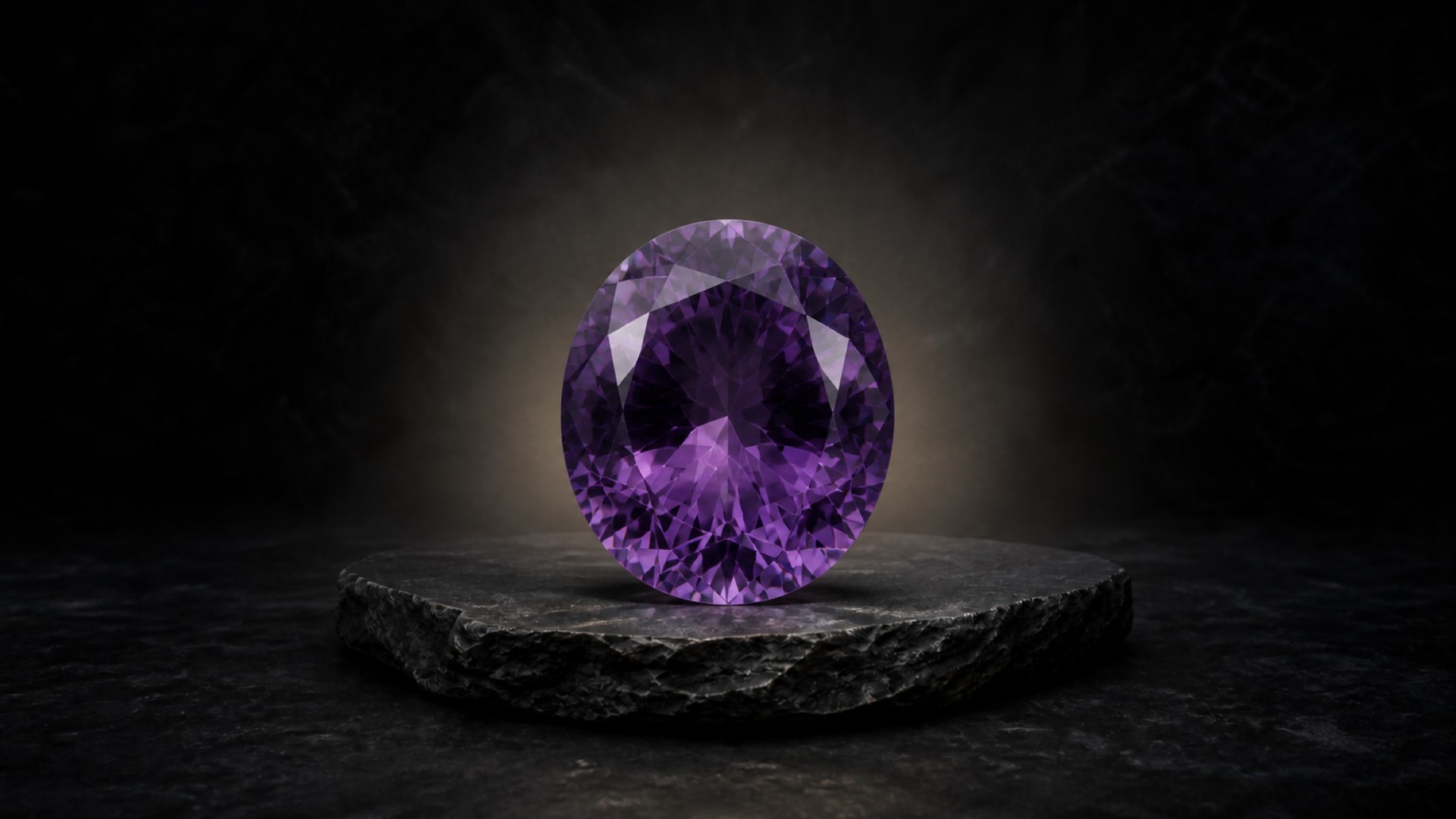
AI-created master image · AI-generated editorial reference illustration
Explore this profile
Definition
What is Amethyst?
Amethyst is trigonal Quartz, SiO₂. Its purple color arises from irradiation-created, iron-related color centers within the Quartz lattice rather than from iron concentration alone. Sector and growth zoning, Brazil-law twinning, heat response, spectroscopy, and inclusions can inform identification, but no single observation answers every origin or treatment question. [1]
Also described asPurple Quartz
At a glance
Gemological properties
Measured values and species-level properties are linked to their evidence. “Pending” means the value has not cleared review.
| Gemstone | Amethyst | Mineral species | Quartz |
|---|---|---|---|
| Mineral group | Silicates | Family | Quartz |
| Chemical formula | SiO₂[1] | Crystal system | Trigonal[1] |
| Mohs hardnessMohs hardnessA comparative scale of scratch resistance from 1 to 10; it does not measure toughness.Learn more | 7[1] | Specific gravitySpecific gravityThe ratio of a material’s density to the density of water under defined conditions.Learn more | 2.65–2.66[1] |
| Refractive indexRefractive indexA measurement describing how light changes speed and direction as it enters a material.Learn more | 1.544–1.553[1] | BirefringenceBirefringenceThe numerical difference between a doubly refractive material’s principal refractive indices.Learn more | 0.009[1] |
| Optic character | Uniaxial positive; anomalous behavior may occur with twinning or strain[1] | DispersionDispersionThe separation of white light into spectral colors because refractive index varies with wavelength.Learn more | 0.013[1] |
| Primary color | Purple[2] | PleochroismPleochroismDifferent body colors seen in some anisotropic gems when viewed along different crystallographic directions.Learn more | Weak to moderate dichroism, commonly reddish purple and bluish purple[2] |
| LusterLusterThe character of light reflected from a material’s surface.Learn more | Vitreous[1] | Transparency | Transparent to translucent[1] |
| CleavageCleavageA mineral’s tendency to split along specific crystallographic planes.Learn more | None; twinning-related parting may occur[1] | Fracture | Conchoidal[1] |
| TenacityTenacityA material’s response to bending, breaking, crushing, or tearing.Learn more | Brittle; generally good toughness for jewelry when free of vulnerable fractures[1] | Fluorescence | Usually inert to weak and variable; not diagnostic[2] |
| Streak | White[1] | Availability | Natural · Laboratory-grown |
| Jewelry suitability | Well suited to jewelry; protect from sharp impact, prolonged intense heat or light where color stability is uncertain, and treatment-specific cleaning risks[3] | ||
Scope note: some physical properties describe corundum as a mineral species; ruby-specific claims are identified separately in the citations.
Mineralogy
Mineralogy & classification
Amethyst inherits Quartz's framework structure, hardness, density, uniaxial optics, and lack of cleavage.
Quartz consists of a three-dimensional SiO₂ framework. At ordinary conditions gem Quartz has trigonal symmetry and commonly forms six-sided prisms terminated by rhombohedral faces.
Dauphiné and Brazil-law twinning can affect internal structure and optical observations without changing the Quartz species identity.
Chemistry
Chemistry & composition
Amethyst color is an iron-related, irradiation-created lattice-defect phenomenon—not simply 'iron makes it purple.'
Small amounts of iron occupy or influence sites in Quartz. Natural irradiation and charge compensation create color centers whose electronic absorption produces purple. Valence, site, defects, dose, temperature, and competing centers matter.
Bulk iron concentration alone cannot predict hue or prove natural color. Spectroscopy, zoning, growth context, and treatment evidence must be interpreted together.
Silicon forms the Quartz framework with oxygen. [1]
Oxygen links silicon tetrahedra in the Quartz framework. [1]
Iron-related defects and irradiation-created color centers contribute to purple absorption. [5]
Formula
SiO₂The ideal formula describes the Quartz host. [1]
Trace iron and defects are not shown in the ideal formula.
Color mechanism
Irradiation-created, iron-related color centersElectronic defects in an iron-bearing Quartz lattice produce purple absorption. [5]
Iron concentration alone does not determine color.
Color
Color science
Fine Amethyst ranges from reddish purple to bluish purple; face-up evenness and lively transparency matter.
Amethyst commonly shows angular, sectoral, or banded color zoning. Cut orientation and proportions can mix zones, leave obvious patches, or create a washed-out window.
Seller labels such as 'deep Siberian' or 'AAA' are not universal laboratory grades and do not establish locality.
Optics
Optical properties
Weak-to-moderate dichroism and characteristic twinning can support interpretation, but neither is a universal stand-alone test.
Reddish-purple and bluish-purple directions may be visible in suitable stones. Brazil-law twinning can appear as alternating optical sectors under crossed polarizers and has historically helped distinguish many natural from hydrothermal synthetic samples.
Modern separation uses a suite of microscopic, optical, spectroscopic, and growth evidence because exceptions exist.
Twinning
Brazil-law and Dauphiné relationshipsOptical sector patterns can contribute to natural-versus-synthetic assessment. [4]
No single twinning observation is universal proof.
Durability
Hardness & durability
Mohs 7 gives useful scratch resistance; brittle Quartz can still chip or fracture.
Amethyst has no easy cleavage and normally good jewelry durability, but sharp blows can chip facet junctions, points, thin girdles, or pre-existing fractures. Hardness does not mean unbreakable.
Quartz can scratch softer gems and be scratched by Corundum, Diamond, and other harder materials in storage.
Normal wear is usually safe, while prolonged intense light or excessive heat can alter some Amethyst color.
Color response varies by material and treatment history. Bench heat can lighten, brown, yellow, or green selected Quartz and can worsen fractures.
Use protective design for exposed points and large rings, and tell the jeweler the stone is Amethyst before repair.
Hardness means scratch resistance. It is not a universal durability score and does not equal toughness.
Formation
Geology & formation
Amethyst forms in hydrothermal veins, volcanic cavities and geodes, and other fluid-mediated Quartz environments.
Silica-bearing fluids deposit Quartz in fractures or cavities as temperature, pressure, chemistry, and redox conditions evolve. Iron availability and later natural irradiation contribute to purple color development.
No single formation story covers every deposit. Host rock, associated minerals, fluid inclusions, zoning, and age must be studied locality by locality.
Color bands and sectors record changing growth conditions and defect distributions.
Alternating pale and saturated zones can follow rhombohedral growth sectors. Fluid inclusions, mineral inclusions, healed fissures, and growth surfaces preserve parts of the crystal's history.
Zoning can support natural-growth interpretation, but synthetic hydrothermal Quartz can also show growth features; context matters.
Locations
Where Amethyst occurs
Brazil, Zambia, Uruguay, Bolivia, Canada, and other regions have documented Amethyst deposits, but source claims require evidence.
Brazilian volcanic geodes and vein deposits have long supplied crystals and faceting rough. Zambia is documented in official 2024 production statistics. Bolivia's Anahí deposit is renowned for natural Amethyst-Citrine zoning.
Appearance cannot prove country or mine. Historic occurrence is not automatically current production.
Current dated evidence
Zambia reported Amethyst output for 2024Government statistics support a country-level current-production statement. [11]
This does not prove activity at every mine or future supply.
Rio Grande do Sul Amethyst Districts
Major documented mining district; current operating status not inferred from the 1988 field report. [10]
- Production
- Historic production documented
- Coordinates
- Not published
Zambia Amethyst Producing Regions
Current status is date-bounded to the cited 2024 government or government-science evidence; continuous activity at every operation is not inferred. [11]
- Production
- Current production verified
- Coordinates
- Not published
Anahí Mine
Natural Amethyst-Citrine mineralization is documented; current production is not asserted. [12]
- Production
- Production not assessed
- Coordinates
- Not published
Canadian Shield Amethyst Occurrences
Peer-reviewed geology and gemology document occurrence; current production is not asserted. [9]
- Production
- Production not assessed
- Coordinates
- Not published
Mogok Stone Tract
GIA field reporting documents amethyst production in the Mogok Stone Tract. [14]
- Production
- Historic production documented
- Coordinates
- Approximate locality position
Origin caution: locality relationships do not by themselves prove geographic origin for an individual stone.
Inclusions
Inclusions & internal features
Mineral crystals, fluids, negative crystals, healed fissures, growth zoning, twinning, and fractures occur in Amethyst.
Microscopy can support natural origin, identify condition, and reveal treatment-sensitive fractures. Brazil-law twin patterns and inclusion suites contribute to natural-versus-synthetic work.
No single inclusion proves a mine, and an eye-clean stone can still be natural.
Useful features
Twinning, zoning, fluids, crystals, healed fissures, and fracturesA feature suite informs growth and condition. [8,9]
One feature cannot prove every conclusion.
Brazil-law twin domains
Alternating optical twin sectors used with other evidence in Amethyst origin work. [4]
- Identification
- Optical sector pattern contributes to Quartz and growth interpretation.
- Treatment context
- Not a treatment test by itself.
- Origin caution
- Not a stand-alone locality indicator.
Amethyst growth and color zoning
Angular, sectoral, or banded growth and purple color domains. [9]
- Identification
- Records staged crystal growth and guides cutting.
- Treatment context
- Heat or irradiation may alter color without erasing all zoning.
- Origin caution
- Patterns are not mine-specific.
Amethyst fluid and negative crystals
Fluid-bearing cavities and negative-crystal forms recording natural growth or healing. [8]
- Identification
- Records growth or fissure healing.
- Treatment context
- Heat response is feature-specific.
- Origin caution
- Assemblages may inform but do not prove locality.
Amethyst mineral crystals
Solid mineral inclusions whose identity and context inform growth history. [9]
- Identification
- Mineral identity can illuminate geology.
- Treatment context
- Some crystals can be heat altered.
- Origin caution
- No single crystal proves a mine.
Amethyst healed fissures and fractures
Healed or open breaks affecting clarity, treatment, and durability. [6]
- Identification
- Affects clarity, condition, and durability.
- Treatment context
- May contain filler or dye.
- Origin caution
- Not a locality indicator.
Treatments
Treatments & disclosure
Amethyst color can be changed or imitated by several treatments whose detectability and care differ.
Heating can lighten purple, create yellow-to-orange Citrine-like color, or yield green Prasiolite in responsive material. Irradiation can create or restore color centers, often with subsequent heat control. Fracture filling and dye alter apparent clarity or color rather than the Quartz lattice itself.
Disclosure should name the process; 'enhanced' alone is not specific enough.
Heat response
May lighten purple or create yellow, orange, brown, or green QuartzHeating modifies color centers in responsive material. [5,6]
Result and detectability vary.
Heat treatment
- Purpose
- Modify color
- Detection
- Color, zoning, spectroscopy, and inclusions may contribute, but routine heat can be difficult to prove.
- Permanence
- Resulting color can be stable in normal wear, though response varies.
- Care effect
- Avoid excessive heat, thermal shock, and repair heat.
- Disclosure
- Disclose heating when known; name the resulting Quartz variety accurately. [5]
Irradiation
- Purpose
- Create or modify color
- Detection
- Detection may be difficult and requires spectroscopy plus growth and treatment context.
- Permanence
- Stability varies with defect structure, dose, heat, and light exposure.
- Care effect
- Avoid prolonged intense light and unnecessary heat when stability is uncertain.
- Disclosure
- Disclose irradiation and subsequent heat when known. [5]
Fracture filling
- Purpose
- Improve apparent clarity
- Detection
- Microscopy, flash effects, bubbles, and spectroscopy can reveal filler.
- Permanence
- Filler may age, abrade, discolor, or be damaged by heat and chemicals.
- Care effect
- Warm soapy water only; avoid ultrasonic, steam, solvents, and repair heat.
- Disclosure
- Disclose filler material and extent when known. [6]
Dye treatment
- Purpose
- Modify apparent color
- Detection
- Concentration in fractures, drill holes, pores, or surface features may be visible; spectroscopy can help.
- Permanence
- Color may fade, bleed, or react to chemicals.
- Care effect
- Avoid solvents, ultrasonic, steam, prolonged soaking, and high heat.
- Disclosure
- Disclose dye and care limitations. [6]
Natural vs synthetic
Natural, laboratory-grown & simulant
Laboratory-grown Amethyst is real Quartz with essentially the same chemistry and many overlapping properties as natural material.
Hydrothermal growth reproduces Quartz under controlled temperature and pressure. Synthetic crystals may show characteristic seed relationships, growth zoning, inclusion types, limited Brazil twinning, or infrared features.
Because features and manufacturing methods vary, trained laboratories use multiple observations rather than a single shortcut.
Identification
How gemologists identify Amethyst
Quartz identity is established first; natural origin and treatment are additional, sometimes harder conclusions.
Typical RI 1.544–1.553, birefringence about 0.009, SG near 2.66, uniaxial-positive behavior, Quartz spectrum, and microscopy support identity. Polariscope twinning, FTIR, Raman, UV-Vis, and trace chemistry can address harder questions.
A report's exact conclusion and limitations matter more than a seller's adjective.
Value factors
Value factors
Color quality, evenness, clarity, cut, size, condition, origin documentation, treatment, and design interact.
Strong reddish-purple to purple color with neither excessive darkness nor obvious zoning is widely valued. Because large clean crystals occur, weak cutting or prominent inclusions receive less tolerance than in rarer gems.
There is no universal AAA scale, guaranteed investment return, or automatic premium for an unsupported locality claim.
Buying guide
How to buy Amethyst
Compare the actual stone in varied lighting and verify identity, disclosure, condition, cut, and seller terms.
Inspect face-up color, zoning, windowing, extinction, clarity, surface-reaching fractures, chips, polish, measurements, setting quality, treatment statements, and return period.
For important natural-origin, treatment, or provenance claims, obtain an independent report appropriate to the question.
Collector guide
Collector’s guide to Amethyst
Collectors value crystal form, zoning, matrix, inclusions, locality, geode architecture, and documented history.
Preserve original labels, invoices, measurements, photographs, treatment statements, and collection history. A famous mine name on a modern dealer tag is not complete provenance.
Do not clean specimens aggressively without understanding matrix minerals, coatings, repairs, and adhesives.
Care
Amethyst care card
Warm water, mild soap, a soft brush, and a gentle rinse are the conservative routine.
Ultrasonic cleaning is usually safe for sound, untreated material but not for dyed, filled, heavily fractured, or uncertain stones. Steam and excessive heat are poor choices.
Tell the jeweler about all known treatments before resizing, retipping, polishing, or repair.
Safest routine
Warm water, mild soap, and a soft brushConservative cleaning protects uncertain treatments and fractures. [3]
Avoid steam and excessive heat.
History
History & etymology
Amethyst has a long cultural history; symbolic and protective meanings are beliefs, not medical facts.
Ancient Mediterranean name traditions connected Amethyst with sobriety, while royal and religious use reinforced associations with status and devotion. It is the modern February birthstone.
Claims that Amethyst heals disease, prevents intoxication, or changes human energy are not established by gemological evidence.
Sources [13]
Historical symbolism
Sobriety, royalty, devotion, and February birthstone traditionsThese meanings document culture. [13]
They are not medical or physical effects.
Short answers
Amethyst questions, answered
What is Amethyst?+
What causes Amethyst's purple color?+
Irradiation-created, iron-related color centers in the Quartz lattice absorb selected wavelengths. Iron presence alone is an incomplete explanation; site, valence, defects, irradiation, and heat history matter. [5]
Irradiation-created, iron-related color centers in the Quartz lattice absorb selected wavelengths. Iron presence alone is an incomplete explanation; site, valence, defects, irradiation, and heat history matter.
Is Amethyst always naturally purple?+
No. Natural irradiation can create color, and laboratory irradiation can create or restore color centers. Heat can also lighten or change Amethyst. Detection and disclosure depend on the material and evidence. [5,6]
No. Natural irradiation can create color, and laboratory irradiation can create or restore color centers. Heat can also lighten or change Amethyst. Detection and disclosure depend on the material and evidence.
Why is Amethyst color zoned?+
Changing growth conditions and defect distributions create angular, sectoral, or banded purple zones. Cutting orientation can mix, conceal, or emphasize those zones. [9,6]
Changing growth conditions and defect distributions create angular, sectoral, or banded purple zones. Cutting orientation can mix, conceal, or emphasize those zones.
What is Ametrine?+
Ametrine is Quartz containing purple Amethyst and yellow-to-orange Citrine zones in one crystal. Natural material is documented from Bolivia's Anahí deposit, but bicolor appearance alone does not prove origin. [12]
Ametrine is Quartz containing purple Amethyst and yellow-to-orange Citrine zones in one crystal. Natural material is documented from Bolivia's Anahí deposit, but bicolor appearance alone does not prove origin.
Is green Amethyst really Amethyst?+
The material is green Quartz, usually called Prasiolite and commonly produced by heating responsive Amethyst. 'Green Amethyst' is a trade phrase, not a distinct mineral species. [5]
The material is green Quartz, usually called Prasiolite and commonly produced by heating responsive Amethyst. 'Green Amethyst' is a trade phrase, not a distinct mineral species.
Is Citrine heated Amethyst?+
Much commercial Citrine-like Quartz is produced by heating Amethyst, but naturally colored Citrine also exists. Color alone cannot determine the history of an individual stone. [5,12]
Much commercial Citrine-like Quartz is produced by heating Amethyst, but naturally colored Citrine also exists. Color alone cannot determine the history of an individual stone.
How hard is Amethyst?+
Amethyst is Mohs 7. It has no easy cleavage and generally wears well, but brittle Quartz can chip or fracture at points, thin girdles, and existing fissures. [1,3]
Amethyst is Mohs 7. It has no easy cleavage and generally wears well, but brittle Quartz can chip or fracture at points, thin girdles, and existing fissures.
Can Amethyst fade?+
Some material can fade with prolonged intense light or change with excessive heat. Response varies by origin and treatment, so avoid high heat and unnecessarily harsh exposure. [3,5]
Some material can fade with prolonged intense light or change with excessive heat. Response varies by origin and treatment, so avoid high heat and unnecessarily harsh exposure.
Is synthetic Amethyst real Amethyst?+
Synthetic Amethyst is laboratory-grown Quartz with the same basic chemistry and structure as natural Amethyst. 'Synthetic' describes origin, not an imitation material. [8]
Synthetic Amethyst is laboratory-grown Quartz with the same basic chemistry and structure as natural Amethyst. 'Synthetic' describes origin, not an imitation material.
How is natural Amethyst separated from synthetic?+
Laboratories interpret growth zoning, seed relationships, twinning, inclusions, infrared spectra, and other evidence together. No one shortcut works for every stone. [8,4]
Laboratories interpret growth zoning, seed relationships, twinning, inclusions, infrared spectra, and other evidence together. No one shortcut works for every stone.
What inclusions occur in Amethyst?+
Documented features include fluids, negative crystals, mineral crystals, healed fissures, color zoning, twinning structures, and fractures. Many faceted stones are eye-clean. [9,8]
Documented features include fluids, negative crystals, mineral crystals, healed fissures, color zoning, twinning structures, and fractures. Many faceted stones are eye-clean.
Where is Amethyst found?+
Important documented regions include Brazil, Zambia, Uruguay, Bolivia, Canada, and others. Official statistics support Zambia's 2024 production; current status elsewhere must be verified separately. [10,11,9]
Important documented regions include Brazil, Zambia, Uruguay, Bolivia, Canada, and others. Official statistics support Zambia's 2024 production; current status elsewhere must be verified separately.
What makes Amethyst valuable?+
Color saturation and evenness, attractive hue and tone, clarity, cut, size, condition, treatment, and documentation interact. Unsupported AAA labels are not universal grades. [6,7]
Color saturation and evenness, attractive hue and tone, clarity, cut, size, condition, treatment, and documentation interact. Unsupported AAA labels are not universal grades.
How should Amethyst be cleaned?+
Use warm water, mild soap, a soft brush, and a gentle rinse. Avoid steam and excessive heat; machine cleaning is inappropriate for filled, dyed, heavily fractured, or uncertain stones. [3]
Use warm water, mild soap, a soft brush, and a gentle rinse. Avoid steam and excessive heat; machine cleaning is inappropriate for filled, dyed, heavily fractured, or uncertain stones.
Does Amethyst have healing powers?+
No medical or energy-healing effect is established by gemological evidence. Sobriety, protection, royalty, and devotional meanings belong to cultural history and belief. [13]
No medical or energy-healing effect is established by gemological evidence. Sobriety, protection, royalty, and devotional meanings belong to cultural history and belief.
Evidence
References & further reading
Citation numbers are deduplicated across properties, claims, sections, structured modules, treatments, inclusions, FAQs, and related educational records.
- [1]Quartz.
Mineralogical Society of America
- [2]Amethyst.
Gemological Institute of America
- [3]Amethyst Care and Cleaning Guide.
Gemological Institute of America
- [4]Robert Crowningshield et al.. Natural and Synthetic Amethyst: Brazil Twinning.
Gems & Gemology · 1986 · Vol. 22 (3)
- [5]Kurt Nassau. The Causes of Color in Minerals and Gemstones.
Gems & Gemology · 1981 · Vol. 17 (1)
- [6]Amethyst Quality Factors.
Gemological Institute of America
- [7]Amethyst Buyer's Guide.
Gemological Institute of America
- [8]FTIR Spectroscopy of Natural and Synthetic Amethyst.
Gems & Gemology · 2011 · Vol. 47 (3)
- [9]Canadian Amethyst: Geology, Mineralogy, and Gemology.
Gems & Gemology · 2024 · Vol. 60 (3)
- [10]David Epstein. Amethyst Mining in Brazil.
Gems & Gemology · 1988 · Vol. 24 (4)
- [11]Annual Mining Statistical Bulletin 2024.
Republic of Zambia, Ministry of Mines and Minerals Development · 2026
- [12]Amethyst-Citrine from the Anahí Mine, Bolivia.
Gems & Gemology · 1994 · Vol. 30 (1)
- [13]February Birthstones.
Gemological Institute of America
- [14]Vincent Pardieu, Andrew Lucas, and GIA field team. Mogok Expedition Series, Part 1: The Valley of Rubies.
Gemological Institute of America · 2014