Cornerstone gemstone profile
Diamond
Carbon crystal, mantle messenger, optical benchmark, and modern grading standard
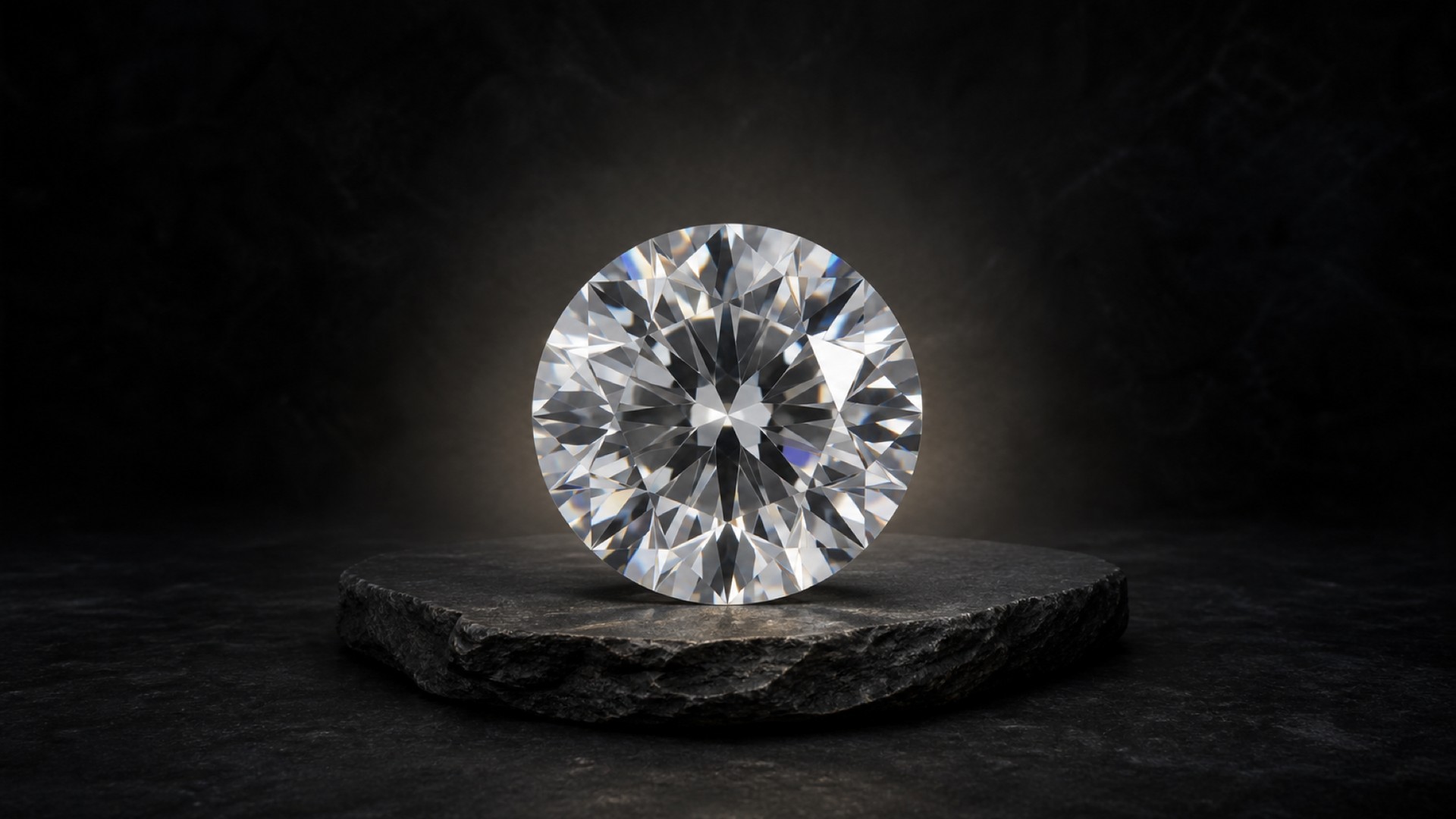
AI-created master image · AI-generated editorial reference illustration
Explore this profile
Definition
What is Diamond?
Diamond is native crystalline carbon, C, with cubic structure. Most natural gem diamonds formed at mantle depths and reached the surface in rapidly emplaced kimberlite or lamproite magmas. Nitrogen, boron, vacancies, radiation-related defects, hydrogen-related centers, and plastic deformation can alter color and spectroscopy. HPHT and CVD create laboratory-grown diamond; neither process should be confused with simulants or with HPHT color treatment. [1]
At a glance
Gemological properties
Measured values and species-level properties are linked to their evidence. “Pending” means the value has not cleared review.
| Gemstone | Diamond | Mineral species | Diamond |
|---|---|---|---|
| Mineral group | Native Elements | Family | Diamond |
| Chemical formula | C[1] | Crystal system | Cubic[1] |
| Mohs hardnessMohs hardnessA comparative scale of scratch resistance from 1 to 10; it does not measure toughness.Learn more | 10[1] | Specific gravitySpecific gravityThe ratio of a material’s density to the density of water under defined conditions.Learn more | 3.5–3.53[1] |
| Refractive indexRefractive indexA measurement describing how light changes speed and direction as it enters a material.Learn more | 2.417–2.419[1] | BirefringenceBirefringenceThe numerical difference between a doubly refractive material’s principal refractive indices.Learn more | 0[1] |
| Optic character | Isotropic and singly refractive; strain may cause anomalous optical effects[1] | DispersionDispersionThe separation of white light into spectral colors because refractive index varies with wavelength.Learn more | 0.044[1] |
| Primary color | Colorless and multicolor[3] | PleochroismPleochroismDifferent body colors seen in some anisotropic gems when viewed along different crystallographic directions.Learn more | None in ideal cubic material; apparent directional color effects require expert interpretation[1] |
| LusterLusterThe character of light reflected from a material’s surface.Learn more | Adamantine[1] | Transparency | Transparent to opaque[1] |
| CleavageCleavageA mineral’s tendency to split along specific crystallographic planes.Learn more | Perfect octahedral cleavage on {111}[1] | Fracture | Conchoidal to irregular[1] |
| TenacityTenacityA material’s response to bending, breaking, crushing, or tearing.Learn more | Brittle; excellent wear resistance but vulnerable at cleavage directions and thin edges[1] | Fluorescence | Variable in color and strength; fluorescence is not a stand-alone identity, origin, or quality test[2] |
| Streak | White[1] | Availability | Natural · Laboratory-grown |
| Jewelry suitability | Excellent when cut, set, and worn with attention to cleavage, girdle condition, treatments, and repair heat[4] | ||
Scope note: some physical properties describe corundum as a mineral species; ruby-specific claims are identified separately in the citations.
Mineralogy
Mineralogy & classification
Diamond is native carbon in the cubic system. Infrared absorption groups diamonds into types according to detectable nitrogen and boron defects, not beauty grades.
Type I diamonds contain measurable nitrogen: type Ia contains aggregated nitrogen, while type Ib has more isolated substitutional nitrogen. Type II diamonds lack measurable nitrogen by the classification threshold; type IIa lacks the boron feature of type IIb, while type IIb contains boron and can be electrically semiconducting.
Type is a scientific and identification tool. It helps laboratories interpret color, treatment possibilities, and growth history, but no type automatically guarantees natural origin, rarity, value, or a particular visible color.
Mineral species
Diamond (C)Cubic crystalline carbon. [1]
Natural and laboratory-grown are growth-origin categories, not different species.
Type categories
Type Ia, Ib, IIa, and IIbInfrared defect classification based chiefly on nitrogen and boron. [3]
Type is not a quality grade or automatic rarity claim.
Chemistry
Chemistry & composition
The ideal formula is C, but atomic-scale defects control much of Diamond's color and spectroscopy.
Nitrogen can occur as isolated atoms or aggregates; boron can create blue color and conductivity. Vacancies and vacancy-impurity complexes may form during growth, mantle residence, radiation exposure, treatment, or annealing. Plastic deformation can produce brown and some pink-to-red color through lattice distortion.
A detected element is not a complete color explanation. Laboratories consider defect configuration, charge state, concentration, spectra, strain, zoning, fluorescence, and phosphorescence together.
Carbon forms Diamond's essential three-dimensional lattice. [1]
Nitrogen defects influence type classification and many yellow-to-brown absorptions. [3]
Boron is associated with type IIb classification, blue color, and semiconductivity. [3]
Hydrogen-related defects contribute to some gray-blue-to-violet absorption patterns. [3]
Defects matter
Nitrogen, boron, vacancies, hydrogen-related centers, and deformationAtomic-scale defects can affect both color and spectroscopy. [3]
Element detection alone is not a full color-origin conclusion.
Color
Color science
Diamond color can reflect nitrogen, boron, vacancies, natural radiation, hydrogen-related defects, plastic deformation, inclusions, or treatment.
Many yellow colors relate to nitrogen defects; many type IIb blue diamonds owe color to boron. Natural radiation can create green surface stains or color centers, while plastic deformation contributes many brown and pink colors. Gray or black appearance may involve dense inclusions, graphitization, or treatment.
Fancy-color grading evaluates hue, tone, saturation, and distribution under controlled conditions. A color name alone cannot establish whether the color is natural, treated, or produced during laboratory growth.
Natural vs treated color
Advanced testing may be requiredSpectra and defect evidence distinguish mechanisms that can look similar. [4]
A visible color name cannot establish color origin.
Optics
Optical properties
Diamond's high refractive index and dispersion enable strong light return and spectral fire, but cutting determines how those properties appear face-up.
Brilliance describes returned white light, fire the visible separation of white light into spectral colors, and scintillation the pattern of bright and dark flashes as the stone, observer, or light moves. These effects interact with proportions, symmetry, polish, facet pattern, transparency, and lighting.
High refractive index does not guarantee a lively stone. Excessive depth, shallow proportions, poor symmetry, obstruction, windowing, or damage can diminish performance.
Durability
Hardness & durability
Diamond is 10 on Mohs and extraordinarily resistant to scratching, but it is not unbreakable.
Mohs hardness is directional and measures relative scratch resistance. Toughness measures resistance to breaking, chipping, or cleavage. Diamond has perfect octahedral cleavage, so a sharp blow in an unfavorable direction can split it; thin girdles, points, corners, feathers, and pre-existing damage increase risk.
Diamond can scratch other jewelry and another Diamond can scratch it. Separate storage and sensible setting design matter despite the famous hardness value.
Sources [1]
Diamond usually performs exceptionally in jewelry, but durability depends on clarity features, cut geometry, setting, treatment, and repair conditions.
Feathers near corners or the girdle can reduce local strength. Princess, marquise, pear, and other pointed shapes benefit from protected tips; extremely thin girdles are vulnerable. Sudden impact can chip facet junctions or activate cleavage.
Ordinary wear does not burn Diamond, but high bench heat in air can oxidize or damage it, and included or treated stones may react differently. A jeweler should know the report and treatment history before repair.
Hardness means scratch resistance. It is not a universal durability score and does not equal toughness.
Formation
Geology & formation
Most natural diamonds crystallized at great depth in ancient mantle environments and can carry inclusions that preserve otherwise inaccessible geologic information.
Many form in lithospheric mantle beneath old continental cratons; some originate still deeper in the transition zone or lower mantle. Mineral inclusions and carbon isotopes record fluids, melts, recycling, pressure, temperature, and mantle history.
The rock that transports a Diamond is often much younger than the Diamond itself. Kimberlite or lamproite eruption age is therefore not the same as crystal-growth age.
Sources [7]
Natural Diamond growth requires carbon-bearing fluids or melts at pressures and temperatures where Diamond is stable, followed by rapid transport to the surface.
Kimberlite and some lamproite magmas can entrain mantle rocks and diamonds and ascend quickly enough to limit conversion to graphite. Weathering then releases resistant diamonds into rivers, coastal sediments, and marine deposits.
Not every kimberlite contains economic Diamond, and not every Diamond recovered from sediment can be tied to a surviving primary pipe. Deposit model, crystal origin, and commercial mine status are separate facts.
Sources [7]
Natural growth
Mostly mantle environmentsDiamonds can predate their host eruption by vast intervals. [7]
Transport-rock age is not crystal-growth age.
Locations
Where Diamond occurs
Botswana, Russia, Canada, Angola, South Africa, the Democratic Republic of the Congo, Namibia, and others have documented production, but rankings and mine status are date-sensitive.
The USGS 2026 summary supports a dated national-production snapshot, not a permanent league table. Botswana, Russia, Canada, Angola, and South Africa include primary deposits; Namibia and parts of southern Africa are also known for alluvial or marine recovery.
Origin generally cannot be assigned to a polished Diamond by visual inspection. Responsible provenance requires chain-of-custody documentation, not an unsupported guess from appearance or inclusions.
Dated evidence
USGS 2026 national dataCurrent rankings require recurring review. [8]
Do not infer permanent mine status from old sources.
Botswana Diamond-Producing Regions
National production documented by USGS Mineral Commodity Summaries 2026; this does not verify every mine. [8]
- Production
- Current production verified
- Coordinates
- Not published
Russia Diamond-Producing Regions
National production documented by USGS Mineral Commodity Summaries 2026; this does not verify every mine. [8]
- Production
- Current production verified
- Coordinates
- Not published
Canada Diamond-Producing Regions
National production documented by USGS Mineral Commodity Summaries 2026; this does not verify every mine. [8]
- Production
- Current production verified
- Coordinates
- Not published
Angola Diamond-Producing Regions
National production documented by USGS Mineral Commodity Summaries 2026; this does not verify every mine. [8]
- Production
- Current production verified
- Coordinates
- Not published
South Africa Diamond-Producing Regions
National production documented by USGS Mineral Commodity Summaries 2026; this does not verify every mine. [8]
- Production
- Current production verified
- Coordinates
- Not published
Namibia Diamond-Producing Regions
National production documented by USGS Mineral Commodity Summaries 2026; this does not verify every mine. [8]
- Production
- Current production verified
- Coordinates
- Not published
Origin caution: locality relationships do not by themselves prove geographic origin for an individual stone.
Inclusions
Inclusions & internal features
Diamond clarity characteristics include internal crystals, feathers, clouds, pinpoints, needles, internal graining, and surface-reaching cavities or naturals.
Location, size, number, relief, and visibility determine their clarity impact. An inclusion under the table may matter more face-up than one near a bezel; a feather at a vulnerable point may matter more for setting than a small central crystal.
Microscopy can reveal natural growth, HPHT metallic flux, CVD growth structures, laser drilling, filling, and treatment-related features. No single inclusion pattern covers all producers or proves geographic origin.
Clarity characteristics
Crystals, feathers, clouds, pinpoints, graining, cavitiesPosition and relief matter as much as count. [2]
No single inclusion proves origin or locality.
Diamond crystals and mineral inclusions
Solid inclusions in Diamond that may record growth and mantle history. [2]
- Identification
- Identity, relief, and location contribute to clarity and geologic interpretation.
- Treatment context
- Some inclusions may graphitize or change under HPHT treatment.
- Origin caution
- Inclusions can inform geologic setting but do not prove a mine alone.
Feathers and cleavage cracks
Fractures or cleavage-related features whose position affects clarity and durability. [2]
- Identification
- Position and extent affect clarity and local durability.
- Treatment context
- Can be laser drilled or fracture filled.
- Origin caution
- Not a locality indicator.
Clouds and pinpoints
Groups of minute inclusions that may affect transparency and clarity. [2]
- Identification
- Density and position can affect transparency and clarity grade.
- Treatment context
- Treatment significance is sample-specific.
- Origin caution
- Not a locality indicator.
Internal graining
Internal growth or deformation-related graining visible under suitable conditions. [2]
- Identification
- Can record growth or plastic deformation.
- Treatment context
- Some graining or graphitization can relate to HPHT processing.
- Origin caution
- Not a stand-alone locality marker.
Laser drill channels
Treatment-created channels reaching inclusions or fractures. [4]
- Identification
- Microscopic channel is evidence of clarity treatment.
- Treatment context
- Directly documents laser drilling when correctly identified.
- Origin caution
- Not a locality indicator.
Treatments
Treatments & disclosure
Diamond treatments can alter apparent clarity or color and differ sharply in permanence, care, report eligibility, and value implications.
Laser drilling creates channels to reach dark inclusions; fracture filling introduces a glass-like material into breaks. HPHT treatment can change color and must not be confused with HPHT crystal growth. Irradiation and annealing create or modify color centers. Surface coating masks or introduces color but can abrade or be damaged by heat and chemicals.
Some treatments leave microscopic clues; sophisticated color treatment may require spectroscopy and advanced instruments. Specific written disclosure and an appropriate independent report are more useful than a vague “enhanced” label.
Clarity treatments
Laser drilling and fracture fillingThese differ in permanence and report handling. [4]
Ask for the specific treatment, not only “enhanced.”
Color treatments
HPHT, irradiation, annealing, coatingDifferent processes create or modify defect-related color. [4]
HPHT treatment is not HPHT growth.
Laser drilling
- Purpose
- Improve apparent clarity
- Detection
- Microscopy reveals drill channels or internal laser features.
- Permanence
- The channel is permanent; associated filling may not be.
- Care effect
- Tell the jeweler before heat or repair; inspect for filling.
- Disclosure
- Disclose laser drilling and any associated filling. [4]
Fracture filling
- Purpose
- Improve apparent clarity
- Detection
- Flash effects, flow features, and spectroscopy can reveal filler.
- Permanence
- Not considered permanent; heat, chemicals, or cleaning can damage it.
- Care effect
- Avoid ultrasonic, steam, heat, and harsh chemicals.
- Disclosure
- Disclose filler, extent, and care limits. [4]
HPHT color treatment
- Purpose
- Remove or create color
- Detection
- Spectroscopy, luminescence, and defect analysis support detection.
- Permanence
- Generally stable under ordinary wear.
- Care effect
- Disclose before repair and avoid unassessed extreme heat.
- Disclosure
- State HPHT treatment; do not confuse it with HPHT growth. [4]
Irradiation
- Purpose
- Create or modify color
- Detection
- Spectroscopy and color zoning patterns may support detection.
- Permanence
- Often stable in wear but some colors can be heat-sensitive.
- Care effect
- Tell a jeweler before heat-intensive work.
- Disclosure
- Disclose irradiation and any subsequent annealing. [4]
Annealing
- Purpose
- Modify color
- Detection
- Advanced spectroscopy is commonly required.
- Permanence
- Many results are stable in normal wear.
- Care effect
- Avoid unassessed bench heat.
- Disclosure
- Disclose annealing when known or detected. [4]
Surface coating
- Purpose
- Change apparent color
- Detection
- Magnification, wear patterns, and spectroscopy can reveal coating.
- Permanence
- Not permanent; it can abrade or be damaged.
- Care effect
- Avoid abrasion, heat, chemicals, ultrasonic, and steam.
- Disclosure
- Disclose coating material and care limits. [4]
Natural vs synthetic
Natural, laboratory-grown & simulant
HPHT and CVD are the two principal commercial growth routes for laboratory-grown Diamond. Simulants are different materials.
HPHT growth uses metal-solvent systems at high pressure and temperature. CVD grows diamond from carbon-bearing gas on a substrate, commonly in layers. Both can produce gem-quality Diamond, and both may receive post-growth treatment.
Modern products can overlap natural stones in routine properties. Laboratories use growth structure, photoluminescence, infrared absorption, fluorescence imaging, trace features, and inscription verification. A handheld tester may separate some simulants yet still fail the natural-versus-laboratory-grown question.
Identification
How gemologists identify Diamond
Identification proceeds from material identity to natural or laboratory growth and then to detectable treatment and color origin.
Thermal and electrical conductivity, refractive behavior, microscopy, infrared and Raman spectra, ultraviolet imaging, absorption and photoluminescence all contribute. Screening is not always a final result: a referral may require more sensitive analysis.
Moissanite can conduct heat and may fool older thermal-only testers. Mounted stones, tiny melee, coatings, mixed parcels, and new production processes complicate shortcuts. Report verification should match number, measurements, inscription where present, and issuing laboratory.
Laboratory sequence
Identity → growth origin → treatment → color originDifferent instruments answer different questions. [11]
A screening referral is not always a final conclusion.
Value factors
Value factors
Value reflects interacting evidence: natural or laboratory growth, color, clarity, cut, carat, treatment, report, demand, condition, provenance, and seller terms.
Price relationships are nonlinear. Weight thresholds, rare natural fancy colors, unusual sizes, and top grades can create steep changes, while treatments or laboratory growth place a stone in a different comparison set. Asking price is not the same as transaction value.
No universal “investment grade” exists, and resale outcomes are not guaranteed. Compare like with like using current market evidence and obtain an independent appraisal when financial purpose requires one.
Buying guide
How to buy Diamond
Choose purpose and budget first, then compare identity, report, measurements, optical appearance, treatment, condition, setting, provenance, and return terms.
Verify whether the stone is natural or laboratory-grown and whether color or clarity treatment is disclosed. Read the complete report rather than relying on four headline grades. View the Diamond in diffuse daylight-equivalent illumination, spot lighting, and ordinary indoor light; inspect face-up and from the side.
Confirm seller identity, return and upgrade terms, matching report number, and independent appraisal needs. For antique or famous material, preserve provenance documents and avoid unsupported historical claims.
Collector guide
Collector’s guide to Diamond
Collectors may focus on natural crystals, morphology, inclusions, rare natural colors, historic cuts, named stones, mine documentation, or scientific significance.
Preserve labels, invoices, laboratory reports, old photographs, mounting records, and publication history. A mine name or royal association is a provenance claim requiring a documented chain, not marketing ornament.
Scientific importance can differ from gem grade: an included crystal may reveal mantle history, while an antique cut may preserve workmanship and period context. Collector desirability does not guarantee investment performance.
Preserve evidence
Reports, labels, invoices, archives, photographsDocumentation supports historical and locality claims. [13]
Collector appeal is not a guaranteed return.
Care
Diamond care card
Warm water, mild detergent, a soft brush, thorough rinsing, and a lint-free cloth are the conservative routine method.
Ultrasonic or steam cleaning may be unsuitable for fracture-filled stones, heavily included stones, damaged settings, or certain assembled pieces. Coatings and fillers need treatment-specific care. Chlorine and household chemicals can damage mountings even when the Diamond itself is unaffected.
Before resizing, retipping, or heat-intensive repair, tell the jeweler about reports and treatments. Inspect the stone and setting before and after service.
Sources [4]
Safest method
Warm soapy water and a soft brushConservative cleaning protects settings and uncertain treatments. [4]
Filled or coated stones need specialized care.
History
History & etymology
Diamond history spans ancient hard-stone use, Indian and Brazilian sources, southern African discoveries, modern cutting, synthesis, and laboratory grading.
Changing supply, cutting technology, advertising, standardized grading, and laboratory-grown production all shaped the modern market. Historical names and weights may change as stones are recut, remounted, or re-examined.
Legends should be labeled as folklore. Scientific examination and archival evidence can confirm some facts while correcting inherited stories.
Famous gems
Famous & historic specimens
The Hope Diamond is a 45.52 ct cushion brilliant Fancy Deep grayish blue Diamond examined by GIA and held by the Smithsonian Institution.
Its documented weight, color grade, clarity, cut description, phosphorescence, and institutional custody make it a defensible famous-stone example. Its popular curse narrative is folklore, not a scientific property.
Other famous Diamond records should require an institutional catalog, laboratory examination, or strong archival chain. The site does not turn a name, auction mention, or copied listicle into verified provenance.
Sources [13]
Hope Diamond
45.52 ct Fancy Deep grayish blue cushion brilliantGIA examination and Smithsonian custody support the record. [13]
Curse stories are folklore, not a gemological property.
Short answers
Diamond questions, answered
What is Diamond?+
Diamond is cubic crystalline carbon, C. It is a mineral species whose natural and laboratory-grown forms share core identity; simulants such as Moissanite and cubic zirconia are different materials. [1]
Diamond is cubic crystalline carbon, C. It is a mineral species whose natural and laboratory-grown forms share core identity; simulants such as Moissanite and cubic zirconia are different materials.
Is Diamond the hardest gemstone?+
Diamond is 10 on Mohs and has exceptional scratch resistance. Hardness is not toughness: perfect octahedral cleavage, thin edges, inclusions, and sharp impact can still cause chips or breaks. [1]
Diamond is 10 on Mohs and has exceptional scratch resistance. Hardness is not toughness: perfect octahedral cleavage, thin edges, inclusions, and sharp impact can still cause chips or breaks.
What is Diamond made of?+
Its ideal composition is carbon. Trace nitrogen, boron, hydrogen-related defects, vacancies, inclusions, and lattice deformation can strongly affect color and spectroscopy. [3]
Its ideal composition is carbon. Trace nitrogen, boron, hydrogen-related defects, vacancies, inclusions, and lattice deformation can strongly affect color and spectroscopy.
Why does Diamond sparkle?+
High refractive index and dispersion provide the optical potential, while proportions, symmetry, polish, facet pattern, transparency, movement, and lighting control brilliance, fire, and scintillation. [6]
High refractive index and dispersion provide the optical potential, while proportions, symmetry, polish, facet pattern, transparency, movement, and lighting control brilliance, fire, and scintillation.
What is the difference between brilliance, fire, and scintillation?+
Brilliance is returned white light, fire is spectral color from dispersion, and scintillation is the moving pattern of bright and dark flashes. Cut and lighting affect all three. [6]
Brilliance is returned white light, fire is spectral color from dispersion, and scintillation is the moving pattern of bright and dark flashes. Cut and lighting affect all three.
What are the 4Cs?+
Carat is weight, color and clarity describe graded appearance and characteristics, and cut evaluates execution under a grading system. They do not alone state growth origin, treatment, provenance, beauty, or value. [9]
Carat is weight, color and clarity describe graded appearance and characteristics, and cut evaluates execution under a grading system. They do not alone state growth origin, treatment, provenance, beauty, or value.
Is shape the same as cut quality?+
No. Shape describes outline or facet style—round, oval, cushion, emerald, pear, and others. Cut quality describes how effectively the facets, proportions, polish, and symmetry produce appearance. [6]
No. Shape describes outline or facet style—round, oval, cushion, emerald, pear, and others. Cut quality describes how effectively the facets, proportions, polish, and symmetry produce appearance.
What are Diamond types Ia, Ib, IIa, and IIb?+
They are infrared defect categories based principally on the presence and arrangement of nitrogen and on boron. They help research and identification but are not consumer quality grades. [3]
They are infrared defect categories based principally on the presence and arrangement of nitrogen and on boron. They help research and identification but are not consumer quality grades.
Why are some Diamonds colored?+
Nitrogen, boron, vacancies, radiation-related centers, hydrogen-related defects, plastic deformation, inclusions, or treatment can contribute. The mechanism differs by stone and requires more than a color name. [3,4]
Nitrogen, boron, vacancies, radiation-related centers, hydrogen-related defects, plastic deformation, inclusions, or treatment can contribute. The mechanism differs by stone and requires more than a color name.
Can Diamond be treated?+
Yes. Laser drilling and fracture filling alter apparent clarity; HPHT treatment, irradiation, annealing, and coating can change color. Stability, care, detection, and report wording differ. [4]
Yes. Laser drilling and fracture filling alter apparent clarity; HPHT treatment, irradiation, annealing, and coating can change color. Stability, care, detection, and report wording differ.
What is laboratory-grown Diamond?+
It is Diamond crystallized in a human-controlled process, chiefly HPHT or CVD. It is not a simulant, but its growth origin differs from natural mantle Diamond and must be disclosed. [10,11]
It is Diamond crystallized in a human-controlled process, chiefly HPHT or CVD. It is not a simulant, but its growth origin differs from natural mantle Diamond and must be disclosed.
What is the difference between HPHT growth and HPHT treatment?+
HPHT growth crystallizes a laboratory-grown Diamond. HPHT treatment applies high pressure and temperature to an existing Diamond to modify defects and color. The same abbreviation describes different operations. [10,4]
HPHT growth crystallizes a laboratory-grown Diamond. HPHT treatment applies high pressure and temperature to an existing Diamond to modify defects and color. The same abbreviation describes different operations.
Can a tester distinguish natural from laboratory-grown Diamond?+
Simple testers may separate some simulants, but natural-versus-laboratory-grown separation often needs microscopy, spectroscopy, fluorescence imaging, and laboratory reference data. [11]
Simple testers may separate some simulants, but natural-versus-laboratory-grown separation often needs microscopy, spectroscopy, fluorescence imaging, and laboratory reference data.
Where do natural Diamonds form?+
Most gem Diamonds formed in ancient mantle environments; some are sublithospheric. Kimberlite or lamproite magmas later transported them rapidly toward the surface. [7]
Most gem Diamonds formed in ancient mantle environments; some are sublithospheric. Kimberlite or lamproite magmas later transported them rapidly toward the surface.
Where are Diamonds mined today?+
USGS 2026 data document production in countries including Botswana, Russia, Canada, Angola, South Africa, the DRC, and Namibia. Production rankings and mine status are dated claims requiring review. [8]
USGS 2026 data document production in countries including Botswana, Russia, Canada, Angola, South Africa, the DRC, and Namibia. Production rankings and mine status are dated claims requiring review.
Does the Kimberley Process guarantee an ethical Diamond?+
No. It regulates international rough-diamond trade under a defined conflict-diamond scope. Broader labor, environmental, community, sanctions, polishing, and post-export chain-of-custody questions need additional evidence. [14]
No. It regulates international rough-diamond trade under a defined conflict-diamond scope. Broader labor, environmental, community, sanctions, polishing, and post-export chain-of-custody questions need additional evidence.
How should Diamond be cleaned?+
Warm water, mild detergent, a soft brush, and careful rinsing are a conservative routine. Fracture-filled or coated stones, damaged settings, and heavily included Diamonds may need specialized care. [4]
Warm water, mild detergent, a soft brush, and careful rinsing are a conservative routine. Fracture-filled or coated stones, damaged settings, and heavily included Diamonds may need specialized care.
What should I check before buying a Diamond?+
Confirm natural or laboratory-grown origin, treatments, the full independent report, measurements, cut appearance, condition, return terms, seller identity, provenance claims, and whether an appraisal is needed. [12,5]
Confirm natural or laboratory-grown origin, treatments, the full independent report, measurements, cut appearance, condition, return terms, seller identity, provenance claims, and whether an appraisal is needed.
Evidence
References & further reading
Citation numbers are deduplicated across properties, claims, sections, structured modules, treatments, inclusions, FAQs, and related educational records.
- [1]Diamond.
Mineralogical Society of America
- [2]Sally Eaton-Magaña and James E. Shigley. Chart: Inclusions in Natural, Synthetic, and Treated Diamond.
Gems & Gemology · 2018 · Vol. 54 (4)
- [3]Christopher M. Breeding and James E. Shigley. The 'Type' Classification System of Diamonds and Its Importance in Gemology.
Gems & Gemology · 2009 · Vol. 45 (2)
- [4]Thomas W. Overton and James E. Shigley. A History of Diamond Treatments.
Gems & Gemology · 2008 · Vol. 44 (1)
- [5]Diamond Gemstone Overview.
Gemological Institute of America
- [6]The 4Cs: Diamond Cut.
Gemological Institute of America
- [7]Steven B. Shirey, Pierre Cartigny, Daniel J. Frost, et al.. Diamonds and the Geology of Mantle Carbon.
Gems & Gemology · 2013 · Vol. 49 (4)
- [8]Mineral Commodity Summaries 2026: Gemstones.
U.S. Geological Survey · 2026
- [9]Diamond Quality Factors.
Gemological Institute of America
- [10]HPHT and CVD Diamond Growth Processes.
Gemological Institute of America
- [11]Sally Eaton-Magaña, Troy Ardon, and Wuyi Wang. GIA's Laboratory-Grown Diamond Report: An Update.
Gems & Gemology · 2024 · Vol. 60 (2)
- [12]Types of GIA Diamond Reports.
Gemological Institute of America
- [13]Famous Diamonds Examined by GIA.
Gemological Institute of America
- [14]What is the Kimberley Process?.
Kimberley Process