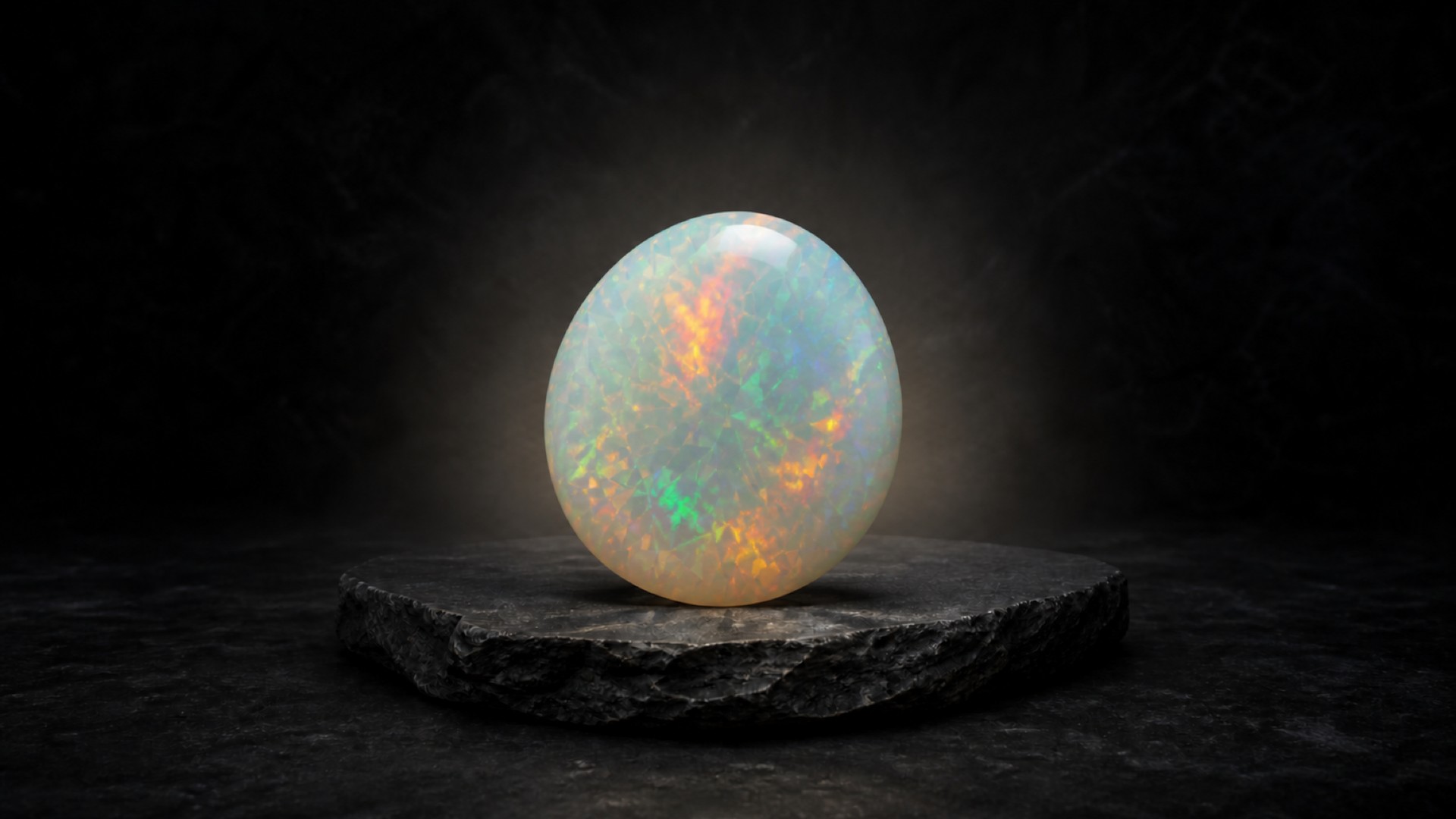
Cornerstone gemstone profile
Opal
Hydrated silica whose nanostructure can diffract light into play-of-color
AI-created master image · AI · Owned
Explore this profile
Definition
What is Opal?
Opal is amorphous to poorly crystalline hydrated silica, conventionally written SiO₂·nH₂O. It is treated here as a mineraloid-like gem material rather than forced into a mineral-species family. Precious Opal's play-of-color results when sufficiently ordered, similarly sized silica particles and intervening voids diffract visible light; disorder produces common Opal. Water content, porosity, deposit type, treatments, and assemblies all affect identification and care. [1]
At a glance
Gemological properties
Measured values and species-level properties are linked to their evidence. “Pending” means the value has not cleared review.
| Gemstone | Opal | Mineral species | Pending verification |
|---|---|---|---|
| Mineral group | Pending verification | Family | Pending verification |
| Chemical formula | SiO₂·nH₂O (variable hydrated silica)[1] | Crystal system | Amorphous to poorly crystalline; nanostructured rather than a single crystal sys[2] |
| Mohs hardnessMohs hardnessA comparative scale of scratch resistance from 1 to 10; it does not measure toughness.Learn more | 5–6.5[1] | Specific gravitySpecific gravityThe ratio of a material’s density to the density of water under defined conditions.Learn more | 1.25–2.23[1] |
| Refractive indexRefractive indexA measurement describing how light changes speed and direction as it enters a material.Learn more | 1.37–1.47[1] | BirefringenceBirefringenceThe numerical difference between a doubly refractive material’s principal refractive indices.Learn more | 0[1] |
| Optic character | Singly refractive aggregate or amorphous response; anomalous strain effects may occur[2] | DispersionDispersionThe separation of white light into spectral colors because refractive index varies with wavelength.Learn more | Pending verification |
| Primary color | Multicolor[3] | PleochroismPleochroismDifferent body colors seen in some anisotropic gems when viewed along different crystallographic directions.Learn more | None[1] |
| LusterLusterThe character of light reflected from a material’s surface.Learn more | Subvitreous to waxy; variable[1] | Transparency | Transparent to opaque[1] |
| CleavageCleavageA mineral’s tendency to split along specific crystallographic planes.Learn more | None[1] | Fracture | Conchoidal to uneven[1] |
| TenacityTenacityA material’s response to bending, breaking, crushing, or tearing.Learn more | Brittle; poor-to-fair toughness depending on crazing, fractures, porosity, matrix, and assembly[1] | Fluorescence | Variable by type, source, treatment, and bodycolor; not diagnostic[1] |
| Streak | White[1] | Availability | Natural · Laboratory-grown |
| Jewelry suitability | Suitable with protective settings and informed care; assess cracks, crazing, hydrophane behavior, treatments, doublet/triplet construction, impact, heat, and drying risk[4] | ||
Scope note: some physical properties describe corundum as a mineral species; ruby-specific claims are identified separately in the citations.
Mineralogy
Mineralogy & classification
Opal's structure spans amorphous and poorly crystalline forms and can include silica particle arrays, pores, water, and accessory material.
That complexity produces broad RI and SG ranges and makes a single idealized property set misleading. Host rock or matrix can remain attached in boulder Opal, while fossils may be replaced or filled by Opal.
This page leaves formal species and family fields empty by design rather than inventing taxonomy.
Chemistry
Chemistry & composition
Silicon and oxygen form the silica particles and framework of Opal. [1]
Oxygen occurs in silica and water-bearing components. [1]
Hydrogen occurs in molecular water and hydroxyl-bearing components represented by nH₂O. [1]
Conventional formula
SiO₂·nH₂OThe variable n represents non-stoichiometric water. [1]
It is not one fixed water percentage.
Color
Color science
Bodycolor is the background appearance; play-of-color is the moving spectral display above or within it.
Bodycolor can be white, gray, black, brown, orange, yellow, red, blue, green, or near-colorless. Dark backgrounds can increase apparent contrast without guaranteeing pattern, brightness, or natural origin.
Evaluate hue range, brightness, coverage, pattern, viewing angles, transparency, and bodycolor independently.
Bodycolor
Background color independent of play-of-colorDark, light, transparent, or colored backgrounds change contrast. [3]
Dark bodycolor alone does not establish black-Opal origin or treatment.
Optics
Optical properties
Opal is generally singly refractive or aggregate-like, with RI and SG varying widely by structure, water, porosity, and matrix.
GIA reports RI around 1.37–1.47 and SG centered near 2.15 with a broad range. Anomalous strain effects or aggregate reactions can occur.
Play-of-color is structural diffraction, not dispersion from faceting, pleochroism, or color change between lamp types.
Durability
Hardness & durability
Mohs 5–6.5 offers moderate scratch resistance, while brittleness, fractures, and crazing can dominate durability.
Crazing is a network of cracks caused by internal stress and water-related instability. It may develop during drying, temperature change, cutting, or later storage depending on the material.
Hardness does not predict whether an individual Opal will craze.
Successful wear depends on the individual Opal, setting, cracks, porosity, treatment, assembly, and exposure.
Protective bezels and low-profile settings reduce impact. Rings face more abrasion and shocks than pendants or earrings. Sudden temperature change, high heat, prolonged dryness, and hard blows should be avoided.
An intact, stable solid Opal and a glued triplet require different care.
Hardness means scratch resistance. It is not a universal durability score and does not equal toughness.
Hydrophane behavior
Readily absorbs water and can change appearance temporarilyPorosity affects testing, treatment uptake, and care. [7,8]
Not all Opal is hydrophane; do not improvise immersion tests.
Mohs hardness
5–6.5Opal has moderate scratch resistance. [1,4]
Crazing and fracture risk matter more than hardness alone.
Crazing
Internal stress crack networkWater-related instability, drying, heat, or stress can contribute. [4,5]
Individual stability cannot be predicted by Mohs hardness.
Formation
Geology & formation
Silica-bearing waters precipitate Opal in cavities, fractures, sediments, weathering profiles, and volcanic environments.
Australian sediment-hosted fields commonly preserve Opal in cracks, nodules, concretions, and fossils, while Ethiopian Wollo material is associated with volcanic sequences. Deposit-specific chemistry and drying history influence porosity and stability.
No single 'water plus sand' story explains all Opal.
Opalized fossils
Silica replacement or infilling of biological materialOpal can preserve scientifically important remains. [5]
Scientific and legal significance may exceed gem value.
Locations
Where Opal occurs
Australia remains a major producer with distinct field traditions; Ethiopia and Mexico add important volcanic and fire-Opal categories.
Geoscience Australia identifies Coober Pedy, Lightning Ridge, and Queensland boulder-Opal fields as active production centers. Wollo, Ethiopia is a documented source of commonly hydrophane play-of-color material.
Source appearance can overlap. Country or field attribution requires evidence and current status must be dated.
Current centers
Coober Pedy, Lightning Ridge, and Queensland fieldsGeoscience Australia documents active production traditions. [5]
A visual style does not prove field origin.
Coober Pedy Opal Field
Current status is date-bounded to the cited 2024 government or government-science evidence; continuous activity at every operation is not inferred. [5]
- Production
- Current production verified
- Coordinates
- Not published
Lightning Ridge Opal Field
Current status is date-bounded to the cited 2024 government or government-science evidence; continuous activity at every operation is not inferred. [5]
- Production
- Current production verified
- Coordinates
- Not published
Queensland Boulder Opal Fields
Current status is date-bounded to the cited 2024 government or government-science evidence; continuous activity at every operation is not inferred. [5]
- Production
- Current production verified
- Coordinates
- Not published
Wegel Tena, Wollo Opal District
Peer-reviewed gemological research documents the deposit and hydrophane material; current production is not asserted. [7]
- Production
- Production not assessed
- Coordinates
- Not published
Origin caution: locality relationships do not by themselves prove geographic origin for an individual stone.
Inclusions
Inclusions & internal features
Matrix, host-rock fragments, growth boundaries, cloudiness, fractures, crazing, fluid residues, and biological textures can occur.
Microscopy can reveal natural growth, hydrophane porosity, dye concentration, smoke or sugar darkening, assembly planes, and synthetic columnar or cellular patterns.
Features must be interpreted as a suite; one visual motif is not universal proof of origin.
Useful features
Matrix, growth pattern, crazing, pores, dye, assembly planes, and synthetic structureFeature suites address origin, treatment, and construction. [9,2]
No single pattern is universal proof.
Opal potch, matrix, and host-rock fragments
Non-precious Opal or host material naturally associated with gem Opal. [5]
- Identification
- Supports natural matrix and boulder-Opal interpretation.
- Treatment context
- Artificial backings must be distinguished from natural matrix.
- Origin caution
- Host associations can inform but not alone prove field origin.
Opal play-of-color growth pattern
Natural nanostructural color domains including digit-like and irregular patterns. [2]
- Identification
- Records nanostructural organization and viewing behavior.
- Treatment context
- Pattern alone does not rule out treatment.
- Origin caution
- Some patterns may be characteristic but not universal locality tests.
Opal pores and hydrophane structure
Open porosity that can absorb water, dye, oil, smoke products, or resin. [8]
- Identification
- Explains water absorption and temporary appearance change.
- Treatment context
- Pores can concentrate dye, oil, smoke, sugar-acid products, or resin.
- Origin caution
- Common in Wollo material but not proof of Wollo origin.
Opal crazing and fractures
Stress cracks or fractures relevant to condition and stability. [4]
- Identification
- Documents condition and potential instability.
- Treatment context
- Fillers or coatings may reduce visibility.
- Origin caution
- Not a locality indicator.
Opal assembly planes and adhesives
Junctions, glue, bubbles, backing, or cap features identifying doublets and triplets. [9]
- Identification
- Identifies composite construction.
- Treatment context
- Adhesive condition and cap/backing affect care.
- Origin caution
- Not a geographic indicator.
Synthetic Opal cellular and columnar structure
Regular cellular, snakeskin-like, or columnar manufactured growth structures. [11]
- Identification
- Regular patterns can support manufactured origin.
- Treatment context
- Not primarily a treatment feature.
- Origin caution
- Not a geographic-origin feature.
Treatments
Treatments & disclosure
Opal treatments can alter bodycolor, apparent contrast, durability, porosity, or surface appearance.
Smoke and sugar-acid methods darken porous Opal to imitate a black background. Dye adds color; oil, resin, or wax may reduce visible porosity or fractures; impregnation or stabilization adds foreign material; coatings alter the surface.
Detection uses magnification, absorption patterns, pore concentrations, luster, fluorescence, spectroscopy, and construction evidence. Disclosure must identify the treatment.
Darkening methods
Smoke and sugar-acid treatmentPorous Opal can be darkened to increase contrast. [9]
Treated dark color is not natural black bodycolor.
Dye
Foreign color concentrated in porous structureDye can alter bodycolor and imitate valuable types. [10]
Stability and cleaning restrictions vary.
Smoke treatment
- Purpose
- Imitate dark or black bodycolor
- Detection
- Magnification, surface and pore concentrations, spectroscopy, and comparison with untreated structure can reveal darkening.
- Permanence
- May be reasonably stable but foreign darkening and porosity remain relevant.
- Care effect
- Avoid abrasion, chemicals, ultrasonic, steam, heat, and prolonged soaking.
- Disclosure
- Disclose smoke treatment explicitly. [9]
Sugar-acid treatment
- Purpose
- Imitate dark or black bodycolor
- Detection
- Dark concentrations, magnification, spectroscopy, and laboratory comparison can detect treatment.
- Permanence
- Carbonized material may be stable, but the porous host remains care-sensitive.
- Care effect
- Avoid heat, chemicals, machine cleaning, and prolonged immersion.
- Disclosure
- Disclose sugar-acid darkening explicitly. [9]
Dye treatment
- Purpose
- Modify bodycolor
- Detection
- Color concentrations, unnatural distribution, spectra, and microscopy support detection.
- Permanence
- Dye may fade, bleed, or react to solvents, heat, or light.
- Care effect
- Use only a soft damp cloth; avoid soaking, chemicals, ultrasonic, and steam.
- Disclosure
- Disclose dye color and process when known. [10]
Clarity enhancement with oil or resin
- Purpose
- Improve appearance or reduce visible porosity
- Detection
- Microscopy, fluorescence, spectroscopy, and surface examination can reveal foreign material.
- Permanence
- Oil or wax may dry or migrate; resin may yellow, abrade, or be heat-sensitive.
- Care effect
- Avoid heat, chemicals, machine cleaning, and prolonged immersion.
- Disclosure
- Disclose impregnation material and extent. [8]
Surface coating
- Purpose
- Modify appearance or surface
- Detection
- Surface wear, edge concentrations, luster differences, magnification, and spectroscopy can reveal coating.
- Permanence
- Coatings can scratch, peel, abrade, or react to heat and chemicals.
- Care effect
- Use a soft damp cloth only; avoid abrasion, solvents, ultrasonic, steam, and heat.
- Disclosure
- Disclose coating composition and extent when known. [9]
Stabilization or impregnation
- Purpose
- Improve stability or appearance
- Detection
- Spectroscopy, fluorescence, density, microscopy, and surface examination can identify polymer or resin.
- Permanence
- Stability depends on the impregnant and may change with age, heat, UV, or chemicals.
- Care effect
- Avoid heat, solvents, machine cleaning, and aggressive polishing.
- Disclosure
- Disclose stabilization and the agent when known. [8]
Natural vs synthetic
Natural, laboratory-grown & simulant
Laboratory-grown Opal can reproduce ordered silica structures and play-of-color, while some manufactured products are better classified as imitations.
Colloidal silica particles can be assembled, consolidated, and sometimes polymer-impregnated. Diagnostic features may include regular cellular, snakeskin, or columnar growth patterns and distinctive structure.
Water-free or compositionally dissimilar products can imitate Opal appearance without meeting a strict synthetic counterpart definition. Report wording matters.
Identification
How gemologists identify Opal
Identity, natural origin, treatment, assembly, and geographic origin are separate conclusions.
Gemologists combine appearance, play-of-color behavior, microscopy, RI, SG, fluorescence, spectroscopy, structure, and chemical analysis. Hydrophane absorption can be informative but immersion should be controlled and never improvised on a mounted or assembled gem.
A laboratory report is especially useful for black-Opal claims, valuable patterns, treatments, and synthetics.
Value factors
Value factors
Type, bodycolor, brightness, spectral range, pattern, coverage, directionality, transparency, size, cut, stability, treatment, and construction interact.
Brightness is often the first practical discriminator. Red within a broad spectral display may be scarce, but a dull red flash does not automatically outrank a brilliant multi-color display. Dark bodycolor can increase contrast.
Cracks, crazing, weak color bars, narrow viewing angles, treatments, and undisclosed assemblies can reduce value.
Sources [3]
Key factors
Brightness, colors, pattern, coverage, bodycolor, directionality, stability, treatment, constructionValue emerges from interacting optical, structural, and market factors. [3]
Red alone does not outrank a brighter multi-color display.
Buying guide
How to buy Opal
Evaluate the whole stone in motion, then document type, construction, treatment, stability, condition, and seller terms.
View diffuse and spot lighting, multiple angles, face-up and side-on. Check brightness, coverage, pattern, color range, transparency, thickness, matrix or backing, cracks, craze lines, glue planes, dye concentrations, and return period.
Ask whether the piece is solid, doublet, triplet, treated, synthetic, or imitation—and obtain the answer in writing.
Collector guide
Collector’s guide to Opal
Collectors can organize Opal by deposit, bodycolor, pattern, matrix, fossil type, hydrophane behavior, treatment, and provenance.
Record weight, dimensions, dry-condition photographs, locality, miner or dealer history, treatments, construction, stability observations, and prior repairs. Track hydrophane stones under consistent dry conditions.
Preserve scientifically significant fossils and original labels before lapidary work.
Care
Opal care card
Use a soft damp cloth or brief mild-soapy cleaning for stable solid Opal; avoid steam, ultrasonic cleaning, heat, and sudden temperature change.
Do not oil Opal as routine maintenance, store it permanently in water, or assume every specimen needs humidity control. Avoid prolonged immersion for hydrophane stones and all glued assemblies.
Seek specialist advice for valuable, crazed, treated, fossil, or historically important material.
Safest routine
Soft damp cloth or brief mild-soapy cleaning for stable solid OpalConservative care avoids heat, vibration, adhesives, and absorption risks. [4]
No ultrasonic, steam, oiling, or permanent water storage.
History
History & etymology
Opal has carried changing symbols of hope, fortune, misfortune, and birthstone identity; these are cultural beliefs.
European literary and commercial traditions helped both celebrate and stigmatize Opal. Modern October-birthstone use and national associations continue that cultural history.
Opal does not have scientifically established powers to heal illness, predict events, or alter human energy.
Short answers
Opal questions, answered
What is Opal?+
Opal is amorphous-to-poorly-crystalline hydrated silica, conventionally SiO₂·nH₂O. It is a gem material rather than a single conventional mineral species. [1,2]
Opal is amorphous-to-poorly-crystalline hydrated silica, conventionally SiO₂·nH₂O. It is a gem material rather than a single conventional mineral species.
What causes play-of-color?+
Sufficiently ordered silica particles and intervening voids diffract visible light. Changing the viewing angle changes the wavelengths that reinforce toward the observer. [6,2]
Sufficiently ordered silica particles and intervening voids diffract visible light. Changing the viewing angle changes the wavelengths that reinforce toward the observer.
Do all Opals show play-of-color?+
No. Precious Opal shows play-of-color; common Opal does not. Both can be attractive and both belong to the broader Opal material category. [1]
No. Precious Opal shows play-of-color; common Opal does not. Both can be attractive and both belong to the broader Opal material category.
What is bodycolor?+
Bodycolor is Opal's background appearance, separate from spectral play-of-color. It can be light, dark, colored, or near-colorless and affects contrast. [3]
Bodycolor is Opal's background appearance, separate from spectral play-of-color. It can be light, dark, colored, or near-colorless and affects contrast.
What is black Opal?+
Black Opal has a dark bodycolor that can strengthen contrast with play-of-color. The name does not by itself prove Australian origin, natural dark color, solid construction, or absence of treatment. [3,9]
Black Opal has a dark bodycolor that can strengthen contrast with play-of-color. The name does not by itself prove Australian origin, natural dark color, solid construction, or absence of treatment.
What is fire Opal?+
Fire Opal is transparent-to-translucent Opal with yellow, orange, or red bodycolor. It may show play-of-color, but the term does not require it. [3]
Fire Opal is transparent-to-translucent Opal with yellow, orange, or red bodycolor. It may show play-of-color, but the term does not require it.
What is boulder Opal?+
Boulder Opal retains natural host rock, commonly ironstone, behind or around a precious Opal seam. Natural matrix differs from an artificially glued doublet backing. [5,3]
Boulder Opal retains natural host rock, commonly ironstone, behind or around a precious Opal seam. Natural matrix differs from an artificially glued doublet backing.
What is crystal Opal?+
Crystal Opal is transparent to semitransparent precious Opal with visible play-of-color. The word crystal describes transparency in this trade term, not a single-crystal structure. [3,2]
Crystal Opal is transparent to semitransparent precious Opal with visible play-of-color. The word crystal describes transparency in this trade term, not a single-crystal structure.
What is hydrophane Opal?+
Hydrophane Opal is porous enough to absorb water readily, temporarily changing weight, transparency, or play-of-color. Much Wollo material is hydrophane, but not all Opal is. [7,8]
Hydrophane Opal is porous enough to absorb water readily, temporarily changing weight, transparency, or play-of-color. Much Wollo material is hydrophane, but not all Opal is.
Should Opal be soaked in water?+
Not as universal maintenance. Soaking cannot restore lost structural water and may affect hydrophane material, dyes, oils, resin, glue, doublets, or triplets. Use construction-specific care. [4,8]
Not as universal maintenance. Soaking cannot restore lost structural water and may affect hydrophane material, dyes, oils, resin, glue, doublets, or triplets. Use construction-specific care.
What is crazing?+
Crazing is a network of cracks caused by internal stress and instability, often involving water loss, drying, temperature change, or cutting history. It differs from harmless play-of-color pattern. [4,5]
Crazing is a network of cracks caused by internal stress and instability, often involving water loss, drying, temperature change, or cutting history. It differs from harmless play-of-color pattern.
How hard is Opal?+
Opal ranges about 5 to 6.5 on Mohs. Its brittleness, existing cracks, crazing tendency, porosity, matrix, treatment, and construction are more important to durability than hardness alone. [1,4]
Opal ranges about 5 to 6.5 on Mohs. Its brittleness, existing cracks, crazing tendency, porosity, matrix, treatment, and construction are more important to durability than hardness alone.
Is Opal treated?+
Yes. Documented treatments include smoke, sugar-acid darkening, dye, oil, wax or resin impregnation, stabilization, and coating. Frequency varies by material and market. [9,10]
Yes. Documented treatments include smoke, sugar-acid darkening, dye, oil, wax or resin impregnation, stabilization, and coating. Frequency varies by material and market.
What are Opal doublets and triplets?+
A doublet joins a thin Opal layer to backing. A triplet also adds a transparent cap. Both are assembled products, not solid Opal, and should be disclosed and kept from soaking. [3,9,4]
A doublet joins a thin Opal layer to backing. A triplet also adds a transparent cap. Both are assembled products, not solid Opal, and should be disclosed and kept from soaking.
Is synthetic Opal available?+
Yes. Laboratory processes assemble and consolidate silica particles to reproduce play-of-color structure. Some water-free or compositionally different products are more accurately called imitations. [11,12]
Yes. Laboratory processes assemble and consolidate silica particles to reproduce play-of-color structure. Some water-free or compositionally different products are more accurately called imitations.
How can synthetic Opal be identified?+
Microscopy may reveal regular cellular, snakeskin, or columnar patterns, while spectroscopy and chemistry address composition and polymer content. Laboratories interpret multiple features. [11,9]
Microscopy may reveal regular cellular, snakeskin, or columnar patterns, while spectroscopy and chemistry address composition and polymer content. Laboratories interpret multiple features.
Where does Opal come from?+
Australia has major fields including Coober Pedy, Lightning Ridge, and Queensland boulder-Opal districts. Ethiopia's Wollo Province is an important documented volcanic source; Mexico is associated with fire Opal. [5,7,3]
Australia has major fields including Coober Pedy, Lightning Ridge, and Queensland boulder-Opal districts. Ethiopia's Wollo Province is an important documented volcanic source; Mexico is associated with fire Opal.
What makes Opal valuable?+
Brightness, color range, pattern, coverage, directionality, bodycolor, transparency, size, cut, stability, condition, treatment, construction, and provenance interact. [3]
Brightness, color range, pattern, coverage, directionality, bodycolor, transparency, size, cut, stability, condition, treatment, construction, and provenance interact.
How should Opal be cleaned?+
Use a soft damp cloth or brief mild-soapy cleaning for stable solid Opal. Avoid ultrasonic and steam cleaners, high heat, sudden temperature change, prolonged immersion, and soaking assemblies. [4]
Use a soft damp cloth or brief mild-soapy cleaning for stable solid Opal. Avoid ultrasonic and steam cleaners, high heat, sudden temperature change, prolonged immersion, and soaking assemblies.
Does Opal bring luck or have healing powers?+
Luck, misfortune, hope, and healing associations are cultural beliefs, not scientifically established effects of hydrated silica. They should be presented as history, not medical advice. [1,5]
Luck, misfortune, hope, and healing associations are cultural beliefs, not scientifically established effects of hydrated silica. They should be presented as history, not medical advice.
Evidence
References & further reading
Citation numbers are deduplicated across properties, claims, sections, structured modules, treatments, inclusions, FAQs, and related educational records.
- [1]Opal.
Gemological Institute of America
- [2]Digit Patterns in Gem Opal.
Gems & Gemology · 2013 · Vol. 49 (3)
- [3]Opal Quality Factors.
Gemological Institute of America
- [4]Opal Care and Cleaning Guide.
Gemological Institute of America
- [5]Australian Mineral Facts: Opal.
Geoscience Australia
- [6]J. B. Jones; J. V. Sanders; E. R. Segnit. Structure of Opal.
Nature · 1964 · Vol. 204 · pp. 990-991
- [7]Play-of-Color Opal from Wegel Tena, Wollo Province, Ethiopia.
Gems & Gemology · 2010 · Vol. 46 (2)
- [8]Hydrophane Opal Treatment.
Gems & Gemology · 2016 · Vol. 52 (1)
- [9]Opal: Inclusions, Synthetics and Treatments Chart.
Gemological Institute of America · 2019
- [10]Dyed Hydrophane Opal.
Gems & Gemology · 2017 · Vol. 53 (4)
- [11]Colored Stones Unearthed: Synthetic Opal.
Gems & Gemology · 2024 · Vol. 60 (2)
- [12]Synthetic Opal by Kyocera and Inamori.
Gems & Gemology · 1987 · Vol. 23 (3)