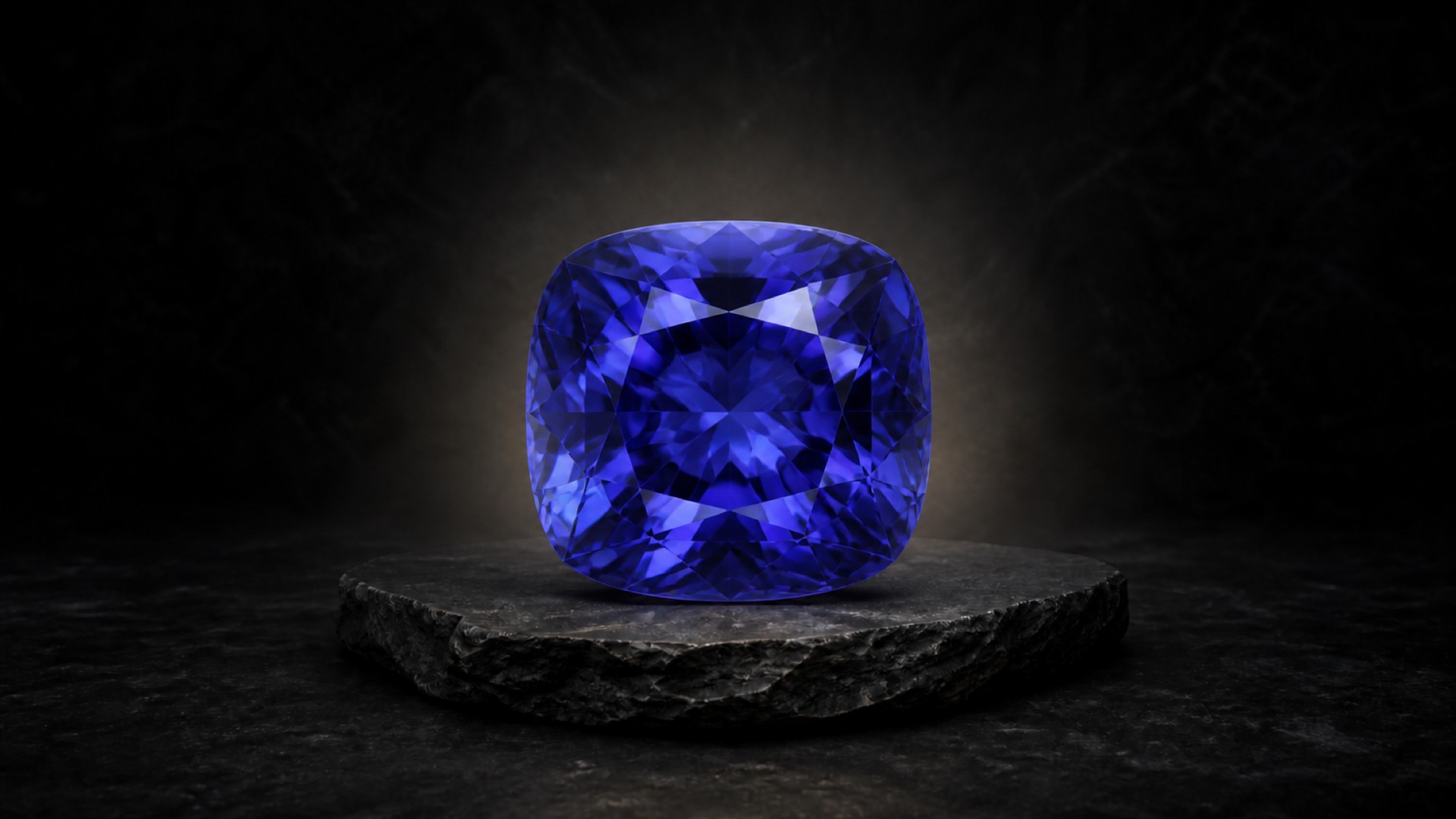
Cornerstone gemstone profile
Tanzanite
Blue-to-violet Zoisite shaped by vanadium, pleochroism, heat, and cutting orientation
Also known descriptively as Merelani Zoisite
- Species
- Zoisite
AI-created master image · AI · Owned
Explore this profile
Definition
What is Tanzanite?
Tanzanite is orthorhombic Zoisite, Ca₂Al₃(SiO₄)(Si₂O₇)O(OH), whose blue-violet color is associated principally with vanadium-related absorption. Strong biaxial pleochroism changes color with crystal direction; it is not the same as color change between light sources. Most commercial blue Tanzanite is heated, and that stable treatment is commonly difficult to distinguish from natural heating. [1,2]
Also described asMerelani ZoisiteBlue Zoisite
At a glance
Gemological properties
Measured values and species-level properties are linked to their evidence. “Pending” means the value has not cleared review.
| Gemstone | Tanzanite | Mineral species | Zoisite |
|---|---|---|---|
| Mineral group | Silicates | Family | Pending verification |
| Chemical formula | Ca₂Al₃(SiO₄)(Si₂O₇)O(OH)[1,2] | Crystal system | Orthorhombic[2] |
| Mohs hardnessMohs hardnessA comparative scale of scratch resistance from 1 to 10; it does not measure toughness.Learn more | 6–7[1,3] | Specific gravitySpecific gravityThe ratio of a material’s density to the density of water under defined conditions.Learn more | 3.15–3.36[1,2] |
| Refractive indexRefractive indexA measurement describing how light changes speed and direction as it enters a material.Learn more | 1.691–1.7[1,2] | BirefringenceBirefringenceThe numerical difference between a doubly refractive material’s principal refractive indices.Learn more | 0.008–0.013[1,2] |
| Optic character | Biaxial positive (doubly refractive)[2] | DispersionDispersionThe separation of white light into spectral colors because refractive index varies with wavelength.Learn more | 0.03[2,4] |
| Primary color | Blue to violet[6] | PleochroismPleochroismDifferent body colors seen in some anisotropic gems when viewed along different crystallographic directions.Learn more | Strong trichroism; untreated material can show blue, violet-red, and yellow-green to brownish directions, while heating commonly suppresses the yellow-green or brown component[5] |
| LusterLusterThe character of light reflected from a material’s surface.Learn more | Vitreous; pearly on cleavage[2] | Transparency | Transparent to translucent[2] |
| CleavageCleavageA mineral’s tendency to split along specific crystallographic planes.Learn more | Perfect on {010}; imperfect on {100}[2] | Fracture | Uneven to conchoidal[2] |
| TenacityTenacityA material’s response to bending, breaking, crushing, or tearing.Learn more | Brittle; fair-to-poor toughness because cleavage can open under impact[2] | Fluorescence | Variable and not diagnostic; identity, treatment, and origin require converging tests[1] |
| Streak | White[2] | Availability | Natural |
| Jewelry suitability | Suitable with protective design and care; rings need protection from impact, high heat, thermal shock, ultrasonic, and steam cleaning[3] | ||
Scope note: some physical properties describe corundum as a mineral species; ruby-specific claims are identified separately in the citations.
Mineralogy
Mineralogy & classification
Tanzanite inherits Zoisite's composition, symmetry, cleavage, density, and biaxial optical behavior.
The structural formula Ca₂Al₃(SiO₄)(Si₂O₇)O(OH) makes the linked silicate groups explicit. Orthorhombic symmetry produces three principal optical directions and supports trichroism.
Pink Zoisite, green Zoisite, opaque Zoisite, and Tanzanite share species identity but not necessarily appearance, trace chemistry, transparency, source, or market category.
Chemistry
Chemistry & composition
Vanadium-related absorption is central to Tanzanite color, but color is a property of ions in a crystal and cannot be reduced to an element name alone.
Vanadium substitutes at low concentration within the Zoisite host. Oxidation state, lattice site, absorption bands, crystal direction, concentration, and heat history influence the observed hue.
Analytical chemistry can support a color explanation, yet finding vanadium does not prove Tanzanite identity or Tanzanian origin. Spectroscopy and standard gemological properties must agree.
Calcium is an essential Zoisite lattice constituent. [2]
Aluminum is an essential Zoisite lattice constituent. [2]
Silicon forms the linked silicate groups of Zoisite. [2]
Oxygen forms the silicate and hydroxyl-bearing framework. [2]
Hydrogen is present in the hydroxyl group of the Zoisite formula. [2]
Vanadium-related absorption is the principal contributor to Tanzanite color. [7]
Ideal Zoisite formula
Ca₂Al₃(SiO₄)(Si₂O₇)O(OH)The detailed sorosilicate formula represents the Zoisite host. [2]
Trace vanadium is not shown in the ideal formula.
Principal color contributor
Vanadium-related absorptionVanadium in the Zoisite lattice is central to blue-violet color. [7]
Element presence alone does not prove color origin or locality.
Color
Color science
Face-up color combines bodycolor, pleochroic directions, cut orientation, tone, saturation, size, and illumination.
Cool daylight-equivalent lighting can emphasize blue; warmer incandescent lighting can emphasize violet or purple. That lighting dependence is ordinary spectral interaction, not proof of the color-change phenomenon.
Deep, vivid violetish blue and bluish violet are widely prized, but a commercial label such as “royal,” “velvet,” or “AAA” is not a universal laboratory grade.
Lighting response
Cool light emphasizes blue; warm light emphasizes violetIllumination spectrum interacts with directional absorption and cut orientation. [6]
This is not proof of the color-change phenomenon.
Optics
Optical properties
Tanzanite's different directional colors arise from anisotropic absorption; color change means a different phenomenon driven by different light-source spectra.
Unheated Tanzanite can be trichroic, showing combinations of violet-red, blue, and yellow-green or brownish directions. Heating commonly suppresses the yellow-green or brownish component, leaving prominent blue and violet.
A cutter selects orientation to balance face-up hue, brightness, and yield. Rocking a finished stone can reveal directional color mixing, but that observation is not a treatment test.
Durability
Hardness & durability
Mohs 6–7 scratch resistance does not overcome perfect cleavage and fair-to-poor toughness.
Hardness concerns scratching; toughness concerns resistance to breaking. Tanzanite can abrade more readily than Sapphire and can split or chip when a blow activates cleavage.
Thin girdles, corners, points, surface-reaching fractures, and exposed ring settings raise risk. A protective bezel or halo can reduce exposure but cannot make the material impact-proof.
Tanzanite can be worn successfully when the setting, condition, activity, and care plan respect its cleavage.
Earrings and pendants are lower-impact choices. Rings require more care, protected edges, secure prongs, and removal for sports, manual work, or situations where a hard knock is likely.
Normal light and common wear are generally safe. Very high temperature and sudden temperature change should be avoided, especially during repair.
Hardness means scratch resistance. It is not a universal durability score and does not equal toughness.
Cleavage
Perfect on {010}A sharp blow can activate a plane of weakness even though the surface resists some scratching. [2,3]
Hardness is not toughness.
Safest cleaning
Warm soapy waterA soft brush and gentle rinse avoid thermal shock and machine-cleaning risk. [3]
Never use ultrasonic or steam cleaners.
Formation
Geology & formation
Tanzanite occurs in a complex metamorphic and hydrothermally altered setting within the Mozambique Belt.
Mineralized rocks in the Merelani–Lelatema area include altered graphite-bearing gneiss and associations with quartz, diopside, calcite, Zoisite, graphite, and Grossular. Fractures and fluid activity helped localize gem mineralization.
This geology explains why a simple “volcanic gem” description is wrong. Deposit-scale claims require locality-specific evidence rather than inference from Tanzanite's country name.
Sources [9]
Tanzanite growth required a rare conjunction of suitable rocks, metamorphism, reactive fluids, deformation, and vanadium availability.
Vanadium-bearing precursors in carbonaceous source rocks were redistributed during metamorphism and alteration. Calcium- and aluminum-bearing Zoisite crystallized in fracture-controlled environments within the mineralized sequence.
The exact evolution is geologically complex. Public explanations should distinguish observed mineral associations from proposed genetic models and avoid converting geographic concentration into a guaranteed scarcity timetable.
Host setting
Altered graphite-bearing metamorphic rocksMineralization occurs with Zoisite, Calcite, Quartz, Diopside, Graphite, and Grossular associations. [9]
The deposit is not accurately described as volcanic.
Locations
Where Tanzanite occurs
Variant spellings refer to the same northern Tanzanian mining area near the Lelatema Mountains in Simanjiro District, Manyara Region.
Merelani is common in gemological literature; Mererani and Mirerani occur in Tanzanian administrative usage. The site records these as aliases rather than inventing separate deposits.
Official 2024 national reporting documents Tanzanite output, supporting a date-bounded current-production relationship. It does not prove that every licensed block was active on every date.
Commercial source
Merelani/Mererani/Mirerani, northern TanzaniaAlias spellings refer to the same mining area. [10,9]
A source name is not a mine-block or chain-of-custody record.
Merelani Tanzanite Mining Area
Official Tanzanian Economic Survey 2024 documents national Tanzanite output; this does not assert continuous activity in every mining block. [10]
- Production
- Current production verified
- Coordinates
- Not published
Origin caution: locality relationships do not by themselves prove geographic origin for an individual stone.
Inclusions
Inclusions & internal features
Many faceted Tanzanites are eye-clean, but crystals, graphite, fluid-filled growth blockages, fractures, cleavage separations, and rare Merelaniite whiskers are documented.
Microscopy can reveal growth history and condition. Intact liquid inclusions in a studied stone supported an unheated interpretation because the inclusions would not be expected to survive routine heating intact.
That observation is sample-specific. Absence of damaged inclusions does not prove unheated status, and one exotic inclusion should not be treated as a universal fingerprint.
Documented features
Graphite, fluids, growth blockages, cleavage, rare MerelaniiteInternal features record growth and condition. [11]
No single feature proves treatment or mine.
Graphite crystals and platelets
Opaque graphite inclusions documented in Tanzanite and its matrix. [11]
- Identification
- Supports natural growth context when correctly identified.
- Treatment context
- Heating response is feature-specific.
- Origin caution
- Consistent with Merelani geology but not a mine-block fingerprint.
Merelaniite whiskers
Rare metallic, curved whisker inclusions identified as Merelaniite in Tanzanite. [11]
- Identification
- Raman-confirmed exotic inclusion in published material.
- Treatment context
- Associated intact fluids supported unheated interpretation in one sample.
- Origin caution
- Known from Merelani specimens but exact sub-locality was undocumented.
Fluid-filled growth blockages
Interrupted growth features containing fluid and sometimes dark solids. [11]
- Identification
- Reveals interrupted crystal growth and internal condition.
- Treatment context
- Intact liquids can constrain heat interpretation, but not universally.
- Origin caution
- Not a stand-alone locality test.
Cleavage separations and fractures
Breaks or separations affecting appearance, treatment interpretation, and durability. [3]
- Identification
- Position and extent affect durability and clarity.
- Treatment context
- May be fracture filled; coatings and fillers require separate testing.
- Origin caution
- Not a locality indicator.
Treatments
Treatments & disclosure
Most blue Tanzanite in commerce is assumed heated; rare coatings and fracture filling are separate treatments with different care implications.
Routine heating changes predominantly brownish material toward blue-to-purple by modifying directional absorption. The result is stable in normal wear and commonly difficult or impossible to distinguish from naturally heated material.
A coating is a foreign surface layer that can scratch or abrade. Fracture filling can improve apparent clarity but may change with time, heat, or chemicals. Disclosure should name the specific treatment.
Routine heat
Most blue market material is assumed heatedHeating suppresses brownish or yellow-green directional color and reveals blue-violet appearance. [8,3]
The stable treatment can be difficult to detect.
Heat treatment
- Purpose
- Modify color
- Detection
- Often difficult or impossible to distinguish from natural heating; microscopy and spectroscopy may occasionally constrain interpretation.
- Permanence
- Stable in normal wear with no added durability concern from routine treatment.
- Care effect
- Avoid very high heat and thermal shock because the host has cleavage.
- Disclosure
- Disclose heat when known; do not promise unheated status without appropriate evidence. [3]
Surface coating
- Purpose
- Modify apparent color
- Detection
- Magnification, surface wear, and analytical testing can reveal a coating.
- Permanence
- Not permanent; it can scratch, abrade, or be damaged.
- Care effect
- Avoid abrasion, harsh chemicals, ultrasonic, steam, and repair heat.
- Disclosure
- Disclose coating and care limits. [3]
Fracture filling
- Purpose
- Improve apparent clarity
- Detection
- Microscopy and analytical testing may reveal filler.
- Permanence
- Fillers can change or deteriorate with time and exposure.
- Care effect
- Use warm soapy water only; avoid machine cleaning, chemicals, and high heat.
- Disclosure
- Disclose filler material and extent when known. [3]
Natural vs synthetic
Natural, laboratory-grown & simulant
Commercially established synthetic gem Tanzanite is not supported by the reviewed source set; blue glass, synthetic Forsterite, YAG, and other look-alikes remain possible.
The absence of a published synthesis record here is deliberate, not proof that experimental Zoisite has never been made. A research task remains open until reproducible commercial evidence and diagnostic literature are located.
Simulants are different materials. A laboratory report can identify the material and evaluate detectable treatment without relying on seller terminology.
Sources [1]
Published status
No commercial synthesis method assertedThe reviewed evidence does not support a reproducible commercial synthetic gem Tanzanite record. [1]
This is an intentional research gap, not proof of impossibility.
Identification
How gemologists identify Tanzanite
Identity is established by converging mineralogical and optical properties, not by blue-violet color.
Refractive indices around 1.691–1.700, birefringence, biaxial behavior, specific gravity, pleochroism, spectrum, microscopy, and Raman spectroscopy can support Zoisite identification. Mounted stones may restrict testing.
Separating Tanzanite from Iolite, Sapphire, blue Tourmaline, glass, and manufactured look-alikes may require different tests. Scratch testing is destructive and unnecessary.
Value factors
Value factors
Color, saturation, tone, clarity, cut, carat weight, condition, treatment disclosure, and documentation interact.
Fine saturated color is more often achieved in larger stones, while smaller material commonly appears lighter. Eye-visible inclusions and durability-threatening fractures can reduce value.
Most market material is assumed heated, so ordinary heat treatment generally has little price effect by itself. There is no universal “AAA” scale and no guaranteed investment return.
Key factors
Color, clarity, cut, size, condition, documentationFine color and lively cutting matter more than an unsupported grade label. [8]
AAA is not a universal laboratory grade.
Buying guide
How to buy Tanzanite
Buy the individual stone, not a scarcity slogan, origin story, or proprietary grade.
Confirm identity, stated treatment, measurements, color in more than one light, face-up extinction, windowing, clarity, fracture placement, girdle condition, setting protection, and return terms.
For consequential purchases, seek an independent colored-stone report. Ask whether “unheated” is a laboratory conclusion or seller assertion and understand that heat detection can be inconclusive.
Collector guide
Collector’s guide to Tanzanite
Collectors may value crystal form, matrix, unusual inclusions, color zoning, mine-block documentation, or historic provenance independently of faceting quality.
Preserve original labels, invoices, collection history, specimen photographs, measurements, and treatment information. “Merelani” on an undocumented dealer label is not equivalent to a traced recovery record.
Rare Merelaniite inclusions are scientifically interesting but should not be generalized to all Tanzanite.
Care
Tanzanite care card
Warm water, mild soap, a soft brush, and a gentle rinse are the safest routine method.
Do not use ultrasonic or steam cleaners. Avoid sudden temperature change, high bench heat, and exposure to hydrofluoric or hydrochloric acid. Coated or filled stones need still more conservative handling.
Tell the jeweler about reports and treatments before resizing, retipping, polishing, or repair.
Sources [3]
Bench precautions
Avoid high heat and thermal shockTell the jeweler about treatment and condition before work. [3]
Coatings and fillers add separate risks.
History
History & etymology
Blue Zoisite entered the international gem trade in the late 1960s and was marketed as Tanzanite in reference to Tanzania.
GIA records the 1967 discovery era and Tiffany & Co.'s role in naming and promotion. Popular accounts differ on individual discovery credit, so unsupported anecdotes should not replace archival evidence.
The modern name is a gem variety and trade identity grounded in Zoisite mineralogy—not a new mineral species.
Short answers
Tanzanite questions, answered
What is Tanzanite?+
Tanzanite is the blue-to-violet transparent gem variety of the mineral Zoisite. It is not a separate mineral species. The name combines a mineral variety, characteristic color range, and strong commercial association with northern Tanzania. [6,2]
Tanzanite is the blue-to-violet transparent gem variety of the mineral Zoisite. It is not a separate mineral species. The name combines a mineral variety, characteristic color range, and strong commercial association with northern Tanzania.
Is Tanzanite a type of Zoisite?+
Yes. Tanzanite is orthorhombic Zoisite, a calcium aluminum sorosilicate. Other Zoisite colors and qualities share the species identity but are not automatically called Tanzanite. [2,6]
Yes. Tanzanite is orthorhombic Zoisite, a calcium aluminum sorosilicate. Other Zoisite colors and qualities share the species identity but are not automatically called Tanzanite.
Why is Tanzanite blue?+
Vanadium-related absorption in the Zoisite lattice is principally responsible. Crystal direction, valence and site, concentration, heat history, cut, and lighting influence the color that reaches the eye. [7]
Vanadium-related absorption in the Zoisite lattice is principally responsible. Crystal direction, valence and site, concentration, heat history, cut, and lighting influence the color that reaches the eye.
Is Tanzanite color change?+
Not in the strict gemological sense. Tanzanite is strongly pleochroic, so its colors vary with crystal direction. Different lamps can also emphasize blue or violet, but this should not be confused with the defined color-change phenomenon. [5,6]
Not in the strict gemological sense. Tanzanite is strongly pleochroic, so its colors vary with crystal direction. Different lamps can also emphasize blue or violet, but this should not be confused with the defined color-change phenomenon.
Is most Tanzanite heat treated?+
Yes. The trade generally assumes most blue Tanzanite has been heated from predominantly brownish material. The treatment is stable in normal wear and often difficult for laboratories to distinguish from natural heating. [8,3]
Yes. The trade generally assumes most blue Tanzanite has been heated from predominantly brownish material. The treatment is stable in normal wear and often difficult for laboratories to distinguish from natural heating.
Can unheated Tanzanite be proven?+
Sometimes internal features or spectroscopy contribute evidence, but many stones remain inconclusive. Intact liquid inclusions supported an unheated interpretation in one published example; that clue cannot be generalized to every stone. [11,8]
Sometimes internal features or spectroscopy contribute evidence, but many stones remain inconclusive. Intact liquid inclusions supported an unheated interpretation in one published example; that clue cannot be generalized to every stone.
How hard is Tanzanite?+
Zoisite is 6 to 7 on Mohs. Tanzanite also has perfect cleavage and fair-to-poor toughness, so it can chip or split under a sharp blow despite reasonable scratch resistance. [2,3]
Zoisite is 6 to 7 on Mohs. Tanzanite also has perfect cleavage and fair-to-poor toughness, so it can chip or split under a sharp blow despite reasonable scratch resistance.
Can Tanzanite be worn in a ring?+
Yes, with care. Choose a protective setting, avoid exposed corners and thin girdles, remove it for impact-heavy activity, and inspect the setting periodically. Pendants and earrings generally face less impact. [3,8]
Yes, with care. Choose a protective setting, avoid exposed corners and thin girdles, remove it for impact-heavy activity, and inspect the setting periodically. Pendants and earrings generally face less impact.
How should Tanzanite be cleaned?+
Use warm water, mild soap, a soft brush, and gentle rinsing. Do not use ultrasonic or steam cleaners, and avoid high heat or sudden temperature change. [3]
Use warm water, mild soap, a soft brush, and gentle rinsing. Do not use ultrasonic or steam cleaners, and avoid high heat or sudden temperature change.
Where is Tanzanite found?+
Commercial Tanzanite is associated with the Merelani mining area in northern Tanzania. Merelani, Mererani, and Mirerani are spelling variants used in gemological and Tanzanian sources. [10,9]
Commercial Tanzanite is associated with the Merelani mining area in northern Tanzania. Merelani, Mererani, and Mirerani are spelling variants used in gemological and Tanzanian sources.
Is Tanzanite running out?+
No responsible fixed depletion date can be given from the reviewed evidence. Production and access change with geology, mining, regulation, economics, and reporting. Treat countdown claims as marketing unless supported by current primary evidence. [10]
No responsible fixed depletion date can be given from the reviewed evidence. Production and access change with geology, mining, regulation, economics, and reporting. Treat countdown claims as marketing unless supported by current primary evidence.
What inclusions occur in Tanzanite?+
Documented features include graphite, mineral crystals, fluids, growth blockages, fractures, cleavage separations, and very rare Merelaniite whiskers. Many faceted stones are eye-clean. [11,8]
Documented features include graphite, mineral crystals, fluids, growth blockages, fractures, cleavage separations, and very rare Merelaniite whiskers. Many faceted stones are eye-clean.
How is Tanzanite identified?+
Gemologists combine refractive index, birefringence, biaxial optical behavior, specific gravity, pleochroism, spectroscopy, microscopy, and sometimes Raman analysis. Blue color alone is insufficient. [2,1]
Gemologists combine refractive index, birefringence, biaxial optical behavior, specific gravity, pleochroism, spectroscopy, microscopy, and sometimes Raman analysis. Blue color alone is insufficient.
Does AAA Tanzanite mean a laboratory grade?+
No. AAA and similar labels are seller systems without one universal standard. Compare actual color, clarity, cut, size, condition, treatment disclosure, report, and return terms. [8]
No. AAA and similar labels are seller systems without one universal standard. Compare actual color, clarity, cut, size, condition, treatment disclosure, report, and return terms.
What makes Tanzanite valuable?+
Vivid balanced blue-violet color, suitable tone, transparency, lively cut, larger size, sound condition, and reliable documentation support value. Eye-visible inclusions and durability-threatening fractures can reduce it. [8]
Vivid balanced blue-violet color, suitable tone, transparency, lively cut, larger size, sound condition, and reliable documentation support value. Eye-visible inclusions and durability-threatening fractures can reduce it.
Is synthetic Tanzanite available?+
The reviewed authoritative sources do not support an established commercial synthetic gem Tanzanite product. That does not eliminate experimental synthesis or simulants, so identification should still rely on testing. [1]
The reviewed authoritative sources do not support an established commercial synthetic gem Tanzanite product. That does not eliminate experimental synthesis or simulants, so identification should still rely on testing.
Evidence
References & further reading
Citation numbers are deduplicated across properties, claims, sections, structured modules, treatments, inclusions, FAQs, and related educational records.
- [1]Tanzanite Gemstone Overview.
Gemological Institute of America
- [2]Zoisite.
Mineralogical Society of America
- [3]Tanzanite Care and Cleaning Guide.
Gemological Institute of America
- [4]Tanzanite — Gemstone Dictionary.
Austrian Gemmological Society
- [5]Richard W. Hughes. Pleochroism in Faceted Gems: An Introduction.
Gems & Gemology · 2014 · Vol. 50 (3)
- [6]Tanzanite Description.
Gemological Institute of America
- [7]Quantitative Analysis of Tanzanite Color and Heat Treatment.
Gems & Gemology · 2018 · Vol. 54 (3)
- [8]Tanzanite Quality Factors.
Gemological Institute of America
- [9]Rosangela Bocchio; Ilaria Adamo; Valeria Bordoni; Franco Caucia; Valeria Diella. Gem-quality zoisites from Merelani (Northeastern Tanzania): review and new data.
Periodico di Mineralogia / University of Milan · 2012
- [10]Economic Survey 2024.
United Republic of Tanzania, Ministry of Finance · 2025
- [11]Augusto Castillo, Tyler Smith, and John A. Jaszczak. Merelaniite Inclusions in Tanzanite.
Gems & Gemology · 2018 · Vol. 54 (2)