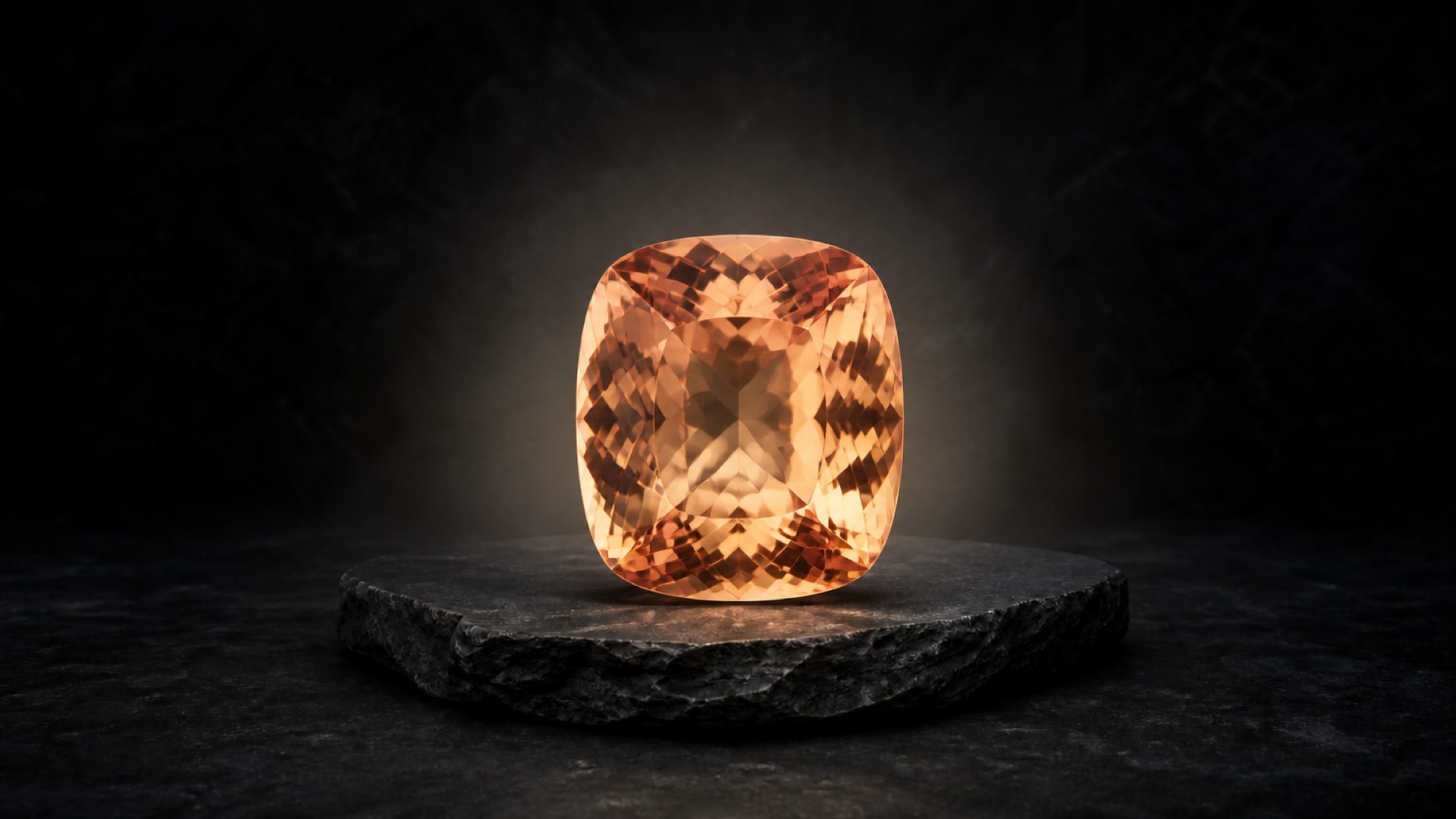
Cornerstone gemstone profile
Topaz
Color, cleavage, and the story behind blue topaz
Also known descriptively as Blue topaz
AI-created master image · AI · Owned
Explore this profile
Definition
What is Topaz?
Topaz is a distinct mineral species, an aluminum silicate containing fluorine and hydroxyl. It can be colorless or colored, and blue is only one part of its palette. A topaz can be natural in origin yet treated to change its color; those descriptions answer different questions. [1,2]
Also described asBlue topazImperial topaz
At a glance
Gemological properties
Measured values and material-specific properties are linked to their evidence. A dash means no canonical value is established here; consult the profile discussion for limitations.
| Gemstone | Topaz | Mineral species | Topaz |
|---|---|---|---|
| Mineral group | Silicates | Family | — |
| Chemical formula | Al₂(F,OH)₂SiO₄[1,2] | Crystal system | Orthorhombic[2] |
| Mohs hardnessMohs hardnessA comparative scale of scratch resistance from 1 to 10; it does not measure toughness.Explore Mohs hardness | 8[1] | Specific gravitySpecific gravityThe ratio of a material’s density to the density of water under defined conditions.Explore Specific gravity | 3.53[1] |
| Refractive indexRefractive indexA measurement describing how light changes speed and direction as it enters a material.Explore Refractive index | 1.619–1.627[1] | BirefringenceBirefringenceThe numerical difference between a doubly refractive material’s principal refractive indices.Explore Birefringence | 0.008–0.01[1] |
| Optic character | Biaxial positive[2] | DispersionDispersionThe separation of white light into spectral colors because refractive index varies with wavelength.Explore Dispersion | — |
| Primary color | Multicolor[1] | PleochroismPleochroismDifferent body colors seen in some anisotropic gems when viewed along different crystallographic directions.Explore Pleochroism | Variable with color and viewing direction[2] |
| LusterLusterThe character of light reflected from a material’s surface.Explore Luster | Vitreous[2] | Transparency | Transparent to opaque with inclusions[2] |
| CleavageCleavageA mineral’s tendency to split along specific crystallographic planes.Explore Cleavage | Perfect basal cleavage {001}[2] | Fracture | Subconchoidal to uneven[2] |
| TenacityTenacityA material’s response to bending, breaking, crushing, or tearing.Explore Tenacity | Brittle[2] | Fluorescence | — |
| Streak | — | Availability | Natural |
| Jewelry suitability | Protect from impact, pressure, and sudden temperature changes[3] | ||
Scope note: Values are cited reference figures, not guaranteed limits for every specimen. A single number may be a nominal value. Some properties describe a mineral species; others vary with composition, structure or treatment. Diamond RI is quoted at 589 nm; numeric dispersion uses the cited wavelength convention. A missing value is not zero and does not by itself mean “not applicable.” Consult the citations and discussion for scope and limitations.
Visual evidence
Documented media & editorial visuals
Every image is labeled by visual class. Documentary identity statements describe the source record and review status—not facts inferred from appearance alone.
Topaz
- Identity
- Not applicable
AI · Owned
Pink topaz crystal on matrix
Source-identified subject; no independent laboratory verification is claimed.
Photographer-identified pink topaz from Shigar Valley, Pakistan. Locality and identity follow the source record; no independent origin or treatment determination is claimed.
- Identity
- Claimed by source
Pink topaz crystal on matrix — Didier Descouens, via Wikimedia Commons. CC BY 3.0. Resized and padded to preserve the source framing; no retouching or color adjustment. · CC BY 3.0 · Original source

Topaz crystals from Ouro Preto
Source-identified subject; no independent laboratory verification is claimed.
Source-described imperial topaz from Vermelhão Mine, Ouro Preto, Brazil. Imperial is the source’s trade description, not an independently assigned quality grade.
- Identity
- Claimed by source
Topaz crystals from Ouro Preto — Didier Descouens, via Wikimedia Commons. CC BY-SA 4.0. Resized and padded to preserve the source framing; no retouching or color adjustment. Derivatives are shared under CC BY-SA 4.0. · CC BY-SA 4.0 · Original source

Topaz in the Paris museum collection
Source-identified subject; no independent laboratory verification is claimed.
Museum-display photograph of source-identified topaz from Minas Gerais, Brazil. Display illumination influences its appearance; treatment and precise mine are not established here.
- Identity
- Claimed by source
Topaz in the Paris museum collection — Marie-Lan Taÿ Pamart, via Wikimedia Commons. CC BY 4.0. Resized and padded to preserve the source framing; no retouching or color adjustment. · CC BY 4.0 · Original source

Faceted blue topaz
Source-identified subject; no independent laboratory verification is claimed.
Source-identified blue topaz, with Brazil recorded by the photographer. Treatment history and geographic origin are not independently established by this photograph.
- Identity
- Claimed by source
Faceted blue topaz — Mauro Cateb, via Wikimedia Commons. CC BY-SA 3.0. Resized and padded to preserve the source framing; no retouching or color adjustment. Derivatives are shared under CC BY-SA 3.0. · CC BY-SA 3.0 · Original source

Mineralogy
Mineralogy & classification
Topaz crystallizes in the orthorhombic system. Prismatic crystals may show grooves along their length and well-developed terminal faces. Color names do not define separate mineral species: blue, pink, and colorless topaz share the same basic structural identity. A crystal habit can suggest an identification, but damaged or cut material requires measurement.
Sources [2]
Mineral species
TopazOne species, multiple colors. [2]
Chemistry
Chemistry & composition
The formula Al₂SiO₄(F,OH)₂ allows fluorine and hydroxyl to occupy corresponding structural positions. The ideal formula does not predict a stone’s color. Trace constituents and defects can alter the way the crystal absorbs light; chromium is associated with some pink-to-red colors, while defects contribute to several yellow, brown, and blue appearances.
Color
Color science
Natural blue topaz exists, but strong blue material in jewelry is commonly produced through irradiation followed by heating. Irradiation changes electronic defects, often called color centers; heating helps develop the desired appearance. Color therefore needs a treatment history, not just an attractive name.
Sky Blue, Swiss Blue, and London Blue are commercial color descriptions. They should not be read as standardized laboratory grades or proof of geographic origin. Imperial is also a trade term: it is associated with desirable warm orange-to-pink or reddish colors and Brazilian material, but a seller should explain the intended meaning rather than rely on the name alone.
Optics
Optical properties
Typical gemological reference values are RI 1.619–1.627 and birefringence 0.008–0.010. These are useful identification references, not a specification for every possible composition. Topaz is biaxial positive. Directional color differences can occur, so the orientation chosen by a cutter can influence the appearance of a colored stone.
Durability
Hardness & durability
Topaz ranks 8 on the Mohs scale but has perfect basal cleavage. A blow can exploit that structural weakness even when the polished surface resists scratching. Rings need protection at exposed edges, and setting pressure matters. A hardness number alone is a poor guide to whether a stone will survive an accident.
Treat a loose topaz as a brittle object: do not test it by tapping, dropping, or scratching it. Tell a jeweler what the stone is before resizing or repair, so pressure and temperature changes can be considered.
Sources [3]
Hardness means scratch resistance. It is not a universal durability score and does not equal toughness.
Hardness versus toughness
8 Mohs; perfect cleavageProtect from impact and setting pressure. [3]
Formation
Geology & formation
Topaz occurs in several geological settings, including cavities in granitic and rhyolitic rocks and related mineralized systems. Fluorine-bearing fluids are important in many occurrences. Some crystals are later released by weathering and recovered from sediments. A loose gem’s appearance does not reveal which of these routes brought it to market.
Sources [5]
Locations
Where Topaz occurs
Brazil, Pakistan, Russia, Nigeria, Sri Lanka, and the United States are among the countries associated with topaz. Ouro Preto is especially important in the history of warm-colored Brazilian material; Utah’s Thomas Range is a familiar crystal locality. Occurrence records describe geology or historical supply, not necessarily current mine output.
Production
Not assessedOccurrence references do not verify current output. [2]
Ouro Preto topaz occurrences
Documented topaz occurrences near Ouro Preto, Minas Gerais. Current mine production is not assessed. [2]
- Production
- Production not assessed
- Coordinates
- Not published
Thomas Range topaz occurrences
Documented topaz occurrences in the Thomas Range, Utah. [2]
- Production
- Production not assessed
- Coordinates
- Not published
Origin caution: locality relationships do not by themselves prove geographic origin for an individual stone.
Inclusions
Inclusions & internal features
Topaz can contain fluid-filled cavities, gas bubbles, solid inclusions, and healed or open fractures. A documented blue topaz contained a complex negative crystal whose fluid phases changed with temperature. That is a specimen-specific observation, not a home test or a universal feature of topaz.
For collectors, an inclusion can be an interesting record of growth. For jewelry, ask separately whether it reaches the surface or compromises durability. A clear-looking face does not exclude a cleavage-related weakness.
Sources [7]
Topaz complex fluid inclusions
Documented fluid-filled negative crystals; not universal or independently diagnostic. [7]
- Identification
- Documented fluid-filled negative crystals; not universal or independently diagnostic.
- Treatment context
- Origin caution
- Not standalone evidence of geographic origin.
Treatments
Treatments & disclosure
Irradiation and heating are important in blue topaz; surface coatings create other appearances, including iridescent effects. A coating is a layer on the stone, so abrasion or repolishing can remove it. Treatment detection can be limited: a report’s wording should be read carefully, especially when a natural-color premium is being claimed.
In the United States, the NRC regulates initial distribution of gems made radioactive by treatment and requires appropriate surveys before release. That controlled release process is distinct from ordinary retail ownership. A blue color or photograph cannot demonstrate radiological compliance; use an established supply chain and retain disclosure records.
Blue color
Treatment commonly involvedNatural origin does not establish natural color. [5]
Coated topaz
Surface layerAvoid abrasive cleaning and repolishing. [3]
Irradiation
- Purpose
- Modify appearance
- Detection
- Laboratory assessment; limitations depend on treatment.
- Permanence
- Treatment-dependent
- Care effect
- Gentle hand cleaning; disclose treatment before repair.
- Disclosure
- Retain written treatment disclosure. [5]
Heat treatment
- Purpose
- Modify appearance
- Detection
- Laboratory assessment; limitations depend on treatment.
- Permanence
- Treatment-dependent
- Care effect
- Gentle hand cleaning; disclose treatment before repair.
- Disclosure
- Retain written treatment disclosure. [8]
Surface coating
- Purpose
- Modify appearance
- Detection
- Laboratory assessment; limitations depend on treatment.
- Permanence
- Treatment-dependent
- Care effect
- Gentle hand cleaning; disclose treatment before repair.
- Disclosure
- Retain written treatment disclosure. [3]
Natural vs synthetic
Natural, laboratory-grown & simulant
A treated natural topaz remains topaz; treatment does not make it laboratory-grown. An imitation merely resembles it and may be a different material. When a seller uses “created,” “simulated,” or “natural,” ask which material is actually offered and what testing supports that claim. An identification report is not automatically a quality grade.
Sources [10]
Identification
How gemologists identify Topaz
Professional identification combines refractive index, optical behavior, specific gravity where appropriate, and microscopic observations. Blue alone cannot distinguish topaz from aquamarine, glass, or other blue materials. A report should identify the material and describe detectable treatments; it may not resolve every question about color history.
Value factors
Value factors
Color, cutting, clarity, and size work together. Readily available treated blue topaz and scarce natural warm-colored material are different comparisons. A large stone with a pale window or uneven appearance may be less appealing than a smaller, well-cut example. Judge the actual face-up appearance in more than one ordinary light source.
Sources [11]
Buying guide
How to buy Topaz
Request a written material name, treatment disclosure, dimensions, weight, and return terms. If “imperial” or “natural color” drives the price, ask what those words mean and whether the report supports them. Our practical recommendation is to compare stones with the same disclosed treatment status before comparing prices.
Inspect the setting as well as the stone. Protective metalwork and a sensible position for vulnerable edges can matter more in daily use than a small difference in carat weight.
Sources [12]
Collector guide
Collector’s guide to Topaz
A topaz collection can explore color, crystal form, inclusions, or locality. Keep the original label and any acquisition record with each specimen. Record repairs, coatings, and other preparation when disclosed. For an attributed locality, distinguish a seller’s label from a traceable collecting history; an attractive crystal shape does not prove its mine.
Care
Topaz care card
Clean topaz with lukewarm soapy water and a soft cloth or brush. Avoid steam, ultrasonic cleaning, sudden temperature changes, and impacts. Coated stones need particular protection from abrasion. Some yellow-to-brown colors can fade with prolonged heat or light exposure; do not assume all topaz colors behave identically.
Sources [3]
History
History & etymology
Historical “topaz” names do not always refer to the mineral recognized today. The name has been linked to the Red Sea island associated with peridot, while other etymological accounts connect it with fire. Imperial terminology also carries royal associations. These histories enrich a collection, but they do not authenticate a modern stone’s identity or origin.
Sources [13]
Short answers
Topaz questions, answered
What is topaz?+
An aluminum silicate mineral containing fluorine and hydroxyl, used as a gemstone in many colors. [2]
Is blue topaz natural?+
Natural blue topaz exists, but much jewelry material has been irradiated and heated to develop its color. [5]
How is blue topaz treated?+
Irradiation changes color-related defects in the crystal; heating is often part of the process. [8]
What is imperial topaz?+
A trade description associated with prized warm orange, pink, or reddish topaz. Ask the seller to define the term. [4]
How hard is topaz?+
It is 8 on the Mohs scale. That measures scratch resistance, not resistance to a blow. [1]
Can topaz break?+
Yes. Perfect basal cleavage makes it vulnerable to splitting under impact or pressure. [3]
Are Sky, Swiss, and London Blue grades?+
They are commercial color descriptions, not proof of origin or standardized quality grades. [6]
Is treated topaz synthetic?+
No. Treatment modifies an existing stone; laboratory growth describes how a material was created. [10]
What is mystic topaz?+
An iridescent appearance commonly produced by a thin surface coating. Abrasion can damage the coating. [3]
Where is topaz found?+
Documented occurrences include Brazil, Pakistan, Russia, Nigeria, Sri Lanka, and the United States. [5]
Can color identify topaz?+
No. Identification combines physical and optical measurements with examination of the stone. [10]
What can topaz inclusions contain?+
Fluid cavities can hold liquids, gas bubbles, and solid phases; each feature needs individual interpretation. [7]
How should I clean topaz?+
Use lukewarm soapy water. Avoid steam and ultrasonic cleaning. [3]
Can topaz color fade?+
Some yellow-to-brown colors can fade with extended heat or light exposure. Stability depends on the material and treatment. [3]
Does a report grade topaz quality?+
An identification report can name the material and detectable treatments without assigning a quality grade. [10]
Is irradiated topaz regulated?+
In the United States, initial distribution of gems made radioactive by treatment is regulated; required surveys precede release. [9]
Evidence
References & further reading
Citation numbers are deduplicated across properties, claims, sections, structured modules, treatments, inclusions, FAQs, and related educational records.
- [1]Topaz Gemstone Overview.
Gemological Institute of America
- [2]Topaz.
Handbook of Mineralogy / Mineral Data Publishing
- [3]Topaz Care and Cleaning.
Gemological Institute of America
- [4]Topaz Description.
Gemological Institute of America
- [5]Topaz.
Geoscience Australia
- [6]November Birthstone: Topaz and Citrine (archived blog listing).
Gemological Institute of America
- [7]Complex Fluid Inclusion in Topaz.
Gemological Institute of America
- [8]An Introduction to Gem Treatments.
Gemological Institute of America
- [9]Backgrounder on Irradiated Gemstones.
U.S. Nuclear Regulatory Commission
- [10]Does GIA grade topaz?.
Gemological Institute of America
- [11]Topaz Quality Factors.
Gemological Institute of America
- [12]Topaz Buyer's Guide.
Gemological Institute of America
- [13]Topaz History and Lore.
Gemological Institute of America