Cornerstone gemstone profile
Tourmaline
A chemically complex mineral supergroup spanning Elbaite, Dravite, Schorl, Uvite, Liddicoatite, and celebrated gem varieties
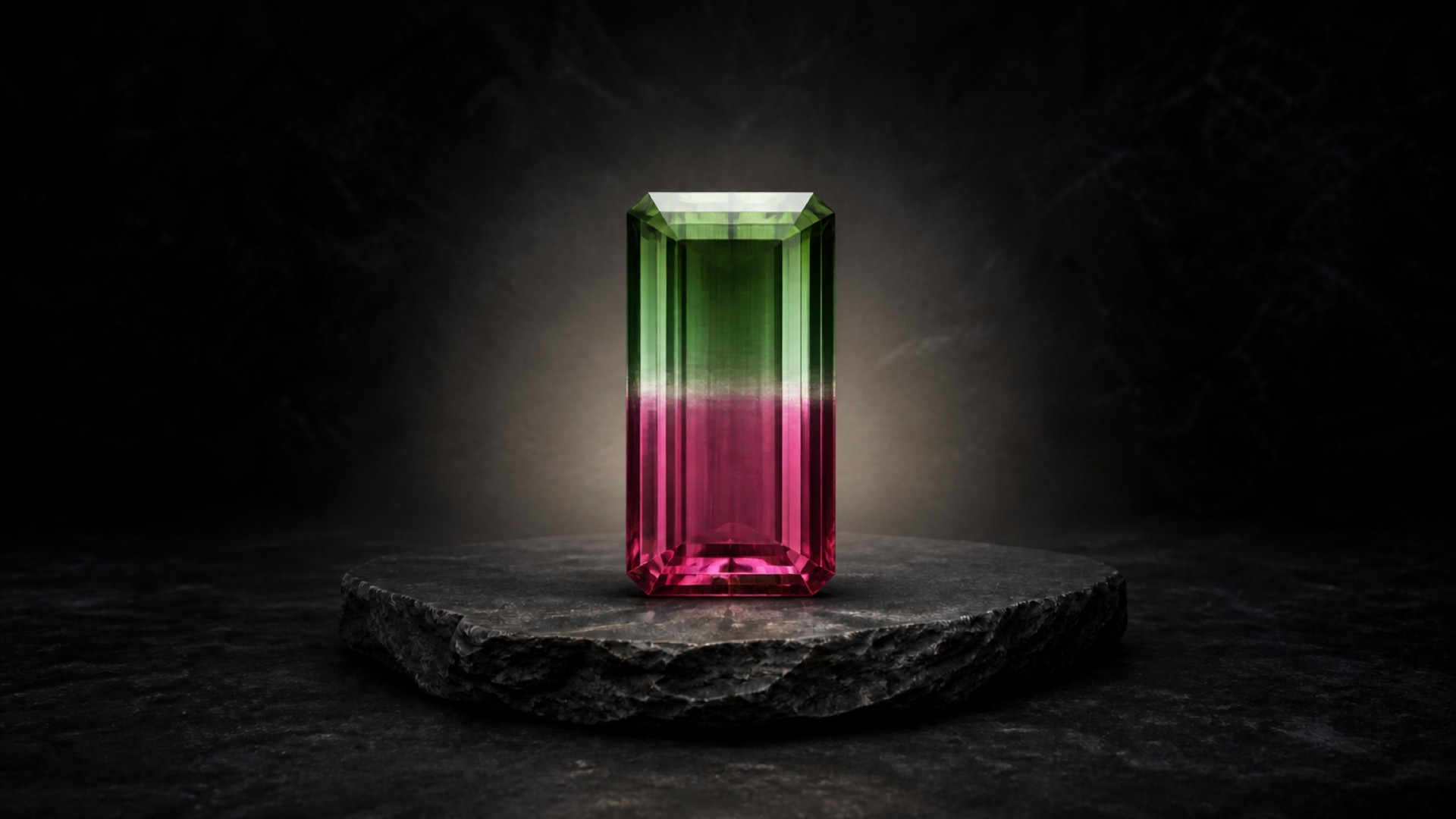
AI-created master image · AI · Owned
Explore this profile
Definition
What is Tourmaline?
Tourmaline-supergroup minerals use the generalized site formula XY₃Z₆(T₆O₁₈)(BO₃)₃V₃W. Site occupancy and coupled substitutions define distinct species. Gem material commonly belongs to Elbaite, Dravite, Uvite, Schorl, or Liddicoatite-related compositions; trade variety names such as Rubellite, Indicolite, Verdelite, Watermelon, Chrome, and Paraíba do not all map one-to-one to mineral species. [1]
At a glance
Gemological properties
Measured values and species-level properties are linked to their evidence. “Pending” means the value has not cleared review.
| Gemstone | Tourmaline | Mineral species | Pending verification |
|---|---|---|---|
| Mineral group | Silicates | Family | Tourmaline |
| Chemical formula | Generalized: XY₃Z₆(T₆O₁₈)(BO₃)₃V₃W[1] | Crystal system | Trigonal[1] |
| Mohs hardnessMohs hardnessA comparative scale of scratch resistance from 1 to 10; it does not measure toughness.Learn more | 7–7.5[2] | Specific gravitySpecific gravityThe ratio of a material’s density to the density of water under defined conditions.Learn more | 3–3.26[3] |
| Refractive indexRefractive indexA measurement describing how light changes speed and direction as it enters a material.Learn more | 1.624–1.644[3] | BirefringenceBirefringenceThe numerical difference between a doubly refractive material’s principal refractive indices.Learn more | 0.018–0.04[3] |
| Optic character | Uniaxial negative (doubly refractive)[3] | DispersionDispersionThe separation of white light into spectral colors because refractive index varies with wavelength.Learn more | 0.017[3,4] |
| Primary color | Multicolor[3] | PleochroismPleochroismDifferent body colors seen in some anisotropic gems when viewed along different crystallographic directions.Learn more | Usually dichroic and often strong; the ordinary ray is commonly darker, making cutting orientation important[5] |
| LusterLusterThe character of light reflected from a material’s surface.Learn more | Vitreous[3] | Transparency | Transparent to opaque[3] |
| CleavageCleavageA mineral’s tendency to split along specific crystallographic planes.Learn more | No easy cleavage; may show indistinct basal parting in some material[3] | Fracture | Uneven to conchoidal[3] |
| TenacityTenacityA material’s response to bending, breaking, crushing, or tearing.Learn more | Brittle; overall toughness commonly rated fair[3] | Fluorescence | Variable by species, color, and source; many stones are inert and fluorescence is not diagnostic[6] |
| Streak | White[3] | Availability | Natural |
| Jewelry suitability | Generally suitable for jewelry with protection from sharp impact, high heat, thermal shock, and unsafe cleaning; inclusion condition and treatment matter[2] | ||
Scope note: some physical properties describe corundum as a mineral species; ruby-specific claims are identified separately in the citations.
Mineralogy
Mineralogy & classification
Tourmaline species are defined through dominant constituents at crystallographic sites, not by color alone.
The IMA nomenclature divides the supergroup using occupancy of X, Y, Z, T, V, and W sites. Alkali, calcic, and X-vacant groups require coupled substitutions, making a single simple formula misleading.
Elbaite supplies much gem material; Dravite and Uvite compositions include notable brown and green gems; Schorl is commonly dark; Liddicoatite-related material is renowned for complex zoning.
Mineral status
Tourmaline supergroupTourmaline encompasses many mineral species with a shared structure. [1,7]
Do not assign all Tourmaline to Elbaite.
Major gem-relevant names
Elbaite, Dravite, Uvite, Schorl, Liddicoatite-related speciesDifferent species can overlap in color and properties. [7,1]
Trade variety and mineral species are not interchangeable.
Chemistry
Chemistry & composition
The generalized formula XY₃Z₆(T₆O₁₈)(BO₃)₃V₃W describes sites whose occupants define species and influence properties.
Common constituents include Na, Ca, Li, Mg, Fe, Mn, Al, Cr, V, Si, B, O, OH, and F. Most compositional variability occurs at several cation and anion sites, and coupled substitution preserves charge balance.
Composition affects refractive index, specific gravity, color, spectra, and species name. Trade color terms cannot substitute for chemical classification.
Boron occurs in BO₃ groups essential to the Tourmaline structure. [1]
Silicon commonly occupies the T site in six-membered silicate rings. [1]
Aluminum commonly occupies Y, Z, or T sites depending on species and substitution. [1]
Sodium commonly occupies the X site in alkali-group Tourmalines. [1]
Calcium occupancy contributes to calcic-group species such as Uvite-related compositions. [1]
Lithium is important in Elbaite and Liddicoatite-related compositions. [7]
Magnesium is important in Dravite and Uvite compositions. [7]
Iron commonly contributes green, blue, brown, and dark color. [3]
Manganese contributes to many pink, red, and yellow Tourmalines. [3]
Copper contributes vivid blue-to-green color in cuprian Tourmaline. [9]
Chromium can contribute rich green color in some Dravite-Uvite material. [7]
Vanadium can contribute rich green color, sometimes with chromium. [7]
Fluorine occupancy at the W site distinguishes fluor-prefixed species from OH-dominant roots. [1]
Generalized site formula
XY₃Z₆(T₆O₁₈)(BO₃)₃V₃WSite occupancy and coupled substitutions define species. [1]
This is a structural template, not one specimen's exact analysis.
Color
Color science
Iron, manganese, copper, chromium, vanadium, titanium, defects, radiation-related color centers, and mixtures can produce or modify color.
Iron commonly contributes green and blue; manganese is important in many pink-to-red and some yellow stones. Copper produces vivid blue-to-green color in cuprian material. Chromium and vanadium can contribute rich green.
The same apparent hue may have different causes, and the same element can behave differently by valence, site, concentration, and competing absorption.
Common terms
Rubellite, Indicolite, Verdelite, Achroite, WatermelonThese are color or zoning terms used in the gem trade. [3]
Boundaries are not universally standardized.
Optics
Optical properties
Tourmaline is commonly strongly dichroic, with a darker ordinary ray and lighter extraordinary ray.
Cutters orient light material to deepen color and dark material to avoid a closed or nearly opaque c-axis. Improper orientation can create dark ends, extinction, or a pleochroic bow tie.
Pleochroism changes with viewing direction. It is not the same as color change under different light sources.
Pleochroism
Often strong dichroismThe ordinary ray is commonly darker, so cutting orientation affects face-up appearance. [5]
Pleochroism is not light-source color change.
Cat's-eye
Chatoyancy from aligned tubes or inclusionsA suitable cabochon concentrates a moving band of light. [3]
Evaluate sharpness, mobility, centering, and disclosure separately.
Durability
Hardness & durability
Tourmaline's Mohs 7–7.5 hardness provides useful scratch resistance, while fair toughness and brittle behavior still permit chipping or fracture.
Hardness does not measure resistance to impact. Elongated shapes, sharp corners, thin girdles, internal tubes, liquid inclusions, and surface-reaching fractures can increase local risk.
Species and composition vary, so broad group-level numbers are guides rather than exact measurements for every specimen.
Tourmaline is generally stable to light and chemicals, but high heat can alter color and sudden temperature change can fracture the stone.
Abundant liquid inclusions make heating especially risky. Repair procedures should account for inclusion condition, filling, irradiation, and color treatment.
Most sound stones wear well in protected jewelry. Rings and bracelets deserve more conservative settings than pendants or earrings.
Hardness means scratch resistance. It is not a universal durability score and does not equal toughness.
Formation
Geology & formation
Tourmaline forms in multiple geologic systems, and geology helps explain species and chemical diversity.
Lithium-rich Elbaite and Liddicoatite-related material commonly crystallize in evolved granitic pegmatites, where gem pockets can produce large crystals and dramatic zoning. Dravite–Uvite compositions commonly occur in metamorphosed carbonate rocks and marbles.
Schorl is widespread in granitic and metamorphic environments. No single deposit model covers the supergroup.
Changing fluid or melt chemistry during growth can record sharp or gradual color and compositional zoning.
Tourmaline is pyroelectric and piezoelectric: temperature change or mechanical stress can produce electrical polarization. These are measurable physical properties used in scientific contexts.
They do not support healing, detoxification, energy-balancing, or other medical claims. The site presents mineral physics, not pseudoscience.
Pyroelectric and piezoelectric
Measurable electrical polarizationTemperature change or stress can polarize Tourmaline electrically. [3]
These properties do not support medical or healing claims.
Principal settings
Evolved pegmatites and metamorphosed carbonate rocksDifferent settings favor different species and compositions. [7]
No one formation model covers the supergroup.
Locations
Where Tourmaline occurs
Brazil, Mozambique, Nigeria, Madagascar, Afghanistan, Pakistan, the United States, Vietnam, and parts of East Africa are important in Tourmaline literature and trade.
Different districts produce different species, colors, and quality ranges. A famous country does not guarantee quality, and visual appearance does not prove locality.
Current mine status changes and is not inferred from a historic paper. Location records here are occurrence or historic relationships unless dated production evidence says otherwise.
Term scope
Copper-bearing blue-to-green Tourmaline; origin may be Brazil, Mozambique, or NigeriaMaterial identity and geographic origin are separate laboratory questions. [9,10]
Ask what a seller means by Paraíba.
Minas Gerais Tourmaline Districts
Important pegmatite source context; current mine status not asserted. [7]
- Production
- Production not assessed
- Coordinates
- Not published
Mozambique Cuprian Tourmaline Deposits
Copper-bearing Tourmaline origin population documented; current production not asserted. [9]
- Production
- Production not assessed
- Coordinates
- Not published
Nigeria Cuprian Tourmaline Deposits
Copper-bearing Tourmaline origin population documented; current production not asserted. [9]
- Production
- Production not assessed
- Coordinates
- Not published
Madagascar Tourmaline Pegmatites
Important gem and collector source context; current production not asserted. [7]
- Production
- Production not assessed
- Coordinates
- Not published
Luc Yen Tourmaline District
Multiple Tourmaline compositions documented; current production not asserted. [6]
- Production
- Production not assessed
- Coordinates
- Not published
Origin caution: locality relationships do not by themselves prove geographic origin for an individual stone.
Inclusions
Inclusions & internal features
Tourmaline commonly shows color zoning, growth tubes, fluid inclusions, mineral crystals, growth blockages, fractures, and healed fissures.
Long thread-like tubes parallel to the crystal can create chatoyancy when dense, aligned, and cut as a cabochon. Inclusion abundance varies by color and variety; red and pink material is often accepted with more visible features than green-to-blue material.
Microscopy supports identity, natural origin, treatment, and sometimes locality work, but no one feature proves all four.
Common features
Growth tubes, fluids, crystals, zoning, growth blockages, fissuresMicroscopy informs identification, treatment, and growth history. [8]
One feature cannot prove origin.
Growth tubes
Elongate tube-like features commonly parallel to Tourmaline crystal growth. [8]
- Identification
- Parallel tubes support Tourmaline microscopy and can create chatoyancy.
- Treatment context
- Liquid-filled tubes increase heat risk.
- Origin caution
- Not a stand-alone locality test.
Color zoning
Compositional and color boundaries formed as growth conditions changed. [8]
- Identification
- Records changes in growth chemistry and explains bicolor patterns.
- Treatment context
- Treatment may modify color but does not explain every zone.
- Origin caution
- Patterns overlap localities.
Fluid inclusions
Fluid-bearing cavities whose form and context may record growth or healing. [8]
- Identification
- Records growth or later healing and affects durability.
- Treatment context
- Liquid-rich material can fracture during heating.
- Origin caution
- Assemblages may inform but not prove origin.
Mineral crystals
Solid inclusions requiring identification and contextual interpretation. [8]
- Identification
- Mineral identity and assemblage contribute to geology and identification.
- Treatment context
- Heat response is mineral- and sample-specific.
- Origin caution
- Some assemblages support origin work but overlap.
Growth structures
Internal planes, blockages, dislocations, or zoning formed during crystal growth. [8]
- Identification
- Growth blockages, dislocations, and planes record crystallization.
- Treatment context
- Some features may help evaluate treatment.
- Origin caution
- Not a country test by itself.
Treatments
Treatments & disclosure
Heat and irradiation are the two principal color treatments documented by GIA, with different detection and stability implications.
Low-temperature heat can lighten or improve some blue and green Tourmalines and can produce desirable cuprian colors; results are stable and may be undetectable. Liquid-rich stones may fracture during heating.
Irradiation can intensify pink or red color. Some irradiation-induced color may fade with heat or bright light. Written disclosure should name the process rather than say only “enhanced.”
Principal color treatments
Heat and irradiationHeat can improve blue-green colors; irradiation can intensify pink-red color. [2,8]
Heat can be undetectable; irradiated colors can be less stable.
Heat treatment
- Purpose
- Modify color
- Detection
- Often undetectable; liquid inclusions can rule out safe heating for a specific stone.
- Permanence
- Color change from heat is generally stable.
- Care effect
- Avoid high heat and thermal shock; liquid-rich stones are vulnerable.
- Disclosure
- Disclose heat when known and avoid unsupported untreated claims. [2]
Irradiation
- Purpose
- Modify or intensify color
- Detection
- Detection can be difficult and may require advanced testing.
- Permanence
- Some irradiation-induced colors can fade with heat or bright light.
- Care effect
- Avoid unnecessary heat and prolonged intense light when treatment is known or suspected.
- Disclosure
- Disclose irradiation and any subsequent heating. [2]
Natural vs synthetic
Natural, laboratory-grown & simulant
The reviewed 2024 GIA source states that no synthetic gem Tourmaline exists, so no commercial synthesis method is published here.
Experimental crystals and future developments are separate from established gem-market products. The conclusion is date- and source-bounded, with an open review task rather than a permanent impossibility claim.
Glass and other gems can imitate Tourmaline colors. Identity requires physical and analytical evidence.
Reviewed evidence
No synthetic gem Tourmaline documented by GIA in 2024No synthesis method is published for this record. [8]
This is date-bounded, not a permanent impossibility claim.
Identification
How gemologists identify Tourmaline
Gemologists combine RI, birefringence, uniaxial character, pleochroism, SG, spectra, microscopy, and chemistry.
Broad RI and SG ranges overlap other stones and vary by composition. Advanced chemical analysis may be required to assign species or assess copper-bearing origin populations.
A blue or green color is not enough to distinguish Indicolite, Paraíba-type cuprian material, Aquamarine, Sapphire, Tanzanite, glass, or another look-alike.
Value factors
Value factors
Species or variety, color, saturation, tone, clarity expectations, cut, size, treatment, origin evidence, rarity, and demand all interact.
Vivid copper-bearing blue-to-green stones can command exceptional prices, but every mine produces a range of quality. Fine Rubellite, Chrome Tourmaline, Indicolite, unusual zoning, and collector crystals form different comparison sets.
There is no universal Tourmaline grade, and a chemical element or famous locality does not guarantee beauty or value.
Buying guide
How to buy Tourmaline
Start with the exact color or variety, then verify identity, treatment, cut, condition, documentation, and seller terms.
View the stone in diffuse and spot lighting, face-up and from the side. Check dark ends, extinction, windowing, zoning, fractures, filled features, girdle condition, and durability around inclusions.
For Paraíba claims or significant prices, seek an independent report and read the precise wording. GIA identifies material and detectable treatments but does not assign a universal quality grade.
Collector guide
Collector’s guide to Tourmaline
Collectors can organize Tourmaline by species, chemistry, locality, crystal form, matrix, zoning, inclusions, or historic provenance.
A specimen labeled only “Tourmaline” may be scientifically incomplete, but species assignment should not be guessed without adequate analysis. Preserve old labels while distinguishing historic wording from modern identification.
Complex Liddicoatite-related zoning, Elbaite pockets, Dravite–Uvite crystals, Schorl morphology, and documented cuprian material support different collecting goals.
Care
Tourmaline care card
Warm water, mild soap, a soft brush, and thorough rinsing are the conservative routine method.
Ultrasonic and steam cleaners are not recommended. Avoid high heat and thermal shock. Irradiated colors may be light- or heat-sensitive, and liquid-rich stones can fracture.
Tell the jeweler about treatment and laboratory documentation before repair.
Sources [2]
Safest cleaning
Warm soapy waterUse a soft brush and gentle rinse. [2]
Ultrasonic and steam cleaners are not recommended.
History
History & etymology
Green Tourmaline was historically confused with Emerald before mineralogical testing separated the materials.
Tourmaline's electrical behavior attracted scientific study, while improved chemistry and crystallography revealed that the old single-name category contains many species. Modern IMA nomenclature formalizes that complexity.
Historic color names remain culturally useful, but they do not override species, treatment, or origin evidence.
Short answers
Tourmaline questions, answered
What is Tourmaline?+
Tourmaline is a mineral supergroup and a gem-trade umbrella containing many species with the same basic trigonal structure but different chemistry and physical properties. [1,7]
Tourmaline is a mineral supergroup and a gem-trade umbrella containing many species with the same basic trigonal structure but different chemistry and physical properties.
Is Tourmaline one mineral species?+
No. Elbaite, Dravite, Uvite, Schorl, and Liddicoatite-related species are among the important names. Species are defined by chemical site occupancy, not by color alone. [1,7]
No. Elbaite, Dravite, Uvite, Schorl, and Liddicoatite-related species are among the important names. Species are defined by chemical site occupancy, not by color alone.
What do Rubellite, Indicolite, and Verdelite mean?+
They are trade variety or color terms: Rubellite for valued red-to-pink, Indicolite for blue, and Verdelite for green Tourmaline. Their boundaries are not universally standardized and they do not establish species or origin. [3]
They are trade variety or color terms: Rubellite for valued red-to-pink, Indicolite for blue, and Verdelite for green Tourmaline. Their boundaries are not universally standardized and they do not establish species or origin.
What is Watermelon Tourmaline?+
Watermelon Tourmaline shows pink or red and green color zones, commonly a pink core surrounded by green. The pattern records changing chemistry during crystal growth and is not a separate mineral species. [3,8]
Watermelon Tourmaline shows pink or red and green color zones, commonly a pink core surrounded by green. The pattern records changing chemistry during crystal growth and is not a separate mineral species.
What is Paraíba Tourmaline?+
Paraíba is used for vivid copper-bearing blue-to-green Tourmaline. Original deposits are Brazilian, while related copper-bearing material also comes from Mozambique and Nigeria. Exact trade and report wording matters. [9,10]
Paraíba is used for vivid copper-bearing blue-to-green Tourmaline. Original deposits are Brazilian, while related copper-bearing material also comes from Mozambique and Nigeria. Exact trade and report wording matters.
Does Paraíba always mean Brazil?+
No. Some trade usage applies the term to qualifying copper-bearing material regardless of origin; other contexts distinguish Brazilian origin. Ask what the seller means and seek an independent origin report for consequential purchases. [9,10]
No. Some trade usage applies the term to qualifying copper-bearing material regardless of origin; other contexts distinguish Brazilian origin. Ask what the seller means and seek an independent origin report for consequential purchases.
Why does Tourmaline have so many colors?+
Its many chemical substitutions allow iron, manganese, copper, chromium, vanadium, titanium, defects, and color centers to affect absorption. The same hue can arise by more than one mechanism. [3,7]
Its many chemical substitutions allow iron, manganese, copper, chromium, vanadium, titanium, defects, and color centers to affect absorption. The same hue can arise by more than one mechanism.
Is Tourmaline pleochroic?+
Yes, often strongly. Tourmaline is commonly dichroic, and one optical direction is usually darker. Cutting orientation therefore has a major effect on face-up color and extinction. [5]
Yes, often strongly. Tourmaline is commonly dichroic, and one optical direction is usually darker. Cutting orientation therefore has a major effect on face-up color and extinction.
How hard is Tourmaline?+
Most gem Tourmaline falls around 7 to 7.5 on Mohs and has fair toughness. It is brittle and can chip or fracture, particularly around tubes, liquid inclusions, fissures, thin girdles, and sharp corners. [2,3]
Most gem Tourmaline falls around 7 to 7.5 on Mohs and has fair toughness. It is brittle and can chip or fracture, particularly around tubes, liquid inclusions, fissures, thin girdles, and sharp corners.
Is Tourmaline treated?+
Heat and irradiation are the two principal color treatments documented by GIA. Heat can improve some blue-green colors and may be undetectable; irradiation can intensify pink-red color and may be sensitive to heat or bright light. [2,8]
Heat and irradiation are the two principal color treatments documented by GIA. Heat can improve some blue-green colors and may be undetectable; irradiation can intensify pink-red color and may be sensitive to heat or bright light.
Can Tourmaline be laboratory grown?+
A 2024 GIA review states that no synthetic gem Tourmaline exists. This is a date-bounded evidence statement, not a claim that experimental crystals or future commercial products are impossible. [8]
A 2024 GIA review states that no synthetic gem Tourmaline exists. This is a date-bounded evidence statement, not a claim that experimental crystals or future commercial products are impossible.
What inclusions occur in Tourmaline?+
Growth tubes, fluid inclusions, crystals, color zoning, growth blockages, healed fissures, and surface-reaching fractures are documented. Inclusion expectations vary by color and variety. [8,10]
Growth tubes, fluid inclusions, crystals, color zoning, growth blockages, healed fissures, and surface-reaching fractures are documented. Inclusion expectations vary by color and variety.
What causes cat's-eye Tourmaline?+
Aligned tubes or inclusions can concentrate a moving band of light when the stone is cut as a cabochon. Sharpness, centering, mobility, bodycolor, and transparency influence quality. [3]
Aligned tubes or inclusions can concentrate a moving band of light when the stone is cut as a cabochon. Sharpness, centering, mobility, bodycolor, and transparency influence quality.
How is Tourmaline identified?+
Gemologists combine RI, birefringence, uniaxial character, pleochroism, SG, spectra, microscopy, and chemistry. Species assignment and Paraíba origin work can require advanced analysis. [3,9]
Gemologists combine RI, birefringence, uniaxial character, pleochroism, SG, spectra, microscopy, and chemistry. Species assignment and Paraíba origin work can require advanced analysis.
What makes Tourmaline valuable?+
Color, saturation, tone, variety or species, clarity expectations, cut, size, treatment, origin evidence, condition, and market demand interact. A famous locality or detected element does not guarantee quality. [10,9]
Color, saturation, tone, variety or species, clarity expectations, cut, size, treatment, origin evidence, condition, and market demand interact. A famous locality or detected element does not guarantee quality.
How should Tourmaline be cleaned?+
Use warm water, mild soap, a soft brush, and gentle rinsing. Ultrasonic and steam cleaning are not recommended; avoid high heat and thermal shock. [2]
Use warm water, mild soap, a soft brush, and gentle rinsing. Ultrasonic and steam cleaning are not recommended; avoid high heat and thermal shock.
Evidence
References & further reading
Citation numbers are deduplicated across properties, claims, sections, structured modules, treatments, inclusions, FAQs, and related educational records.
- [1]Darrell J. Henry, Milan Novák, Frank C. Hawthorne, Andreas Ertl, Barbara L. Dutrow, Pavel Uher, and Federico Pezzotta. Nomenclature of the tourmaline-supergroup minerals.
American Mineralogist · 2011 · Vol. 96 (5-6) · pp. 895-913
- [2]Tourmaline Care and Cleaning Guide.
Gemological Institute of America
- [3]Tourmaline.
Gemological Institute of America
- [4]Liddicoatite Tourmaline from Anjanabonoina, Madagascar.
Gems & Gemology · 2002 · Vol. 38 (1)
- [5]Richard W. Hughes. Pleochroism in Faceted Gems: An Introduction.
Gems & Gemology · 2014 · Vol. 50 (3)
- [6]An Update on Tourmaline from Luc Yen, Vietnam.
Gems & Gemology · 2017 · Vol. 53 (2)
- [7]Tourmaline Description.
Gemological Institute of America
- [8]Nathan Renfro, Tyler Smith, John I. Koivula, Shane F. McClure, and James E. Shigley. Micro-Features of Tourmaline.
Gems & Gemology · 2024 · Vol. 60 (2) · pp. 208-210
- [9]Yusuke Katsurada, Ziyin Sun, Christopher M. Breeding, and Barbara L. Dutrow. Geographic Origin Determination of Paraíba Tourmaline.
Gems & Gemology · 2019
- [10]Tourmaline Buyer's Guide.
Gemological Institute of America