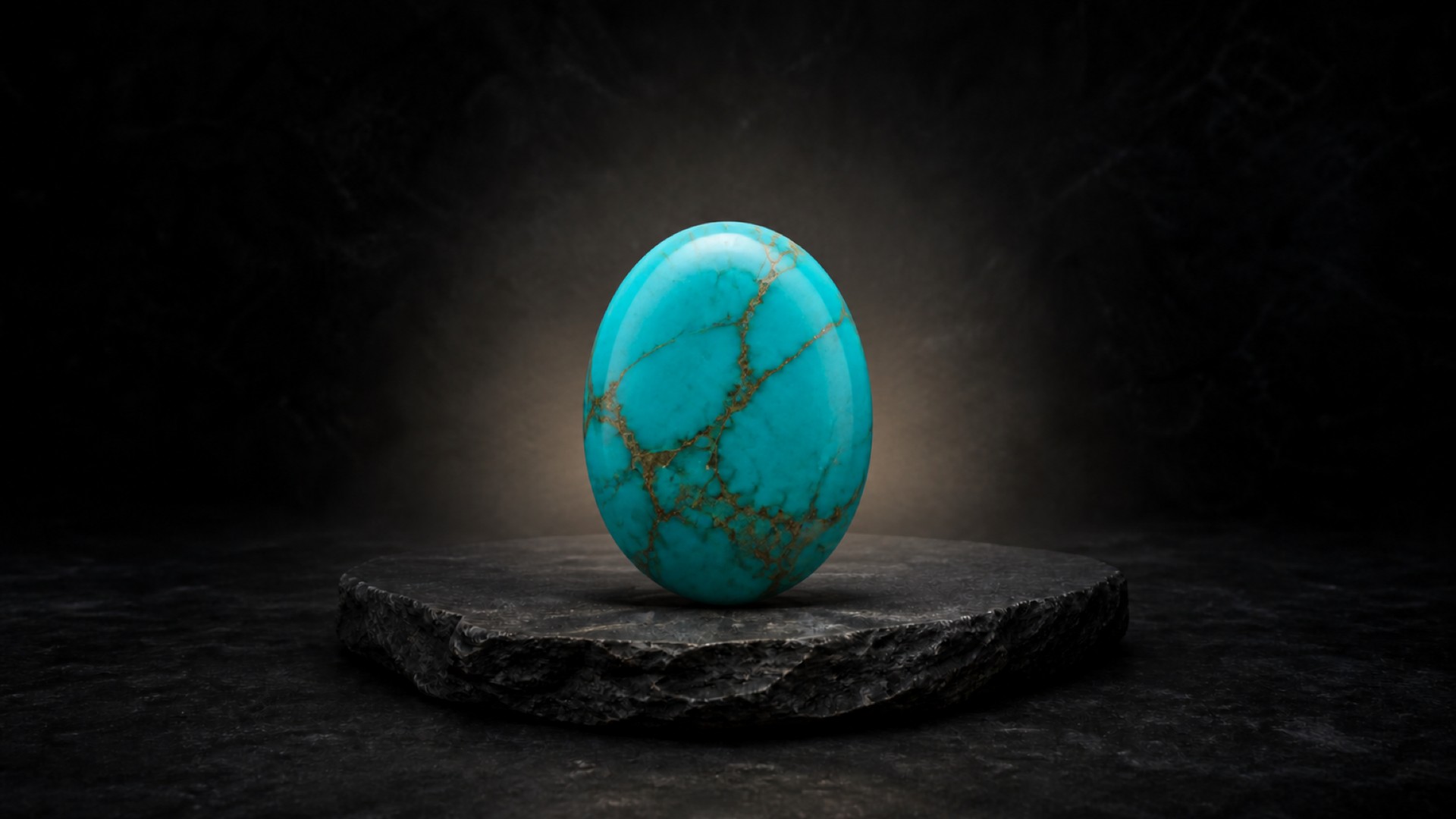
Cornerstone gemstone profile
Turquoise
Blue and green mineral color, matrix and a rich cultural record
AI-created master image · AI · Owned
Explore this profile
Definition
What is Turquoise?
Turquoise is a hydrated copper-aluminum phosphate mineral. Most gem material is an aggregate of extremely small crystals, rather than one large transparent crystal. Its beauty comes from bodycolor, surface texture, polish and the pattern of any surrounding rock retained in the stone. Natural origin, treatment and provenance are separate questions: a natural turquoise can be stabilized, and a convincing blue object can instead be an imitation. [1]
At a glance
Gemological properties
Measured values and material-specific properties are linked to their evidence. A dash means no canonical value is established here; consult the profile discussion for limitations.
| Gemstone | Turquoise | Mineral species | Turquoise |
|---|---|---|---|
| Mineral group | Phosphates | Family | — |
| Chemical formula | CuAl₆(PO₄)₄(OH)₈·4H₂O (ideal formula)[1] | Crystal system | Triclinic[1] |
| Mohs hardnessMohs hardnessA comparative scale of scratch resistance from 1 to 10; it does not measure toughness.Explore Mohs hardness | 5–6[2] | Specific gravitySpecific gravityThe ratio of a material’s density to the density of water under defined conditions.Explore Specific gravity | — |
| Refractive indexRefractive indexA measurement describing how light changes speed and direction as it enters a material.Explore Refractive index | — | BirefringenceBirefringenceThe numerical difference between a doubly refractive material’s principal refractive indices.Explore Birefringence | — |
| Optic character | Biaxial positive in individual crystals[1] | DispersionDispersionThe separation of white light into spectral colors because refractive index varies with wavelength.Explore Dispersion | — |
| Primary color | Blue[3] | PleochroismPleochroismDifferent body colors seen in some anisotropic gems when viewed along different crystallographic directions.Explore Pleochroism | — |
| LusterLusterThe character of light reflected from a material’s surface.Explore Luster | Vitreous in crystals; dull to waxy when massive[1] | Transparency | Transparent in crystals; translucent to opaque when massive[1] |
| CleavageCleavageA mineral’s tendency to split along specific crystallographic planes.Explore Cleavage | — | Fracture | Small conchoidal; smooth[1] |
| TenacityTenacityA material’s response to bending, breaking, crushing, or tearing.Explore Tenacity | — | Fluorescence | — |
| Streak | White to pale greenish blue[1] | Availability | Natural |
| Jewelry suitability | — | ||
Scope note: Values are cited reference figures, not guaranteed limits for every specimen. A single number may be a nominal value. Some properties describe a mineral species; others vary with composition, structure or treatment. Diamond RI is quoted at 589 nm; numeric dispersion uses the cited wavelength convention. A missing value is not zero and does not by itself mean “not applicable.” Consult the citations and discussion for scope and limitations.
Visual evidence
Documented media & editorial visuals
Every image is labeled by visual class. Documentary identity statements describe the source record and review status—not facts inferred from appearance alone.
Turquoise
- Identity
- Not applicable
AI · Owned
Polished turquoise in a Nishapur workshop
Polished stones photographed by Sonia Sevilla in the village of Ma’dan near Nishapur, Iran, and identified in the source as turquoise. The photograph documents a workshop assortment and its visible color and matrix variation. The location of the photograph does not independently prove the mine origin or treatment history of each stone.
- Identity
- Claimed by source
Polished turquoise in a Nishapur workshop — Sonia Sevilla, via Wikimedia Commons. CC0. Resized and padded to preserve the complete source composition; no retouching or color adjustment. · CC0 1.0 · Original source

Turquoise in the pectoral of Sithathoryunet
The pectoral of Sithathoryunet with the name of Senwosret II, The Metropolitan Museum of Art, object 16.1.3a,b, dated about 1887–1878 BCE. The museum identifies turquoise among its gold, carnelian, lapis lazuli and garnet materials. Not every blue inlay is turquoise. This Open Access image illustrates documented historical use, not modern gemstone identification.
- Identity
- Claimed by source
Turquoise in the pectoral of Sithathoryunet — The Metropolitan Museum of Art, Open Access, object 16.1.3a,b. CC0, via Wikimedia Commons. Photographer uncredited. Resized and padded to preserve the complete source composition; no retouching or color adjustment. · CC0 1.0 · Original source

Raw turquoise from Arizona
Photographer W.carter identifies this rough specimen as turquoise from Arizona. The image records its unpolished texture and matrix. Identity and locality follow the source record; treatment history and composition have not been independently established.
- Identity
- Claimed by source
Raw turquoise from Arizona — W.carter, via Wikimedia Commons. CC BY 4.0. Resized and padded to preserve the complete source composition; no retouching or color adjustment. · CC BY 4.0 · Original source

Mineralogy
Mineralogy & classification
The ideal mineral formula is CuAl₆(PO₄)₄(OH)₈·4H₂O. Turquoise belongs to its own mineral group and crystallizes in the triclinic system. Small individual crystals are unusual; nodules, vein fillings and compact masses are more familiar.
The mineral and the whole object need separate descriptions. A cabochon may contain turquoise, host-rock remnants, pores and treatment material. Those components help explain why measurements of a massive gem can differ from a mineralogical reference for a crystal. Crystallographic properties do not guarantee that an opaque aggregate will display an easily observable optical effect.
Sources [1]
Mineral identity
TurquoiseA mineral species in the turquoise group; most gem material is a fine-grained aggregate. [1]
Crystal system
TriclinicRare individual crystals and massive gem material have different observable appearances. [1]
Luster and transparency
Dull to waxy; commonly opaqueCrystals can be vitreous and transparent; massive material is commonly translucent to opaque. [1]
Chemistry
Chemistry & composition
Copper is an essential constituent of turquoise, not simply an optional trace impurity. Iron can substitute for some aluminum, while related turquoise-group compositions can involve other substitutions. Chemical composition describes part of the material; pore space, water and associated minerals also affect its appearance.
A laboratory analysis samples a particular area or volume. Matrix, a coating or a filler may contribute to the result. An interpretation should therefore identify what was tested and whether the result describes turquoise itself or the entire composite object.
Ideal formula
CuAl₆(PO₄)₄(OH)₈·4H₂OThe Handbook formula is used; composition and water-related observations need sample-specific context. [1]
Color
Color science
Copper-related absorption is central to turquoise’s blue color. Iron-bearing material can absorb additional violet light and shift the appearance toward green; the 2022 study of porcelain-treated turquoise related stronger iron features to greener samples. This is more useful than treating blue and green as two unrelated stones.
Color also depends on structure, porosity, scattering and material condition. Filling pores can deepen apparent color without adding a blue dye, while dyeing changes the explanation again. Green is therefore neither proof of treatment nor proof of a particular mine. Yellowish or brown areas may include associated minerals rather than a uniform change in the turquoise itself.
Optics
Optical properties
A gemological reference gives refractive indices of about 1.610–1.650 and a specific-gravity reference of 2.76 with a broad asymmetric tolerance, equivalent to roughly 2.40–2.90. These are reference values, not an acceptance test for every porous, matrix-bearing or treated piece.
Individual turquoise crystals are biaxial positive, with directional refractive indices. In an opaque fine-grained cabochon, however, routine observation does not resolve birefringence the way it can in a transparent single crystal. “Not detectable” in an aggregate reference should not be read as “the mineral has no birefringence.” Surface quality and the test method matter.
Reference refractive index
1.610–1.650Broad gemological reference; a spot observation on opaque material is not a full set of directional measurements. [3]
Reference specific gravity
About 2.40–2.90Equivalent to GIA’s 2.76 (+0.14, −0.36). Porosity, matrix and treatment affect interpretation. [3]
Optical character
Biaxial positiveA crystal-level classification; birefringence is not routinely resolved in an opaque cryptocrystalline cabochon. [1]
Durability
Hardness & durability
The familiar Mohs reference is 5–6. That describes scratching, not the force required to crack a piece or detach a weak area of matrix. Porous or poorly consolidated rough can behave differently from compact gem material. A polished surface should not be treated as evidence that the entire stone has uniform strength.
For rings and bracelets, our practical preference is a setting that shields edges and supports the stone. Remove the jewelry before abrasive work. Earrings and pendants usually encounter fewer impacts, although their stones still need protection from chemicals and careless storage.
Pores can admit skin oils, cosmetics and other contaminants, altering color or surface appearance. A compact stone and a chalky, open-textured piece do not respond identically. Stabilization can improve the usefulness of porous material, but does not make it immune to heat, solvents or mechanical damage.
Judge durability at the level of the actual object: inspect cracks, the edge, matrix contacts, adhesive layers and the mounting. Untreated is a treatment description, not a universal durability score. A well-disclosed stabilized stone may be a sensible choice for a particular design.
Hardness means scratch resistance. It is not a universal durability score and does not equal toughness.
Mohs hardness
5–6A scratching reference, not a uniform toughness or wear score. [7]
Formation
Geology & formation
Turquoise commonly develops when copper-bearing fluids interact with aluminum- and phosphate-bearing material during alteration near the surface. Many famous deposits occur in dry landscapes. Fractures and pores provide spaces where mineral-bearing water can move and turquoise can accumulate.
The details differ between deposits. A 2024 study of Tianhu East in Xinjiang proposed supergene weathering of black shale as the source of important elements, with turquoise precipitating in quartzite fissures. That case demonstrates why one simple copper-mine diagram cannot represent every deposit. Host rock, fluid pathways and the source of phosphorus deserve attention alongside copper.
Locations
Where Turquoise occurs
Documented turquoise localities include Iran’s Nishapur region; Arizona, Nevada and New Mexico in the United States; and districts in China including Hubei. Egypt also has an important turquoise history. An occurrence list is not a current production register.
Kingman and Sleeping Beauty are established Arizona source names, but a seller’s mine label needs its own supporting documentation. “Persian blue” can describe a color even when a stone was not mined in Iran. Similarly, a geographic or cultural trade label should not be silently upgraded into verified mine provenance. Retain the original label, seller’s statement and any independent evidence separately.
Inclusions
Inclusions & internal features
Matrix is material associated with the rock in which turquoise formed. It may remain as patches or fine branching seams after cutting. The term spiderweb describes an attractive network of these lines; it is a pattern description, not a mineral species or an origin certificate. Cutters balance color, pattern, soundness and yield when deciding what to retain.
Not every dark mark has the same cause. Published field studies identify associated minerals such as quartz, iron oxides and sulfates in particular deposits. Manufactured matrix effects also exist, including material placed in cavities to resemble pyrite. Magnification and appropriate analysis help distinguish observations from assumptions. A web-like appearance alone cannot establish locality, treatment or authenticity.
Treatments
Treatments & disclosure
Stabilization commonly refers to introducing material into pores to make weak turquoise more workable and improve its appearance or stability. Resins, waxes and oils do not have identical effects or care requirements. A transparent filler can change light scattering and deepen apparent color; a colored filler can combine impregnation with dyeing. The word stabilized is therefore only a starting point for disclosure.
Other processes need their own names. The Zachery treatment reduces porosity without conventional polymer impregnation and can improve polish; published research used chemical analysis to distinguish treated material. Inorganic treatments marketed as porcelain enhancement present further challenges. No single visual cue or ultraviolet reaction reliably separates every treatment.
For a purchase, request the material identity, treatment description and any limitations of testing in writing. Disclosure helps explain both price and future care. Stabilized natural turquoise is not automatically an imitation, while a claim of untreated material does not establish superior workmanship, strength or provenance.
Stabilization
Treatment of natural materialPore filling may improve workability and appearance; it must be distinguished from a manufactured composite. [5]
Natural vs synthetic
Natural, laboratory-grown & simulant
A backing is a separate support layer attached beneath a stone. It should be disclosed, especially when a closed setting hides it. Reconstituted or composite products combine fragments or powders with a binder; their composition should be stated rather than left to an ambiguous trade name.
Dyed howlite, carbonate minerals such as magnesite, glass, plastic and ceramic products can resemble turquoise. Their blue color does not make them the mineral turquoise. Older research used the label synthetic turquoise for some Gilson material, while modern educational references describe a ceramic imitation. Because product composition and terminology vary, report the tested material rather than treating every manufactured blue product as one substance.
A historical study also found products sold as reconstructed turquoise whose major identified mineral was gibbsite. That is a warning about names, not a claim that every present-day composite has the same recipe.
Identification
How gemologists identify Turquoise
Identification asks what the object is; treatment testing asks what has been done to it; provenance asks where it came from. These questions may need different evidence. Microscopy, density observations, infrared spectroscopy, Raman spectroscopy, diffraction or chemical analysis can contribute, depending on the specimen.
A 2015 laboratory case used spectroscopic evidence to identify both impregnation and dye in a green turquoise sphere. It does not follow that every green sphere is treated. Similarly, the absence of an obvious polymer signal does not exclude treatments that use inorganic substances. Avoid hot needles, scratches, acid or solvent experiments on jewelry: they risk damage and do not replace an appropriately scoped laboratory report.
Matrix and origin
Pattern alone is insufficientPreserve documentary provenance; a color or pattern name is not a mine certificate. [10]
Value factors
Value factors
Color, texture, polish, matrix pattern and workmanship all contribute to appeal. An even blue cabochon and a strongly patterned green stone may serve different artistic purposes. Our suggestion is to compare pieces under the same ordinary lighting, then examine their surfaces and edges under magnification.
A mine-name premium requires evidence for the mine claim. A treatment premium requires credible disclosure. Carat weight alone says little about the quality of a carving or an inlaid jewel, where design and craftsmanship can be central. Avoid treating a seller’s descriptive grade as a universal gemological standard.
Sources [10]
Buying guide
How to buy Turquoise
Ask whether the piece is natural turquoise, a treated natural stone, a composite or an imitation. Request the specific enhancement, including dye, resin, wax, oil or backing when known. Ask what evidence supports the locality and whether the return terms permit independent examination.
Look at the underside when possible, and ask about repairs or hidden support layers. For an important purchase, discuss the exact identification question with a laboratory before paying for a report. Choose treatment and durability characteristics that fit the intended jewelry, then keep the invoice and disclosures with it. These are practical buying steps, not a promise that price or appearance proves authenticity.
Collector guide
Collector’s guide to Turquoise
A useful collection can compare rough vein material, nodules, polished cabochons, patterned stones and documented historic jewelry. Record identity, dimensions, source label, acquisition history, treatments and repairs separately. A locality label belongs to a particular specimen; it should not become a visual rule for identifying the next blue stone.
Unusual banding can be scientifically interesting. A study of six Zhushan specimens examined differently colored layers rather than assigning a cause from appearance alone. Historical jewelry adds questions about maker, date, restoration and cultural context. Collectors can value these different kinds of evidence without assuming investment performance or an unsupported rarity ranking.
Patterned material
Document the specimenBanded turquoise has been studied in particular Zhushan samples; the pattern is not universal origin proof. [16]
Care
Turquoise care card
Use warm water with mild soap and a soft cloth or brush, then rinse and dry gently. Avoid steam and ultrasonic cleaning. Keep perfume, cosmetics, cleaning chemicals and heat away from the stone; discuss any repair with a jeweler who knows its identity and treatment history.
Turquoise is generally stable to ordinary light, so sunlight should not be blamed for every color change. Absorbed substances, heat and treatments may matter. Store pieces separately to reduce abrasion. When the enhancement or assembly is unknown, ask for care advice specific to the jewel before using a chemical cleaner.
Sources [7]
Cleaning
Gentle warm soapy waterAvoid ultrasonic and steam cleaning, harsh chemicals and heat. [7]
History
History & etymology
Turquoise appears in very different artistic traditions. The Metropolitan Museum’s Middle Kingdom pectoral of Sithathoryunet, dated about 1887–1878 BCE, combines turquoise with gold and other stones. Its museum record ties the object to Lahun and the name of Senwosret II, providing a specific archaeological context rather than a generic story about ancient jewelry.
In Mesoamerica, the British Museum’s double-headed serpent uses turquoise mosaic on a wooden support with shell details. The museum associates it with Mexico and the late pre-Hispanic period; its precise original use remains qualified.
Southwestern North American jewelry is equally deserving of specificity. Diné, Zuni, Hopi and Rio Grande Pueblo artists have distinct and evolving traditions, represented in the Heard Museum’s collection. Identify the maker and community when documented; a turquoise setting alone does not establish either. Iran’s long association with the material also survives in trade language such as Persian blue, which must be separated from proven origin.
Short answers
Turquoise questions, answered
Is stabilized turquoise fake?+
Not necessarily. Stabilization can treat natural turquoise. A composite or imitation is a different material category; ask for the actual composition and enhancement. [5]
Why can turquoise be green?+
Iron-related absorption can contribute to green color, while texture, porosity and treatments also affect appearance. Green alone does not prove dyeing. [4]
What is spiderweb turquoise?+
Turquoise with a network-like matrix pattern. The pattern does not by itself establish a mine, country or treatment history. [10]
Does Persian blue mean mined in Iran?+
No. Persian blue is also used as a color description. Iranian origin requires separate evidence. [10]
How hard is turquoise?+
The usual reference is Mohs 5–6. Porosity, matrix and material condition also affect how a particular stone wears. [3]
Can turquoise go in an ultrasonic cleaner?+
No. Use gentle warm soapy-water cleaning and avoid steam, ultrasonic cleaning and harsh chemicals. [7]
Can skin oils change turquoise?+
Porous material can absorb oils and other substances that change its appearance. Avoid cosmetics and perfumes on the stone. [2]
Is blue color proof that turquoise is untreated?+
No. Color can be influenced by dye, filling and other enhancement. Disclosure and appropriate testing are more useful than appearance alone. [6]
What is turquoise backing?+
A separate support layer attached beneath the stone. It should be disclosed, including when a setting conceals it. [12]
Is reconstituted turquoise the same as one natural stone?+
No. The term generally describes a manufactured product made from smaller constituents and binder; ask exactly what those constituents are. [14]
Can howlite imitate turquoise?+
Yes. Dyed howlite is a documented imitation. Its appearance should not replace professional identification. [12]
Does a dark matrix identify a mine?+
No. Similar-looking patterns occur in different material, and artificial matrix effects exist. Provenance needs independent support. [9]
Does turquoise fade in ordinary light?+
It is generally light-stable, but heat and absorbed chemicals can alter appearance. Treatment history can add further care limits. [7]
Is all turquoise formed in the same rock?+
No. Turquoise occurs in several geological settings; the source of its elements and the rock hosting precipitation can differ. [8]
Is a higher price proof of authenticity?+
No. Separate material identification, treatment disclosure, workmanship and documented provenance when evaluating a price. [14]
Is turquoise a December birthstone?+
Yes. It is one of the gemstones associated with December. [9]
Evidence
References & further reading
Citation numbers are deduplicated across properties, claims, sections, structured modules, treatments, inclusions, FAQs, and related educational records.
- [1]Handbook of Mineralogy / Mineral Data Publishing. Turquoise.
Handbook of Mineralogy / Mineral Data Publishing
- [2]Turquoise Description.
Gemological Institute of America
- [3]GIA. Turquoise Gemstone Overview.
GIA
- [4]Liying Huang; Quanli Chen; Yan Li; Zuowei Yin; Fengshun Xu; Xinxin Gao; Yang Du. Composition and Spectral Characteristics of Porcelain-Treated Turquoise.
GIA / Gems & Gemology · 2022
- [5]Ling Liu; Mingxing Yang; Yan Li; Jingru Di; Ruoxi Chen; Jia Liu; Chong He. Technical Evolution and Identification of Resin-Filled Turquoise.
GIA / Gems & Gemology · 2021
- [6]Wen Han; Taijin Lu; Huiru Dai; Jun Su; Hui Dai. Impregnated and Dyed Turquoise.
GIA / Gems & Gemology · 2015
- [7]GIA. Turquoise Care and Cleaning Guide.
GIA
- [8]Ling Liu; Mingxing Yang; Qiaoqiao Li; Yi Tang; Huilin Wen; Ye Yuan; Yan Li; Jia Liu. Mineralogy and Geochemistry of Turquoise from Tianhu East, Xinjiang, China.
GIA / Gems & Gemology · 2024
- [9]GIA. December Birthstones.
GIA
- [10]GIA. Turquoise Quality Factors.
GIA
- [11]Emmanuel Fritsch; Shane F. McClure; Mikhail Ostrooumov; Yves Andres; Thomas Moses; John I. Koivula; Robert C. Kammerling. The Identification of Zachery-Treated Turquoise.
GIA / Gems & Gemology · 1999
- [12]Jewelers of America. Gem Treatment Guide.
Jewelers of America
- [13]GIA. An Introduction to Imitation Diamonds and Other Gems.
GIA
- [14]Th. Lind, K. Schmetzer, and H. Bank. The Identification of Turquoise by Infrared Spectroscopy and X-Ray Powder Diffraction.
Gems & Gemology · 1983 · Vol. 19 (3) · pp. 164–168
- [15]GIA. Turquoise Buying Guide.
GIA
- [16]Tianting Lei; Yan Li; Fengshun Xu; Mingxing Yang. Banded Turquoise from Zhushan County, Hubei Province, China.
GIA / Gems & Gemology · 2021
- [17]Heard Museum. Jewelry Collection.
Heard Museum
- [18]The Metropolitan Museum of Art. Pectoral and Necklace of Sithathoryunet with the Name of Senwosret II.
The Metropolitan Museum of Art
- [19]British Museum. Double-headed serpent turquoise mosaic.
British Museum