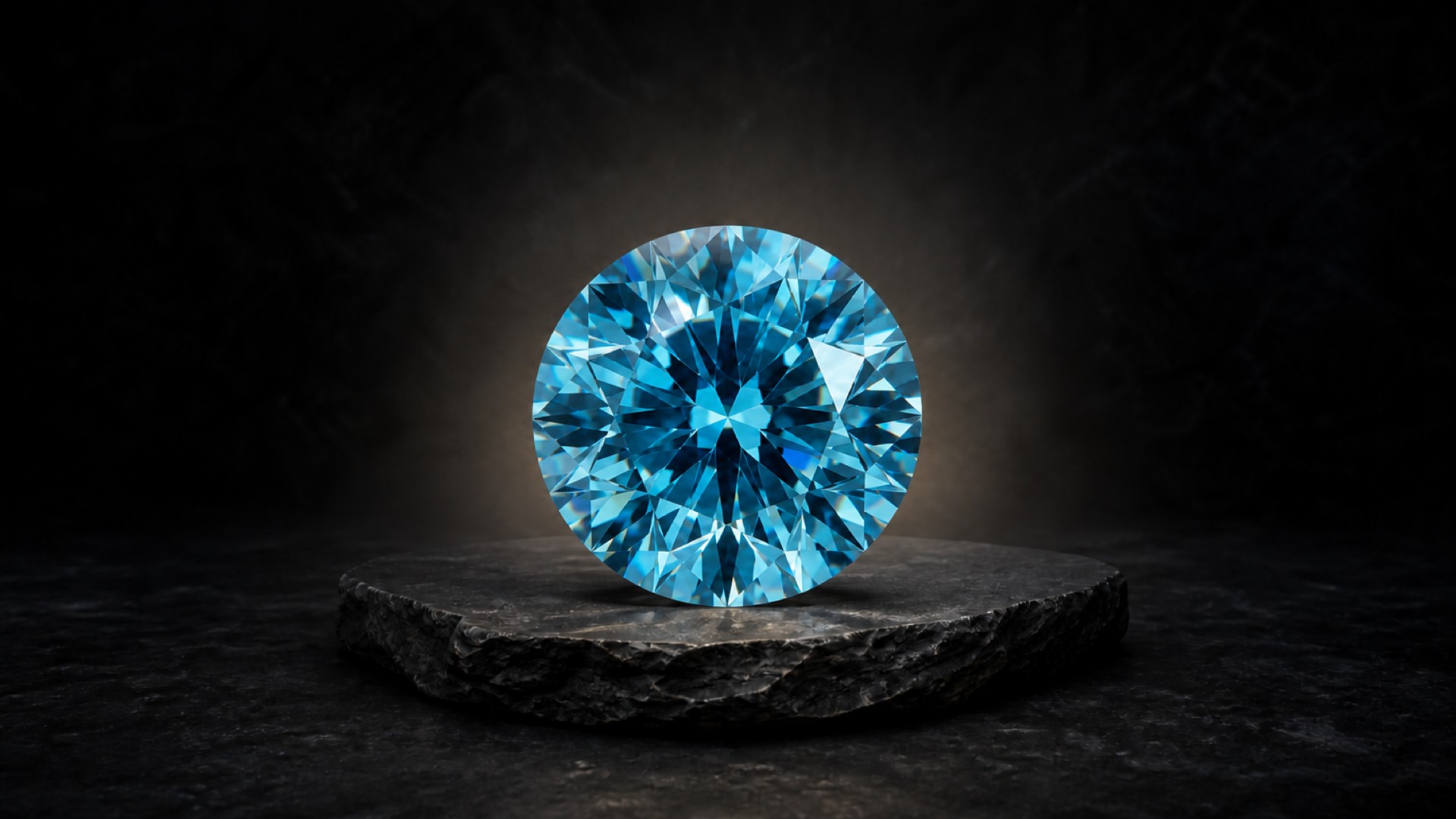
Cornerstone gemstone profile
Zircon
Natural brilliance, structural change and a record of deep time
AI-created master image · AI · Owned
Explore this profile
Definition
What is Zircon?
Zircon is the mineral zirconium silicate, ZrSiO₄. Its optical properties and density vary with crystalline order and radiation-related structural damage. Natural origin, heat treatment and the use of a different material as an imitation are separate questions. [1]
At a glance
Gemological properties
Measured values and material-specific properties are linked to their evidence. A dash means no canonical value is established here; consult the profile discussion for limitations.
| Gemstone | Zircon | Mineral species | Zircon |
|---|---|---|---|
| Mineral group | Silicates | Family | — |
| Chemical formula | ZrSiO₄[1] | Crystal system | Tetragonal; may become metamict[2] |
| Mohs hardnessMohs hardnessA comparative scale of scratch resistance from 1 to 10; it does not measure toughness.Explore Mohs hardness | 6–7.5[1] | Specific gravitySpecific gravityThe ratio of a material’s density to the density of water under defined conditions.Explore Specific gravity | 3.9–4.73[1] |
| Refractive indexRefractive indexA measurement describing how light changes speed and direction as it enters a material.Explore Refractive index | — | BirefringenceBirefringenceThe numerical difference between a doubly refractive material’s principal refractive indices.Explore Birefringence | — |
| Optic character | Uniaxial positive; may be isotropic when metamict[2] | DispersionDispersionThe separation of white light into spectral colors because refractive index varies with wavelength.Explore Dispersion | — |
| Primary color | Multicolor[1] | PleochroismPleochroismDifferent body colors seen in some anisotropic gems when viewed along different crystallographic directions.Explore Pleochroism | Weak[2] |
| LusterLusterThe character of light reflected from a material’s surface.Explore Luster | Vitreous to adamantine; greasy when metamict[2] | Transparency | Transparent to opaque[2] |
| CleavageCleavageA mineral’s tendency to split along specific crystallographic planes.Explore Cleavage | Indistinct {110} and {111}[2] | Fracture | Conchoidal[2] |
| TenacityTenacityA material’s response to bending, breaking, crushing, or tearing.Explore Tenacity | Brittle[2] | Fluorescence | — |
| Streak | White[2] | Availability | Natural |
| Jewelry suitability | — | ||
Scope note: Values are cited reference figures, not guaranteed limits for every specimen. A single number may be a nominal value. Some properties describe a mineral species; others vary with composition, structure or treatment. Diamond RI is quoted at 589 nm; numeric dispersion uses the cited wavelength convention. A missing value is not zero and does not by itself mean “not applicable.” Consult the citations and discussion for scope and limitations.
Visual evidence
Documented media & editorial visuals
Every image is labeled by visual class. Documentary identity statements describe the source record and review status—not facts inferred from appearance alone.
Zircon
- Identity
- Not applicable
AI · Owned
Zircon in the Nantes museum collection
Zircon specimens displayed at the Muséum de Nantes, photographed by Koreller. The display identifies material from Sri Lanka (historically Ceylon) and Madagascar without assigning each stone individually. Display lighting influences the colors; no treatment determination is claimed.
- Identity
- Claimed by source
Zircon in the Nantes museum collection — Koreller, via Wikimedia Commons. CC BY-SA 4.0. Resized and padded to preserve the complete source composition; no retouching or color adjustment. Derivatives are shared under CC BY-SA 4.0. · CC BY-SA 4.0 · Original source

Rough zircon from Madagascar
Photographer-identified zircon from Madagascar in the Muséum de Nantes collection. This photograph documents variations in rough appearance; it does not establish treatment history or gemological measurements.
- Identity
- Claimed by source
Rough zircon from Madagascar — Koreller, via Wikimedia Commons. CC BY-SA 4.0. Resized and padded to preserve the complete source composition; no retouching or color adjustment. Derivatives are shared under CC BY-SA 4.0. · CC BY-SA 4.0 · Original source

Mineralogy
Mineralogy & classification
Crystalline zircon belongs to the tetragonal system. Over geological time, decay of trace radioactive constituents can disrupt the atomic arrangement, a process called metamictization. The terms high, intermediate and low zircon describe the resulting range of structural and physical states. They are not quality grades. A handsome gem and an interesting geological specimen may be valued for very different reasons; neither should be judged by interpreting “low” as a commercial ranking.
Sources [4]
Mineral identity
Zircon — zirconium silicateThe ideal formula is ZrSiO₄. Cubic zirconia is a different material, not a synthetic version of zircon. [2]
Crystal structure
Tetragonal when crystallineRadiation damage can disrupt long-range order. High, intermediate and low describe structural states rather than commercial quality grades. [4]
Chemistry
Chemistry & composition
The ideal formula records zirconium, silicon and oxygen. Real crystals can incorporate other constituents, including hafnium and trace uranium or thorium. Their amounts and the crystal’s subsequent history matter: radiation damage changes structural order, while heating can partly restore it. A formula alone therefore cannot predict a specimen’s refractive index, density or color. Trace-element analysis and measurements of structural order answer questions that a photograph cannot.
Color
Color science
Zircon occurs in blue, colorless, yellow, brown, orange, red and green material. Color can reflect several interacting influences, including trace chemistry, defects, radiation-related alteration and heating. It is misleading to assign every zircon color to one element. For blue material, published research discusses uranium-related mechanisms, but the explanation should retain the uncertainty of the study rather than turn a proposed mechanism into a universal diagnostic rule. A green color alone does not establish a low structural state.
Optics
Optical properties
Refractive index describes how strongly a material bends light. Dispersion describes how differently it bends different wavelengths, producing colored flashes called fire. Birefringence is a different property: the difference between directional refractive indices. Well-crystallized zircon is uniaxial positive and can show conspicuous double refraction. Through a suitably oriented faceted stone, rear facet edges may look doubled under magnification. The effect depends on direction, cut and structural state; absence of obvious doubling in one view does not rule out zircon.
GIA lists hardness of 6–7.5 and specific gravity of 3.90–4.73 across low-to-high zircon, with birefringence extending from effectively zero to 0.059. Its reference RI values are separately organized by structural state. High zircon’s reference range must not be applied to every zircon. A useful report records the measured result, method and material condition. These distinctions also explain why mineralogical tables for crystalline zircon can differ from broad gemological ranges without either necessarily being wrong.
Refractive index: high zircon
1.925–1.984 (reference tolerance ±0.040)High-state reference values. Do not apply this range to intermediate or low zircon. [1]
Refractive index: intermediate zircon
1.875–1.905 (reference tolerance ±0.030)Intermediate-state reference values; the specimen’s condition is part of their interpretation. [1]
Refractive index: low zircon
1.810–1.815 (reference tolerance ±0.030)Low-state reference values. A low structural state is not a quality grade. [1]
Birefringence across structural states
0.000–0.059The broad range includes strongly damaged material and crystalline zircon. Facet doubling depends on direction as well as structural state. [1]
Durability
Hardness & durability
Hardness measures resistance to scratching; it does not describe resistance to chipping. Zircon is brittle, and edges can acquire wear when stones rub together. A ring can be enjoyed with sensible protection, but rough handling and exposed corners increase the chance of damage. Examine facet junctions and the girdle before buying an older stone. For storage, give each piece its own padded compartment. Our practical recommendation is to choose a setting that shields vulnerable edges.
Hardness means scratch resistance. It is not a universal durability score and does not equal toughness.
Mohs hardness
6–7.5Scratch resistance varies with material condition. The Mohs scale does not measure resistance to chipping. [1]
Wear consideration
Brittle; protect facet edgesAvoid impacts, abrasion during storage, steam and ultrasonic cleaning. Gentle soapy water is the recommended cleaning method. [8]
Formation
Geology & formation
Uranium incorporated into a zircon can decay to lead. Measuring isotopic relationships allows geologists to investigate when parts of a crystal formed, while checking for later disturbance. Some Jack Hills zircons preserve evidence extending back about 4.4 billion years. This exceptional record belongs to specifically studied grains. It is not a default age for commercial zircon. A loose jewelry stone needs its own scientific evidence before an ancient-age claim becomes more than a sales story.
Zircon occurs as an accessory mineral in igneous and metamorphic rocks and can also accumulate in sediments after weathering and transport. A detrital zircon is a grain moved from its original rock into a later sedimentary setting. Its survival makes it useful to geological research. The age of a surviving crystal can differ substantially from the age of the sediment containing it, and neither tells us when a modern ring was made.
Specific gravity
3.90–4.73 across low-to-high materialThis published broad range is retained. Density should be interpreted together with structural state and other measurements. [1]
Locations
Where Zircon occurs
Published geological and gemological references document zircon in Sri Lanka, Cambodia, Myanmar, Tanzania, Madagascar and Australia, among many other places. Mogok is already represented in this encyclopedia’s geographic records as historic production. A country list is not a current mining forecast. Keep locality labels with specimens, but distinguish a dealer’s attribution from independently documented provenance. A stone’s color or crystal habit cannot by itself establish the mine from which it came.
Mogok Stone Tract
GIA field reporting documents zircon production in the Mogok Stone Tract. [13]
- Production
- Historic production documented
- Coordinates
- Approximate locality position
Origin caution: locality relationships do not by themselves prove geographic origin for an individual stone.
Inclusions
Inclusions & internal features
Zircon can show growth-related zoning, internal cloudiness and fractures. Published observations include discoid tension features and occasional material displaying a cat’s eye. Those features require their own observational context. An inclusion photograph should describe the actual documented specimen and magnification, rather than imply that every zircon contains the same feature. Visible internal material may interest a collector, while a surface-reaching fracture may matter more to a wearer concerned with durability.
Treatments
Treatments & disclosure
Heating is important in producing blue and colorless zircon. Appropriate brown material can develop blue under reducing conditions, but results depend on the starting material and treatment. Do not infer an individual stone’s treatment history from a blue photograph. Ask for written disclosure and read the scope of any laboratory conclusion. Research combining chemistry and Raman spectroscopy suggests ways of investigating some treatments; it does not justify promising that every heated zircon can always be recognized.
Blue zircon is not uniformly immune to color change. A published experiment documented browning after long-wave ultraviolet exposure in the studied material, with subsequent changes under visible light. This is a reason to discuss care and treatment with the seller, not a prediction that every blue zircon will behave identically. If a stone changes appearance, seek professional advice; home irradiation or heating experiments can damage jewelry and do not establish its original treatment history.
Natural vs synthetic
Natural, laboratory-grown & simulant
Zircon is ZrSiO₄; cubic zirconia is stabilized cubic ZrO₂; diamond is crystalline carbon. Common jewelry CZ is manufactured as a simulant, not grown as zircon. Its cubic optical behavior also differs from strongly birefringent crystalline zircon. Diamond is substantially harder than either, but hardness alone is not a complete identification method. Similar sparkle does not establish identity. A report should name the material explicitly instead of relying on ambiguous phrases such as “created zircon.”
Zircon itself has also been made in a laboratory. Hanchar and colleagues grew zircon crystals from a lithium-molybdenum flux for a 2001 study of trace-element incorporation. That research concerns synthetic zircon with the zircon mineral structure; it does not turn cubic zirconia into zircon, and it does not establish a retail supply of laboratory-grown zircon jewelry. Keep crystal origin, heat treatment and the use of a different mineral as a look-alike separate when reading a seller’s description.
Experimental synthesis
Flux-grown zircon has been studiedLaboratory crystals in a trace-element study do not demonstrate a commercial supply of synthetic zircon jewelry. [15]
Identification
How gemologists identify Zircon
Gemologists combine optical behavior, density when measurable, magnification and other appropriate tests. Zircon’s state-dependent properties make a single universal cutoff misleading. For a mounted stone, the setting can limit what can be measured. Strong facet doubling is useful supporting evidence in some specimens, but one photograph is not a laboratory identification. An identification report is also different from a quality grade or a guarantee of geographic origin.
Value factors
Value factors
An appealing zircon balances color, clarity, proportion and finish. Look for uneven brightness, a conspicuous window and damaged facet edges. A transparent stone may show stronger fire in suitable lighting, but a lively sales video does not establish treatment status. Compare dimensions as well as weight, and compare stones with similar disclosed histories. Our buying recommendation is to obtain a written material description, treatment information and return terms before paying a premium for a special claim.
Collector guide
Collector’s guide to Zircon
A zircon collection can explore contrasting colors, crystal habits, localities and structural states. Keep a specimen label, acquisition record and any analytical report together. Distinguish a crystallographic classification from an aesthetic preference, and a source attribution from a tested origin. An unusual crystal or inclusion can be worth studying without an unsupported rarity claim. Geological significance is a strong reason to collect; it is not evidence of future financial return.
Care
Zircon care card
Use lukewarm soapy water and a soft cleaning tool, rinse gently and dry without abrasive rubbing. Avoid ultrasonic and steam cleaning. Store zircon separately from other gems, and remove rings before activities likely to strike or scrape them. Tell the jeweler the material and disclosed treatments before repair, since heat can affect color. These are practical precautions for enjoying the stone, rather than a suggestion that zircon cannot be worn as jewelry.
Sources [8]
History
History & etymology
Colorless zircon was used as a diamond look-alike before modern synthetic simulants became widespread. Victorian jewelry also featured blue zircon, and the proposed trade name “starlite” never became established. Older names do not substitute for a modern mineral identification.
Stories connecting zircon with sleep, wisdom or prosperity belong to its cultural history. They do not demonstrate therapeutic effects. The age of zircon as a mineral is another, separate subject: dating a particular geological grain requires analytical evidence, and an ancient name or a vintage setting does not establish the age of the crystal in a jewel.
Short answers
Zircon questions, answered
Is zircon the same as cubic zirconia?+
Is heated zircon still natural zircon?+
Heating changes a natural stone’s condition or color; it does not mean the crystal was grown in a laboratory. Treatment should still be disclosed. [5]
What do high and low zircon mean?+
They describe structural and physical states related to radiation damage. They are not grades of beauty, workmanship or commercial quality. [4]
What is metamictization?+
It is radiation-related loss of crystalline order over time. In zircon, this can change density and optical properties without changing its familiar gem name. [4]
Does every zircon show facet doubling?+
No. Visibility depends on crystallinity, orientation and cut. A single view without obvious doubling cannot exclude zircon. [7]
Why is one hardness number misleading?+
Is every blue zircon untreated?+
No. Heat treatment is important in producing blue zircon. A photograph cannot establish the treatment history of an individual stone. [5]
Can blue zircon change color?+
Some studied stones changed after ultraviolet exposure. The finding is specimen dependent, so ask about care rather than assuming all blue zircon behaves identically. [10]
Can zircon be worn in a ring?+
Yes, with appropriate protection and care. Avoid impacts and inspect exposed facet edges for wear. A protective setting is a practical design choice. [8]
How should zircon be cleaned?+
Use lukewarm soapy water and gentle handling. Steam and ultrasonic cleaning are not recommended. [8]
Are all zircons billions of years old?+
No age should be assigned without evidence. Very ancient Jack Hills grains are specifically studied examples, not a default age for jewelry zircon. [12]
What is detrital zircon?+
A zircon grain eroded from earlier rock and transported into sediment. Its crystallization age can predate the sediment containing it. [11]
Does green color prove low zircon?+
Does a lab report give zircon a quality grade?+
An identification report describes material and relevant detectable characteristics. It should not be assumed to provide a commercial quality grade or origin conclusion. [9]
What should a collector keep with a specimen?+
Retain locality labels, acquisition records and analytical reports. Treat undocumented attribution as a claim rather than verified provenance. [11]
Evidence
References & further reading
Citation numbers are deduplicated across properties, claims, sections, structured modules, treatments, inclusions, FAQs, and related educational records.
- [1]Zircon Gemstone Overview.
Gemological Institute of America
- [2]Zircon.
Handbook of Mineralogy / Mineral Data Publishing
- [3]Kurt Nassau / GIA / Gems & Gemology. Cubic Zirconia An Update.
Kurt Nassau / GIA / Gems & Gemology
- [4]Zircon Description.
GIA
- [5]Chemical Analysis of Zircon.
GIA / Gems & Gemology
- [6]Zircon Quality Factors.
GIA
- [7]Zircon A Very Old Gemstone.
Henry A. Hänni / Journal of the Gemmological Association of Hong Kong / SSEF
- [8]Zircon Care and Cleaning Guide.
GIA
- [9]Zircon Buyer’s Guide.
GIA
- [10]Reversible Color Modification of Blue Zircon by Long-Wave Ultraviolet Radiation.
GIA / Gems & Gemology
- [11]Geoscience Australia. Zircon.
Geoscience Australia
- [12]California Institute of Technology. Ancient Zircon Crystals Provide a Window into Early Earth History.
California Institute of Technology
- [13]Vincent Pardieu, Andrew Lucas, and GIA field team. Mogok Expedition Series, Part 1: The Valley of Rubies.
Gemological Institute of America · 2014
- [14]GIA. An Introduction to Simulants or Imitation Gem Materials.
GIA
- [15]John M. Hanchar; Robert J. Finch; Paul W. O. Hoskin; E. Bruce Watson; Daniele J. Cherniak; Anthony N. Mariano. Rare earth elements in synthetic zircon: Part 1. Synthesis, and rare earth element and phosphorus doping.
American Mineralogist · 2001 · Vol. 86 (5–6) · pp. 667–680
- [16]GIA. Zircon History and Lore.
GIA