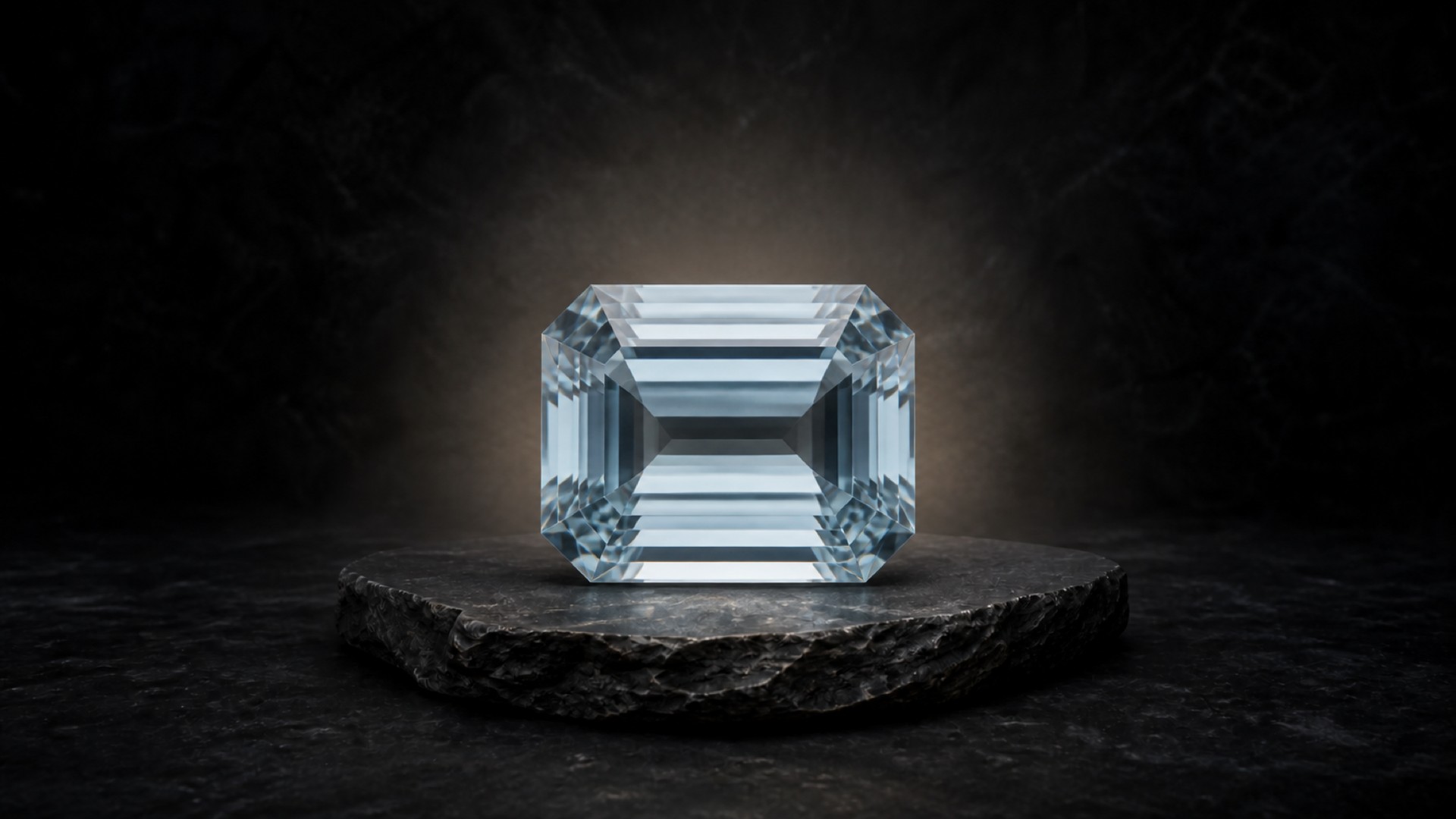
Cornerstone gemstone profile
Aquamarine
Blue to greenish-blue Beryl colored by iron
- Species
- Beryl
AI-created master image · AI-generated editorial reference illustration
Explore this profile
Definition
What is Aquamarine?
Aquamarine is the blue to greenish-blue gem variety of Beryl, Be₃Al₂Si₆O₁₈. Ferrous and ferric iron in different lattice and channel environments contribute blue, green, and yellow components; heat commonly reduces yellow-green components to produce a bluer appearance. [1,2]
At a glance
Gemological properties
Measured values and species-level properties are linked to their evidence. “Pending” means the value has not cleared review.
| Gemstone | Aquamarine | Mineral species | Beryl |
|---|---|---|---|
| Mineral group | Silicates | Family | Beryl |
| Chemical formula | Be₃Al₂Si₆O₁₈[1,2] | Crystal system | Hexagonal[1,2] |
| Mohs hardnessMohs hardnessA comparative scale of scratch resistance from 1 to 10; it does not measure toughness.Learn more | 7.5–8[1,3] | Specific gravitySpecific gravityThe ratio of a material’s density to the density of water under defined conditions.Learn more | 2.68–2.74[1,2] |
| Refractive indexRefractive indexA measurement describing how light changes speed and direction as it enters a material.Learn more | 1.567–1.59[1,2] | BirefringenceBirefringenceThe numerical difference between a doubly refractive material’s principal refractive indices.Learn more | 0.005–0.009[1,2] |
| Optic character | Uniaxial negative (doubly refractive)[2] | DispersionDispersionThe separation of white light into spectral colors because refractive index varies with wavelength.Learn more | 0.014[2] |
| Primary color | Blue[1] | PleochroismPleochroismDifferent body colors seen in some anisotropic gems when viewed along different crystallographic directions.Learn more | Dichroic, commonly near-colorless or pale blue and stronger blue to blue-green[4] |
| LusterLusterThe character of light reflected from a material’s surface.Learn more | Vitreous[2] | Transparency | Transparent to translucent[2] |
| CleavageCleavageA mineral’s tendency to split along specific crystallographic planes.Learn more | Imperfect basal cleavage[2] | Fracture | Conchoidal to uneven[2] |
| TenacityTenacityA material’s response to bending, breaking, crushing, or tearing.Learn more | Brittle; generally good practical toughness when free of significant fractures[2] | Fluorescence | Usually weak or inert; response is not diagnostic[1] |
| Streak | White[2] | Availability | Natural · Laboratory-grown |
| Jewelry suitability | Suitable for frequent wear when sound, securely set, and protected from hard impacts and heat[3] | ||
Scope note: some physical properties describe corundum as a mineral species; ruby-specific claims are identified separately in the citations.
Mineralogy
Mineralogy & classification
Aquamarine is hexagonal Beryl with ideal formula Be₃Al₂Si₆O₁₈. Emerald and Morganite are related color varieties, not separate mineral species.
Beryl’s ring-silicate structure contains channels that can host water, carbon dioxide, and alkali ions. Substitution and channel constituents influence physical properties and spectroscopy.
Shared mineralogy explains similar hardness and optical character, but it does not justify copying Emerald treatment, clarity, or care expectations onto Aquamarine.
Mineral species
BerylAquamarine is blue to greenish-blue Beryl. [2]
Do not copy Emerald treatment expectations.
Chemistry
Chemistry & composition
Ferrous and ferric iron in different sites and proportions contribute blue, yellow, and green components. Water and alkali constituents in Beryl channels can modify the spectral environment.
Research on blue-to-yellow Beryl links blue color with absorption near 600 nm and yellow with a violet-blue absorption edge. Different proportions of iron valence and occupancy can shift material from blue through green to yellow.
One simplified Fe²⁺/Fe³⁺ slogan cannot describe every stone. Sample-specific color-cause work uses polarized spectroscopy and chemistry.
Sources [5]
Beryllium is an essential Beryl lattice constituent. [2]
Aluminum occupies octahedral sites in Beryl. [2]
Silicon and oxygen form ring-silicate units. [2]
Oxygen is an essential lattice constituent. [2]
Iron valence, site occupancy, and interactions control blue-to-green and yellow components. [5]
Iron-related absorption
Fe²⁺ and Fe³⁺ in contextValence, occupancy, water, and alkalis influence spectra. [5]
Do not reduce color to one ion.
Color
Color science
Aquamarine ranges from pale to stronger blue and greenish blue. Tone, saturation, pleochroism, size, cut, and lighting affect face-up appearance.
Heating commonly reduces yellow or green components and produces a bluer appearance. The result is generally stable under normal wear, but treatment should still be disclosed when required by applicable standards.
Darker is not automatically better. An overly dark, gray, poorly cut, or windowed stone may be less attractive than a lighter stone with lively color and strong cutting.
Accepted range
Blue to greenish blueTone, saturation, pleochroism, size, and cut affect appearance. [6]
Darker is not always better.
Optics
Optical properties
Aquamarine is uniaxial negative and doubly refractive. Dichroism may show near-colorless or pale blue in one direction and stronger blue to blue-green in another.
RI, birefringence, specific gravity, polariscope behavior, dichroism, spectrum, microscopy, and Raman or infrared spectroscopy can support identification. Property ranges vary with chemistry.
These observations overlap other Beryls and do not alone prove natural origin, heat treatment, or locality.
Dichroism
Pale to stronger blue directionsPleochroism supports optical interpretation. [4]
It is not proof of natural origin.
Durability
Hardness & durability
Aquamarine is 7.5–8 on Mohs and is generally suitable for many jewelry uses. Hardness does not prevent chipping, cleavage, fracture, or heat damage.
Sound stones can perform well in rings, but exposed corners and large stones benefit from secure settings. Existing fractures or fracture filling change cleaning and repair decisions.
Warm soapy water is the safest routine cleaning method. High heat can alter color, and thermal shock or impact can damage a stone.
Hardness means scratch resistance. It is not a universal durability score and does not equal toughness.
Mohs hardness
7.5–8Many sound stones suit frequent wear. [3]
Hardness does not prevent chipping or heat damage.
Formation
Geology & formation
Aquamarine commonly crystallizes in granitic pegmatites and related hydrothermal systems, where slow cooling and fluid-rich conditions can support large Beryl crystals.
Pegmatites concentrate incompatible elements such as beryllium. Aquamarine may occur with quartz, feldspar, mica, tourmaline, topaz, and other pegmatite minerals.
Weathering can release crystals into secondary deposits. A specimen’s associated minerals can support geologic context but do not by themselves prove a country of origin.
Locations
Where Aquamarine occurs
Brazil is historically important, and documented Aquamarine also comes from Pakistan, Afghanistan, Madagascar, Nigeria, Mozambique, Russia, the United States, and other pegmatite regions.
Minas Gerais is central to Brazilian Aquamarine history, while Himalayan and Hindu Kush pegmatites are known for crystals and matrix specimens. African deposits contribute both pale and strongly colored material.
Current mine activity changes. This profile records occurrence and broad importance without presenting old locality references as current-production proof.
Locality evidence
Keep precision explicitHistoric importance is not current-production proof. [1]
Mine names need source support.
Minas Gerais Aquamarine Pegmatites
Historic source importance documented; current production not asserted. [1]
- Production
- Historic production documented
- Coordinates
- Not published
Northern Pakistan Aquamarine Pegmatites
Documented pegmatite occurrence; exact mine status not asserted. [7]
- Production
- Production not assessed
- Coordinates
- Not published
Afghanistan Aquamarine Pegmatites
Documented pegmatite occurrence. [7]
- Production
- Production not assessed
- Coordinates
- Not published
Madagascar Aquamarine Pegmatites
Documented source country; current mine status not asserted. [6]
- Production
- Production not assessed
- Coordinates
- Not published
Nigeria Aquamarine Pegmatites
Documented source country; current mine status not asserted. [6]
- Production
- Production not assessed
- Coordinates
- Not published
Origin caution: locality relationships do not by themselves prove geographic origin for an individual stone.
Inclusions
Inclusions & internal features
Aquamarine may contain growth tubes, fluid inclusions, mineral crystals, healed fissures, cavities, and other Beryl micro-features. Most fine faceted material is expected to be eye-clean.
Parallel tubes can contribute chatoyancy when suitably dense and oriented. Two-phase inclusions may change during heating, but no single feature universally proves treatment.
Microscopy supports identification and growth interpretation. Included or translucent material can still be attractive in cabochons, carvings, or specimens without meeting faceted-gem clarity expectations.
Growth tubes and fluids
Beryl micro-featuresFeatures can support growth interpretation. [7]
No inclusion is universally diagnostic.
Growth tubes
Elongate tube-like features commonly parallel to Tourmaline crystal growth. [7]
- Identification
- Parallel tubes are characteristic Beryl growth features.
- Treatment context
- Dense tubes may affect clarity or cleaning decisions.
- Origin caution
- Not a stand-alone locality marker.
Fluid inclusions
Fluid-bearing cavities whose form and context may record growth or healing. [7]
- Identification
- Fluid-bearing cavities record pegmatitic growth.
- Treatment context
- Some two-phase inclusions may change during heating.
- Origin caution
- Broadly distributed among pegmatite origins.
Mineral crystals
Solid inclusions requiring identification and contextual interpretation. [7]
- Identification
- Associated crystals support geologic context.
- Treatment context
- Treatment interpretation is sample-specific.
- Origin caution
- Associated minerals do not alone prove country.
- Identification
- Fingerprint-like fissure planes may occur.
- Treatment context
- Heating can alter some fluid features.
- Origin caution
- Not a stand-alone origin marker.
Surface-reaching fissures
Open fractures that may accept clarity enhancement. [3]
- Identification
- Important to condition and durability assessment.
- Treatment context
- May accept fracture filler and require conservative care.
- Origin caution
- Not a locality indicator.
Treatments
Treatments & disclosure
Heat is used to reduce green or yellow components and produce a bluer Aquamarine appearance. The color change is generally stable; fracture filling is separate and requires more conservative care.
Heat may alter two-phase inclusions at sufficiently high temperature, while spectra and microscopy may provide additional evidence. Routine laboratories may not always be able to determine heating conclusively.
Ask sellers to distinguish heat from filling, coating, irradiation, or Maxixe-type material. Treatments should not be assumed to mirror Emerald.
Heat treatment
Reduces green/yellow componentsA bluer appearance is commonly produced and generally stable. [5,3]
Heat and fracture filling are separate disclosures.
Heat treatment
- Purpose
- Produce a bluer appearance
- Detection
- Spectra, microscopy, and altered inclusions may provide evidence, but routine detection can be limited.
- Permanence
- Color is generally stable in normal wear.
- Care effect
- Avoid excessive bench heat and thermal shock.
- Disclosure
- Disclose heat where required by applicable standards. [5]
Fracture filling
- Purpose
- Improve apparent clarity
- Detection
- Microscopy and spectroscopy may reveal filling.
- Permanence
- Stability depends on filler and exposure.
- Care effect
- Use warm soapy water only when filling is present or uncertain.
- Disclosure
- Disclose filler and condition. [3]
Natural vs synthetic
Natural, laboratory-grown & simulant
Hydrothermal synthetic blue Beryl is documented and can be separated from natural Aquamarine by combined microscopy, chemistry, and visible and infrared spectroscopy.
Synthetic Aquamarine has Beryl identity but laboratory growth history. Blue glass, synthetic Spinel, Topaz, and other blue materials can serve as simulants depending on representation.
Maxixe-type Beryl is a distinct irradiated-color context with different dichroism and spectra. Color alone cannot reliably separate these materials.
Documented method
Hydrothermal growthMicroscopy, chemistry, and spectra can separate synthetic blue Beryl. [4]
Technical existence does not imply every stone is synthetic.
Identification
How gemologists identify Aquamarine
Gemologists combine RI, birefringence, specific gravity, pleochroism, microscopy, absorption spectra, and—when needed—Raman, infrared, or chemical analysis.
The first question is Beryl identity; the next is whether color and evidence support Aquamarine wording. Natural/synthetic separation and treatment investigation require additional observations.
A blue appearance, scratch resistance, or one home test cannot prove Aquamarine. Significant or unusually colored stones may justify independent laboratory testing.
Converging evidence
RI, optics, microscopy, spectra, chemistryMultiple observations distinguish Aquamarine from look-alikes. [4]
Color and scratch tests are inconclusive.
Value factors
Value factors
Color, tone, saturation, clarity, cut, size, treatment, condition, natural or synthetic origin, and provenance interact. No universal AAA scale or price-per-carat rule exists.
Moderately strong blue to slightly greenish blue is widely valued, but preference varies. Cutting is especially important because much material is pale; windowing, extinction, and orientation can change face-up color.
Most faceted Aquamarine is expected to be eye-clean. Origin names and size alone do not establish quality.
No standard AAA scale
Assess the complete stoneColor, clarity, cut, size, treatment, and provenance interact. [6]
Size alone does not establish value.
Buying guide
How to buy Aquamarine
Compare color in several lights, inspect clarity and cut, and ask about heat, filling, natural or synthetic origin, documentation, and return terms.
Check for windowing, chips, surface-reaching fractures, and weak settings. Large size is available, so carat weight alone should not justify a premium without attractive color and cutting.
A laboratory report can identify material and detectable treatments but is not an appraisal. Match setting protection and size to intended wear.
Collector guide
Collector’s guide to Aquamarine
Collectors may focus on saturated color, crystal perfection, large crystals, matrix specimens, historic pegmatites, unusual inclusions, chatoyancy, and documented provenance.
Preserve mine or district labels, prior collection records, repair history, and photographs. Treat exact mine names as claims requiring evidence rather than decoration.
Deep color, size, or locality can attract interest, but none creates a universal rarity rank or guaranteed investment return.
Preserve context
Locality labels, reports, photographsPegmatite specimens need documented provenance. [7]
Collector appeal is not an investment promise.
Care
Aquamarine care card
Warm water, mild soap, and a soft brush are safe general choices. Avoid high heat, rapid temperature change, and machine cleaning when fractures, filling, or condition are uncertain.
Sound Aquamarine can tolerate normal wear, but hard impacts can chip edges or extend fractures. Protect large stones with appropriate settings and inspect prongs periodically.
Tell a jeweler about treatment and laboratory reports before repair. Heat from a torch can alter color.
Sources [3]
Safest method
Warm soapy water and a soft brushConservative cleaning fits uncertain treatment or condition. [3]
Avoid high heat and thermal shock.
History
History & etymology
Aquamarine takes its name from Latin words associated with seawater. Historical maritime protection stories belong to folklore, not mineral science.
Brazilian pegmatites and exceptionally large crystals helped establish Aquamarine in modern jewelry and museum collections. Historic labels should be checked against modern mineral identification.
Traditional birthstone, luck, or healing claims can be documented as culture but are not demonstrated medical effects.
Sources [1]
Short answers
Aquamarine questions, answered
What is Aquamarine?+
Aquamarine is the blue to greenish-blue gem variety of Beryl. [1]
Aquamarine is the blue to greenish-blue gem variety of Beryl.
What mineral is Aquamarine?+
Aquamarine is Beryl, Be₃Al₂Si₆O₁₈, and shares that species with Emerald and Morganite. [2]
Aquamarine is Beryl, Be₃Al₂Si₆O₁₈, and shares that species with Emerald and Morganite.
Why is Aquamarine blue?+
Iron-related absorptions involving different valence states and sites contribute blue, green, and yellow components. Their proportions and environment determine appearance. [5]
Iron-related absorptions involving different valence states and sites contribute blue, green, and yellow components. Their proportions and environment determine appearance.
Is Aquamarine a type of Beryl?+
Yes. Aquamarine is a Beryl color variety, not a separate mineral species. [2]
Yes. Aquamarine is a Beryl color variety, not a separate mineral species.
Is Aquamarine treated?+
Does Aquamarine fade?+
Ordinary heat-treated Aquamarine color is generally stable in normal wear, but intense repair heat can alter color. Irradiated Maxixe-type Beryl is a separate color-stability context. [3,4]
Ordinary heat-treated Aquamarine color is generally stable in normal wear, but intense repair heat can alter color. Irradiated Maxixe-type Beryl is a separate color-stability context.
Where is Aquamarine found?+
Important sources include Brazil, Pakistan, Afghanistan, Madagascar, Nigeria, Mozambique, Russia, and the United States. Historic occurrence does not prove current mine activity. [1]
Important sources include Brazil, Pakistan, Afghanistan, Madagascar, Nigeria, Mozambique, Russia, and the United States. Historic occurrence does not prove current mine activity.
How hard is Aquamarine?+
Can Aquamarine be worn every day?+
Many sound Aquamarines suit frequent wear when securely set. Large stones, exposed corners, fractures, or filling deserve additional protection. [3]
Many sound Aquamarines suit frequent wear when securely set. Large stones, exposed corners, fractures, or filling deserve additional protection.
How is Aquamarine different from Blue Topaz?+
Can Aquamarine be synthetic?+
Hydrothermal synthetic blue Beryl is documented and can be separated using microscopy, chemistry, and spectroscopy. [4]
Hydrothermal synthetic blue Beryl is documented and can be separated using microscopy, chemistry, and spectroscopy.
How is Aquamarine cleaned?+
Warm soapy water and a soft brush are safe general choices. Avoid high heat and use conservative care when fractures or filling are present. [3]
Warm soapy water and a soft brush are safe general choices. Avoid high heat and use conservative care when fractures or filling are present.
What determines Aquamarine value?+
Color, tone, saturation, clarity, cut, size, treatment, condition, natural or synthetic origin, and provenance interact. No universal AAA scale exists. [6]
Color, tone, saturation, clarity, cut, size, treatment, condition, natural or synthetic origin, and provenance interact. No universal AAA scale exists.
Is darker Aquamarine always better?+
No. Balanced hue, tone, saturation, clarity, and cutting matter together; overly dark, gray, windowed, or extinct material can be less attractive. [6]
No. Balanced hue, tone, saturation, clarity, and cutting matter together; overly dark, gray, windowed, or extinct material can be less attractive.
How do gemologists identify Aquamarine?+
They combine RI, birefringence, pleochroism, specific gravity, microscopy, spectra, and sometimes Raman, infrared, or chemistry. [4]
They combine RI, birefringence, pleochroism, specific gravity, microscopy, spectra, and sometimes Raman, infrared, or chemistry.
Evidence
References & further reading
Citation numbers are deduplicated across properties, claims, sections, structured modules, treatments, inclusions, FAQs, and related educational records.
- [1]Aquamarine Gemstone Overview.
Gemological Institute of America
- [2]Beryl.
Mineralogical Society of America
- [3]Aquamarine Care and Cleaning Guide.
Gemological Institute of America
- [4]Ilaria Adamo et al.. Aquamarine, Maxixe-Type Beryl, and Hydrothermal Synthetic Blue Beryl: Analysis and Identification.
Gems & Gemology · 2008 · Vol. 44 (3) · pp. 214–226
- [5]Yang Hu and Ren Lu. Color Characteristics of Blue to Yellow Beryl from Multiple Origins.
Gems & Gemology · 2020 · Vol. 56 (1)
- [6]Aquamarine Quality Factors.
Gemological Institute of America
- [7]Nathan D. Renfro, Tyler Smith, John I. Koivula, Shane F. McClure, Kevin Schumacher, and James E. Shigley. Micro-Features of Beryl.
Gems & Gemology · 2023 · Vol. 59 (4) · pp. 484–485
- [8]An Introduction to Gem Treatments.
Gemological Institute of America
- [9]An Introduction to Simulants or Imitation Gem Materials.
Gemological Institute of America
- [10]Analysis of Gemstones at GIA Laboratories.
Gemological Institute of America