Cornerstone gemstone profile
Emerald
The green Beryl variety shaped by color, inclusions, and treatment disclosure
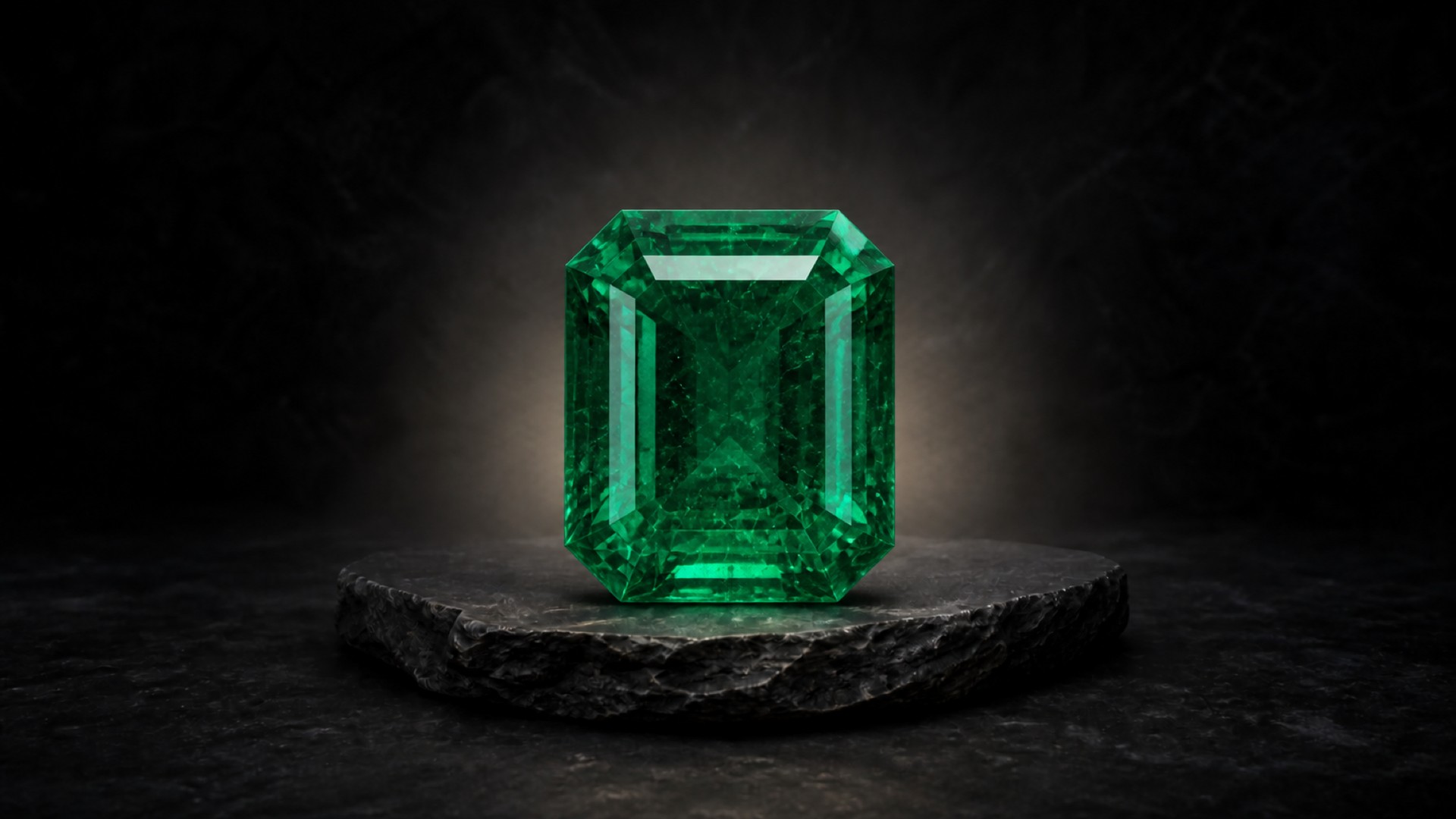
AI-created master image · AI-generated editorial reference illustration
Explore this profile
Definition
What is Emerald?
Emerald is a green to bluish-green gem variety of Beryl, Be₃Al₂Si₆O₁₈. Chromium and/or vanadium substitute for aluminum and contribute color; iron can modify absorption and fluorescence. Terminology at the pale Green Beryl boundary varies, so no universal numeric color threshold is asserted. [1]
At a glance
Gemological properties
Measured values and species-level properties are linked to their evidence. “Pending” means the value has not cleared review.
| Gemstone | Emerald | Mineral species | Beryl |
|---|---|---|---|
| Mineral group | Silicates | Family | Beryl |
| Chemical formula | Be₃Al₂Si₆O₁₈[1] | Crystal system | Hexagonal[1] |
| Mohs hardnessMohs hardnessA comparative scale of scratch resistance from 1 to 10; it does not measure toughness.Learn more | 7.5–8[2] | Specific gravitySpecific gravityThe ratio of a material’s density to the density of water under defined conditions.Learn more | 2.67–2.78[1] |
| Refractive indexRefractive indexA measurement describing how light changes speed and direction as it enters a material.Learn more | 1.565–1.602[1] | BirefringenceBirefringenceThe numerical difference between a doubly refractive material’s principal refractive indices.Learn more | 0.005–0.009[1] |
| Optic character | Uniaxial negative (doubly refractive)[1] | DispersionDispersionThe separation of white light into spectral colors because refractive index varies with wavelength.Learn more | 0.014[1] |
| Primary color | Green[5] | PleochroismPleochroismDifferent body colors seen in some anisotropic gems when viewed along different crystallographic directions.Learn more | Dichroic, commonly bluish green and yellowish green[3] |
| LusterLusterThe character of light reflected from a material’s surface.Learn more | Vitreous[1] | Transparency | Transparent to translucent[1] |
| CleavageCleavageA mineral’s tendency to split along specific crystallographic planes.Learn more | Imperfect basal cleavage; usually not prominent in fashioned stones[1] | Fracture | Conchoidal to uneven[1] |
| TenacityTenacityA material’s response to bending, breaking, crushing, or tearing.Learn more | Brittle; practical toughness varies with fissures and filling[1] | Fluorescence | Variable; chromium-related red may be suppressed by iron and is not diagnostic[4] |
| Streak | White[1] | Availability | Natural · Laboratory-grown |
| Jewelry suitability | Suitable for many jewelry types with protective setting, disclosed treatment, and careful cleaning[2] | ||
Scope note: some physical properties describe corundum as a mineral species; ruby-specific claims are identified separately in the citations.
Mineralogy
Mineralogy & classification
Emerald shares Beryl’s hexagonal structure and ideal formula Be₃Al₂Si₆O₁₈ with Aquamarine and Morganite. Variety names describe color and chemistry within the same mineral species.
Rings of silicate tetrahedra form channels in the Beryl structure. Aluminum and beryllium occupy other structural sites, while water, alkalis, and trace elements may occur in channels or substitute into lattice sites.
Shared species does not mean identical gem behavior. Emerald commonly records more disturbed growth and more fissures than many faceted Aquamarines, so clarity expectations, treatments, and care differ substantially.
Mineral species
BerylEmerald is a color variety within Beryl. [1]
Do not treat Emerald as a separate mineral species.
Chemistry
Chemistry & composition
Chromium and/or vanadium substituting for aluminum are central Emerald chromophores. Iron may modify hue, absorption, and fluorescence; host-lattice context and combinations matter more than a one-element slogan.
Trace-element presence does not automatically identify the dominant cause of visible color. Concentration, valence, site occupancy, competing absorptions, tone, and cutting all affect appearance.
This is why “chromium makes Emerald green” is incomplete. Some Emeralds are vanadium-dominant, and iron can add yellow or blue components or suppress chromium-related red fluorescence.
Beryllium is an essential Beryl lattice constituent. [1]
Aluminum occupies octahedral sites and may be substituted by chromophores. [1]
Silicon and oxygen form ring-silicate units. [1]
Oxygen is an essential lattice constituent. [1]
Chromium commonly contributes green color. [6]
Vanadium can contribute recognized Emerald color. [6]
Iron can modify hue, spectra, and fluorescence. [4]
Color
Color science
Emerald typically ranges from green to bluish green. Hue must be considered with tone and saturation, and no single photograph or hex value can reproduce the laboratory naming decision.
Cut orientation, pleochroism, lighting, transparency, and fissures alter face-up color. Very dark tone can conceal transparency; very light or weakly saturated green may be called Green Beryl under a laboratory’s comparison system.
Individual quality varies within every origin. Colombia or Zambia is not a color grade, and country reputation must never replace evaluation of the stone.
Emerald vs Green Beryl
Authority-dependent boundaryTone and saturation are assessed against stated conventions. [5]
No universal numeric threshold is asserted.
Optics
Optical properties
Emerald is doubly refractive and normally uniaxial negative. Its RI and specific gravity vary with composition, and ranges overlap other Beryls; agreement among several tests is required.
Gemologists may combine RI, birefringence, pleochroism, specific gravity, spectrum, fluorescence, microscopy, and advanced chemistry. Mounted stones and heavy inclusions can limit routine measurements.
These tests establish different questions in stages: Beryl identity, Emerald variety wording, natural or synthetic growth, clarity enhancement, and possible geographic origin are not the same conclusion.
Optical character
Uniaxial negativeRI and birefringence support Beryl identification. [1]
Optics alone do not prove origin or treatment.
Durability
Hardness & durability
Emerald is 7.5–8 on Mohs, but hardness measures scratch resistance. Fissures, filling, exposed corners, impact, heat, and cleaning method govern practical risk.
Emerald is not automatically fragile, and well-set examples have survived centuries. It nevertheless needs more care than many Sapphires because common surface-reaching fissures can reduce toughness and may contain oil, resin, or polymer.
Protective settings and careful handling can support ring use. Avoid steam, ultrasonics, high heat, harsh chemicals, and repair procedures that ignore treatment and fracture condition.
Hardness means scratch resistance. It is not a universal durability score and does not equal toughness.
Hardness is not toughness
7.5–8 MohsFissures and filling influence practical durability. [2]
Avoid steam, ultrasonics, and unassessed repair heat.
Formation
Geology & formation
Emerald requires the unusual meeting of Beryllium with chromium and/or vanadium. Important deposits form in contrasting hydrothermal, black-shale-hosted, and metamorphic environments.
Colombian deposits are associated with hydrothermal fluids in black shale and carbonate-vein systems, unlike many schist-hosted deposits in Zambia, Brazil, Russia, Ethiopia, and Madagascar. Other occurrences involve pegmatitic or hydrothermal interaction with chromium-bearing rocks.
No single formation diagram describes every Emerald. Similar geology can occur in different countries, and origin opinions depend on reference data rather than one generic deposit model.
Multiple deposit models
Black-shale hydrothermal and schist-hostedImportant deposits form in contrasting environments. [6]
Do not apply one formation story worldwide.
Locations
Where Emerald occurs
Documented sources include Colombia, Zambia, Brazil, Afghanistan, Pakistan, Ethiopia, Zimbabwe, Russia, Madagascar, and others. The record distinguishes occurrence and historical importance from current mine status.
Muzo, Chivor, and Coscuez are major Colombian names; Kafubu is central to Zambian Emerald literature. Brazil, Afghanistan, Russia, Ethiopia, Madagascar, China, and other sources broaden the laboratory reference population.
An individual-stone origin opinion may integrate inclusions, UV-Vis-NIR and FTIR spectra, and trace-element chemistry. Some stones remain inconclusive, and no country name guarantees quality.
Laboratory comparison
Inclusions + spectra + trace chemistrySome stones remain inconclusive. [4]
Color alone cannot prove Colombia or Zambia.
Colombian Emerald Districts
Historic importance documented; current production not asserted. [4]
- Production
- Historic production documented
- Coordinates
- Not published
Kafubu Emerald District
Documented origin-reference population; current status not asserted. [4]
- Production
- Production not assessed
- Coordinates
- Not published
Brazilian Emerald Deposits
Documented occurrence; individual quality varies. [4]
- Production
- Production not assessed
- Coordinates
- Not published
Panjshir Emerald Region
Documented occurrence; inclusion overlap requires laboratory analysis. [4]
- Production
- Production not assessed
- Coordinates
- Not published
Ural Emerald Region
Historic significance documented; current status not asserted. [4]
- Production
- Historic production documented
- Coordinates
- Not published
Origin caution: locality relationships do not by themselves prove geographic origin for an individual stone.
Inclusions
Inclusions & internal features
Emerald can contain fluid inclusions, crystals, growth tubes, healed fissures, and multiphase inclusions. “Jardin” is a descriptive trade word for garden-like internal features, not a scientific grade.
Microscopy supports natural/synthetic separation, treatment evaluation, and sometimes origin interpretation. Three-phase inclusions are not automatically Colombian: similar multiphase features occur in Emeralds from Afghanistan, China, and Zambia.
Origin analysis evaluates the whole inclusion scene with spectra and chemistry. One inclusion, however familiar, is rarely a complete locality conclusion.
Three-phase inclusions
Not uniquely ColombianSimilar features occur at several origins. [10]
Use the full analytical suite.
Jardin
Descriptive trade termGarden-like internal features are not a scientific grade. [9]
Do not equate jardin with a locality.
Three-phase fluid inclusions
Fluid, gas, and a solid phase in one cavity; not uniquely Colombian. [10]
- Identification
- Can support Emerald growth interpretation.
- Treatment context
- Can coexist with surface-reaching fissures and filling.
- Origin caution
- Occurs at multiple origins and is not uniquely Colombian.
Fluid inclusions
Fluid-bearing cavities whose form and context may record growth or healing. [4]
- Identification
- Record growth fluids and pressure history.
- Treatment context
- May be altered or obscured by later fissuring and filling.
- Origin caution
- Overlaps among several origins.
Mineral crystals
Solid inclusions requiring identification and contextual interpretation. [9]
- Identification
- Crystal identity and assemblage support microscopic interpretation.
- Treatment context
- Heat or filling interpretation requires associated features.
- Origin caution
- Some minerals support geology but rarely prove locality alone.
- Identification
- Contributes to the internal record of growth and later stress.
- Treatment context
- Can overlap with clarity-enhanced fissure networks.
- Origin caution
- Not a stand-alone origin marker.
- Identification
- Important to transparency and durability evaluation.
- Treatment context
- Primary pathway for oil, resin, or polymer clarity enhancement.
- Origin caution
- Not a locality indicator.
Treatments
Treatments & disclosure
Clarity enhancement introduces oil, resin, or polymer into surface-reaching fissures to reduce visibility. Material, extent, stability, re-treatment, and disclosure can affect care and value.
Microscopy, flash effects, flow structures, infrared spectroscopy, and other observations may help identify filler and estimate enhancement. GIA describes the degree of clarity enhancement as minor, moderate, or significant rather than issuing an overall clarity grade.
Heat, light, chemicals, ultrasonics, and steam can alter or remove filler. Ask what was used, how much enhancement was observed, whether re-treatment is expected, and how the seller documents disclosure.
Oil/resin clarity enhancement
Fissure visibility reductionFiller and degree affect care and value. [7,2]
Ask for type, extent, stability, and re-treatment history.
Clarity enhancement with oil or resin
- Purpose
- Reduce fissure visibility
- Detection
- Microscopy and spectroscopy may identify filler and enhancement extent.
- Permanence
- Filler can change, leak, discolor, or require re-treatment.
- Care effect
- Avoid steam, ultrasonics, heat, and harsh chemicals.
- Disclosure
- Disclose filler and observed enhancement extent. [7]
Natural vs synthetic
Natural, laboratory-grown & simulant
Hydrothermal and flux growth are established methods for synthetic Emerald. Synthetic Emerald is Beryl with laboratory growth history; a simulant is another material that only imitates appearance.
Flux residues, nail-head spicules, seed plates, growth structures, chemistry, and spectra may contribute to separation, but no single feature covers every producer or method.
Laboratory-grown origin does not mean fake mineral identity. Clear disclosure should state natural or synthetic first, then identify treatment and any simulant role separately.
Identification
How gemologists identify Emerald
Professional identification combines optics, microscopy, spectra, and—when needed—trace chemistry. Color, a scratch test, or one inclusion cannot prove Emerald, treatment, synthesis, or origin.
Routine testing can support Beryl identity and reveal dichroism or absorption patterns. Microscopy evaluates growth and fillers; advanced instruments can characterize polymers, chromophores, and trace-element populations.
Origin is a comparative laboratory opinion against reliably collected reference stones. It may be unavailable or inconclusive, and it should never be inferred from color alone.
No home certainty
Converging laboratory evidenceDifferent tests answer identity, treatment, synthesis, and origin. [8]
Avoid scratch tests and inclusion shortcuts.
Value factors
Value factors
Color, transparency, fissures, cut, size, clarity enhancement, natural or synthetic origin, condition, origin evidence, and provenance interact. No universal price-per-carat table can safely describe all Emeralds.
Hue, tone, saturation, and even color distribution are evaluated together. Eye-visible inclusions are more accepted than in Aquamarine, but features that reduce transparency or durability can materially change value.
Enhancement level and filler stability matter. Origin may influence some markets when independently supported, but country reputation never makes an individual stone automatically fine.
Buying guide
How to buy Emerald
Ask for identity, natural or synthetic origin, treatment type and extent, filler, origin basis, laboratory report, return terms, and setting suitability in writing.
View color in several lights and examine transparency, fissures, windowing, extinction, cut symmetry, and chips. Consider how exposed corners and surface-reaching features will behave in the intended jewelry.
For important purchases, an independent colored-stone report can document identity, detectable treatment, and sometimes origin. It is not an appraisal or guarantee of beauty.
Collector guide
Collector’s guide to Emerald
Collectors may value fine color, little or no clarity enhancement, documented localities, unusual inclusions, crystal or matrix specimens, historic provenance, and institutionally documented objects.
Preserve reports, invoices, labels, old photographs, treatment records, and collection history. A mine name on an old label should be retained as source wording until independently supported.
Rarity and investment claims require defined evidence. Crystal size, matrix aesthetics, provenance, and locality can matter without creating a universal ranking.
Preserve provenance
Reports, labels, invoices, photographsDocumentation supports locality and treatment history. [4]
Rarity language needs scope and evidence.
Care
Emerald care card
Warm water, mild soap, and gentle brushing are the safest routine method. Avoid steam and ultrasonic cleaning because fissures and fillers can be damaged or altered.
Remove Emerald jewelry before impact-heavy work and exposure to strong chemicals. Do not allow bench heat or rapid temperature change without assessment by a jeweler familiar with the stone’s treatment.
Have settings inspected, especially around corners and fissures. If filler deteriorates, seek qualified evaluation before any re-treatment.
Sources [2]
Safest method
Warm soapy water and gentle brushingConservative cleaning protects fissures and fillers. [2]
No steam or ultrasonic cleaning.
History
History & etymology
The name Emerald descends through ancient words associated with green. Historical Emerald trade connects Egypt, Central Asia, Colombia, Europe, and South Asia, but old color names do not always match modern mineral identification.
Colombian Emerald entered global trade networks after Spanish contact, while older sources in Egypt and Central Asia have distinct archaeological histories. Museum and institutional records are preferred for famous objects.
Folklore about vision, protection, or healing belongs to cultural history and is not evidence of medical effect.
Short answers
Emerald questions, answered
What is Emerald?+
Emerald is green to bluish-green Beryl. Chromium and/or vanadium absorption contributes to its recognized color; tone and saturation also affect whether an authority uses Emerald rather than Green Beryl. [5]
Emerald is green to bluish-green Beryl. Chromium and/or vanadium absorption contributes to its recognized color; tone and saturation also affect whether an authority uses Emerald rather than Green Beryl.
What mineral is Emerald?+
Emerald is the mineral species Beryl, Be₃Al₂Si₆O₁₈. Aquamarine and Morganite are other Beryl color varieties. [1]
Emerald is the mineral species Beryl, Be₃Al₂Si₆O₁₈. Aquamarine and Morganite are other Beryl color varieties.
Why is Emerald green?+
Chromium and/or vanadium substituting for aluminum contribute green color. Iron can modify hue, absorption, and fluorescence, so one-element explanations are incomplete. [6,4]
Chromium and/or vanadium substituting for aluminum contribute green color. Iron can modify hue, absorption, and fluorescence, so one-element explanations are incomplete.
What is the difference between Emerald and Green Beryl?+
Authorities differ at the pale or weakly saturated boundary. GIA uses comparison stones; no universal numeric color threshold governs every laboratory or market. [5]
Authorities differ at the pale or weakly saturated boundary. GIA uses comparison stones; no universal numeric color threshold governs every laboratory or market.
Why do Emeralds have inclusions?+
Emerald growth commonly records fluids, crystals, stress, and fissures. Inclusions can inform identification, treatment, synthesis, and sometimes origin, but do not automatically make a stone undesirable. [9]
Emerald growth commonly records fluids, crystals, stress, and fissures. Inclusions can inform identification, treatment, synthesis, and sometimes origin, but do not automatically make a stone undesirable.
What does jardin mean?+
Jardin is a trade term for garden-like internal features in Emerald. It is descriptive language, not a scientific clarity grade or proof of locality. [9]
Jardin is a trade term for garden-like internal features in Emerald. It is descriptive language, not a scientific clarity grade or proof of locality.
Are Emeralds treated?+
Clarity enhancement with oil, resin, or polymer is documented. Treatment prevalence and extent vary, so the individual stone’s disclosure and laboratory findings matter. [7,9]
Clarity enhancement with oil, resin, or polymer is documented. Treatment prevalence and extent vary, so the individual stone’s disclosure and laboratory findings matter.
What is Emerald oiling?+
Oil is introduced into surface-reaching fissures to reduce their visibility. Filler can change with heat, chemicals, light, age, cleaning, or re-treatment. [2,7]
Oil is introduced into surface-reaching fissures to reduce their visibility. Filler can change with heat, chemicals, light, age, cleaning, or re-treatment.
Can Emerald be synthetic?+
Yes. Hydrothermal and flux growth are established. Synthetic Emerald is laboratory-grown Beryl, while a simulant is a different material that imitates appearance. [12,9]
Yes. Hydrothermal and flux growth are established. Synthetic Emerald is laboratory-grown Beryl, while a simulant is a different material that imitates appearance.
Where are Emeralds found?+
Important documented sources include Colombia, Zambia, Brazil, Afghanistan, Pakistan, Ethiopia, Zimbabwe, Russia, and Madagascar. Current production is a separate dated claim. [4]
Important documented sources include Colombia, Zambia, Brazil, Afghanistan, Pakistan, Ethiopia, Zimbabwe, Russia, and Madagascar. Current production is a separate dated claim.
What is Colombian Emerald?+
It is an origin description that should be supported by reliable provenance or laboratory comparison of inclusions, spectra, and trace chemistry. Color alone cannot prove Colombia. [4]
It is an origin description that should be supported by reliable provenance or laboratory comparison of inclusions, spectra, and trace chemistry. Color alone cannot prove Colombia.
Can Emerald be worn every day?+
Many Emeralds can be worn regularly in protective settings, but fissures, filling, impacts, exposed corners, and cleaning require more care than Mohs hardness alone suggests. [2]
Many Emeralds can be worn regularly in protective settings, but fissures, filling, impacts, exposed corners, and cleaning require more care than Mohs hardness alone suggests.
How should Emerald be cleaned?+
Use warm water, mild soap, and gentle brushing. Avoid steam and ultrasonic cleaning because fissures and fillers can be affected. [2]
Use warm water, mild soap, and gentle brushing. Avoid steam and ultrasonic cleaning because fissures and fillers can be affected.
How do gemologists identify Emerald?+
They combine optical properties, microscopy, spectra, and sometimes trace chemistry. Identity, treatment, synthesis, and geographic origin are separate conclusions. [8,4]
They combine optical properties, microscopy, spectra, and sometimes trace chemistry. Identity, treatment, synthesis, and geographic origin are separate conclusions.
What determines Emerald value?+
Color, transparency, fissures, cut, size, enhancement, natural or synthetic origin, condition, origin evidence, and provenance interact. No universal price formula exists. [7]
Color, transparency, fissures, cut, size, enhancement, natural or synthetic origin, condition, origin evidence, and provenance interact. No universal price formula exists.
Evidence
References & further reading
Citation numbers are deduplicated across properties, claims, sections, structured modules, treatments, inclusions, FAQs, and related educational records.
- [1]Beryl.
Mineralogical Society of America
- [2]Emerald Care and Cleaning Guide.
Gemological Institute of America
- [3]Emerald Gemstone Overview.
Gemological Institute of America
- [4]Sudarat Saeseaw, Nathan D. Renfro, Aaron C. Palke, Ziyin Sun, and Shane F. McClure. Geographic Origin Determination of Emerald.
Gems & Gemology · 2019 · Vol. 55 (4)
- [5]Emerald Description.
Gemological Institute of America
- [6]Giuliani, Groat, Marshall, Fallick, Branquet and Pardieu. Geology of Corundum and Emerald Gem Deposits.
Gems & Gemology · 2019
- [7]Emerald Quality Factors.
Gemological Institute of America
- [8]Analysis of Gemstones at GIA Laboratories.
Gemological Institute of America
- [9]Nathan D. Renfro, John I. Koivula, Shane F. McClure, and Kevin Schumacher. Chart: Inclusions in Natural, Synthetic, and Treated Emerald.
Gems & Gemology · 2016 · Vol. 52 (4)
- [10]Sudarat Saeseaw, Nathan D. Renfro, Aaron C. Palke, Ziyin Sun, and Shane F. McClure. Three-Phase Inclusions in Emerald and Their Impact on Origin Determination.
Gems & Gemology · 2014 · Vol. 50 (2)
- [11]An Introduction to Gem Treatments.
Gemological Institute of America
- [12]An Introduction to Synthetic Gem Materials.
Gemological Institute of America
- [13]An Introduction to Simulants or Imitation Gem Materials.
Gemological Institute of America