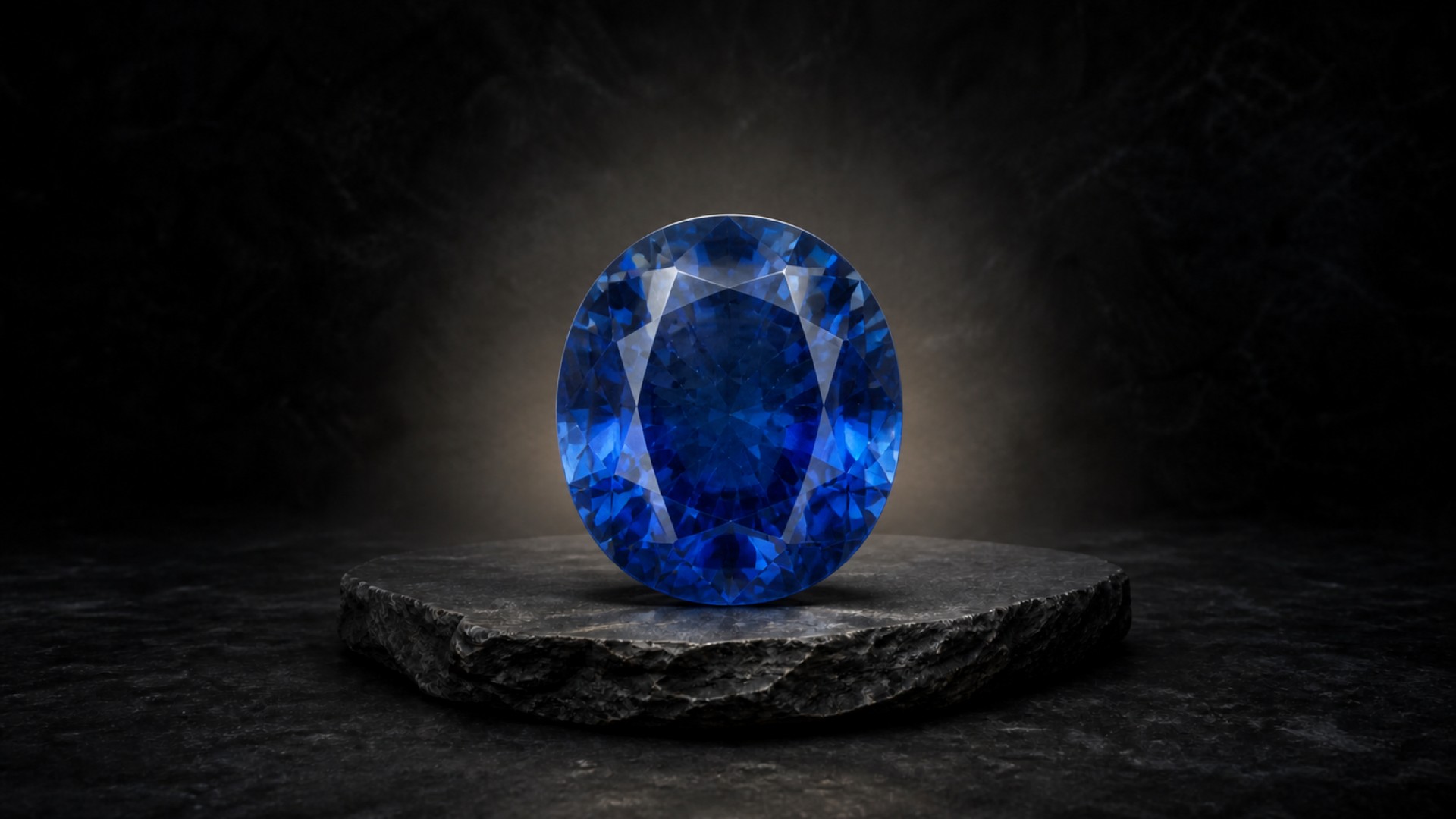
Cornerstone gemstone profile
Sapphire
The gem-corundum family beyond ruby red
Also known descriptively as Blue Sapphire
- Species
- Corundum
AI-created master image · AI-generated editorial reference illustration
Explore this profile
Definition
What is Sapphire?
Sapphire is gem-quality corundum, Al₂O₃, in colors outside the ruby-red boundary. Blue is the best-known category, but pink, yellow, orange, green, purple, colorless, color-change, and star sapphires are also part of the broader sapphire entity. Color alone cannot establish identity, treatment, or geographic origin. [1,2]
Also described asBlue Sapphire
At a glance
Gemological properties
Measured values and species-level properties are linked to their evidence. “Pending” means the value has not cleared review.
| Gemstone | Sapphire | Mineral species | Corundum |
|---|---|---|---|
| Mineral group | Oxides | Family | Corundum |
| Chemical formula | Al₂O₃[1,2] | Crystal system | Trigonal[1,2] |
| Mohs hardnessMohs hardnessA comparative scale of scratch resistance from 1 to 10; it does not measure toughness.Learn more | 9[1,2] | Specific gravitySpecific gravityThe ratio of a material’s density to the density of water under defined conditions.Learn more | 4[1,2] |
| Refractive indexRefractive indexA measurement describing how light changes speed and direction as it enters a material.Learn more | 1.762–1.77[1,2] | BirefringenceBirefringenceThe numerical difference between a doubly refractive material’s principal refractive indices.Learn more | 0.008–0.01[1,2] |
| Optic character | Uniaxial negative (doubly refractive)[2] | DispersionDispersionThe separation of white light into spectral colors because refractive index varies with wavelength.Learn more | 0.018[2] |
| Primary color | Multicolor[1] | PleochroismPleochroismDifferent body colors seen in some anisotropic gems when viewed along different crystallographic directions.Learn more | Dichroic; strength and colors vary with body color[2] |
| LusterLusterThe character of light reflected from a material’s surface.Learn more | Vitreous to adamantine[2] | Transparency | Transparent to translucent[2] |
| CleavageCleavageA mineral’s tendency to split along specific crystallographic planes.Learn more | No true cleavage; basal and rhombohedral parting may occur[3] | Fracture | Uneven to conchoidal[2] |
| TenacityTenacityA material’s response to bending, breaking, crushing, or tearing.Learn more | Brittle; generally excellent toughness as a gem[3] | Fluorescence | Variable; not diagnostic by itself[4] |
| Streak | White[2] | Availability | Natural · Laboratory-grown |
| Jewelry suitability | Suitable for frequent wear when appropriately set; treatment and damage influence care[3] | ||
Scope note: some physical properties describe corundum as a mineral species; ruby-specific claims are identified separately in the citations.
Mineralogy
Mineralogy & classification
Sapphire belongs to the mineral species corundum and has the ideal chemical formula Al₂O₃. Corundum crystallizes in the trigonal system. Variety names such as blue sapphire, pink sapphire, and star sapphire describe color or optical appearance; they do not create separate mineral species.
Corundum is an aluminum oxide mineral. Its structure can accept small quantities of other elements and lattice defects, which can change color without changing the underlying mineral species. Ruby and sapphire therefore share core hardness, density, refractive-index, and crystal-system characteristics.
The red-to-pink naming boundary is not a universal instrument reading. Laboratories and markets can apply conventions, so precise reports should identify the issuing laboratory and wording rather than presenting one boundary as a law of nature.
Chemistry
Chemistry & composition
Pure corundum is Al₂O₃, but gem color commonly involves trace elements, defects, or interactions inside the crystal lattice. Iron, titanium, chromium, and other minor constituents may contribute differently according to oxidation state, lattice site, concentration, and neighboring defects.
Aluminum and oxygen form the host structure. Trace chemistry must be described in that host-lattice context: the same element can behave differently in another mineral, and the presence of an element does not prove that it caused the visible color.
For blue sapphire, the central mechanism involves intervalence charge transfer associated with iron and titanium rather than titanium acting alone. Pink to red corundum commonly involves chromium, while yellow and other colors may involve different combinations of iron, trapped-hole centers, and other defects. Laboratory spectroscopy and chemistry are needed when the distinction matters.
Aluminum occupies the principal cation sites in the Al₂O₃ host lattice. [2]
Oxygen forms the oxide framework of corundum. [2]
Iron participates in several color mechanisms; Fe²⁺ paired with Ti⁴⁺ is central to common blue coloration. [5]
Titanium contributes to common blue coloration through iron–titanium intervalence charge transfer and can occur in rutile inclusions. [5]
Chromium contributes pink to red coloration in corundum; classification near the ruby boundary follows stated conventions. [1]
Color
Color science
Sapphire can be blue or occur in a wide range of so-called fancy colors. Blue commonly involves Fe²⁺–Ti⁴⁺ intervalence charge transfer. Other colors can arise through different chromophores or defects, and mixed mechanisms are possible. Hue names are descriptions, not proof of natural origin or treatment status.
Blue sapphire ranges from greenish blue through blue to violetish blue. Pink, yellow, orange, green, purple, and colorless sapphires are also recognized; padparadscha is a debated pink-orange to orange-pink trade and laboratory description rather than a simple universal swatch.
Tone, saturation, zoning, pleochroism, lighting, cutting, and treatment can all affect appearance. A photograph cannot establish a sapphire’s exact color grade, treatment history, or identity.
Key mechanism
Fe²⁺–Ti⁴⁺ intervalence charge transferBlue sapphire is not accurately explained by titanium alone; paired ions and lattice context matter. [5]
Color cause requires appropriate spectroscopy and chemistry when applied to an individual stone.
Sapphire is not always blue
Pink, yellow, orange, green, purple, colorless and mixed colorsThe broader sapphire family includes corundum colors outside the accepted ruby-red category. [1]
Padparadscha wording is debated and should be tied to a stated laboratory or trade definition.
Optics
Optical properties
Sapphire is doubly refractive and normally uniaxial negative, with a refractive-index range near 1.762–1.770 and birefringence near 0.008–0.010. These measurements support identification, but they are not sufficient alone to determine whether a stone is natural, treated, synthetic, or from a claimed origin.
A refractometer can place a polished stone within the corundum range. A polariscope, dichroscope, microscope, spectroscope, and other tests add independent observations. Pleochroism may be visible in colored sapphire because different crystallographic directions can transmit different colors or intensities.
Overlapping properties, mounting limitations, unusual samples, and synthetic material mean that professional identification uses converging evidence. Origin and some treatment questions often require advanced spectroscopy and trace-element analysis.
Durability
Hardness & durability
Sapphire ranks 9 on the Mohs scale, has excellent toughness for a transparent gem, and has no true cleavage. Those qualities make many sapphires suitable for frequently worn jewelry, but hardness only describes scratch resistance. Existing fractures, sharp impacts, treatments, and repair heat can still create risk.
Corundum can show parting, and any gemstone can chip at an exposed edge or fracture under a sufficiently hard blow. Durability should therefore be considered as hardness, toughness, structural condition, setting protection, chemical stability, and treatment condition—not as a single score.
Untreated and conventionally heat-treated sapphire is generally stable in normal wear. Fracture-filled, cavity-filled, dyed, or shallow diffusion-treated material can require more restrictive cleaning and repair practices.
Hardness means scratch resistance. It is not a universal durability score and does not equal toughness.
Formation
Geology & formation
Natural sapphire forms in several geologic environments, including metamorphic rocks and igneous or basalt-related settings. Weathering can release durable corundum crystals from host rock and concentrate them in secondary gravels. A gem’s presence in alluvium does not by itself reveal its original bedrock deposit.
Metamorphic blue sapphires are associated with rock types that can include marbles, gneisses, aluminous rocks, and syenite-related settings. Basalt-related sapphire represents another broad geologic population. These groups can show different chemistry and inclusions, but substantial overlap remains.
Geographic origin work depends on reliable reference samples. Similar geology can occur in more than one country, so a locality name should not be inferred from color or a single inclusion.
Locations
Where Sapphire occurs
Historically or gemologically important sapphire sources include Sri Lanka, Myanmar, the Kashmir region, Madagascar, Australia, Thailand, Cambodia, and Montana in the United States. Importance, production period, geology, typical appearance, and market reputation differ, and a country name never guarantees quality.
Laboratories compare an unknown sapphire with carefully documented reference collections using microscopy, spectroscopy, and trace-element chemistry. Even then, some stones remain inconclusive because material from different origins can overlap or because heat has altered useful evidence.
Origin labels should distinguish a documented locality relationship, a seller’s representation, and an independent laboratory opinion. Current-production claims require recent evidence; this profile does not infer present mining activity from historic records.
Laboratory origin opinion
Reference-comparison conclusionOrigin work compares inclusions, chemistry and spectra with reliably collected reference material. [6]
Some sapphires remain inconclusive, especially after heat alters useful evidence.
Sri Lanka Sapphire and Spinel Gravels
Metamorphic sapphire reference material and long-established alluvial recovery are documented. [6]
- Production
- Production not assessed
- Coordinates
- Not published
Kashmir Sapphire Region
Historic sapphire source; current production is not asserted. [6]
- Production
- Historic production documented
- Coordinates
- Not published
Madagascar Sapphire Deposits
Large modern reference populations include metamorphic and basalt-related blue sapphire. [6]
- Production
- Production not assessed
- Coordinates
- Not published
Mogok Stone Tract
GIA field reporting documents sapphire mining in the Mogok Stone Tract. [13]
- Production
- Historic production documented
- Coordinates
- Approximate locality position
Montana Sapphire Deposits
Documented sapphire locality; current production is not assessed here. [8]
- Production
- Production not assessed
- Coordinates
- Not published
Origin caution: locality relationships do not by themselves prove geographic origin for an individual stone.
Inclusions
Inclusions & internal features
Sapphire may contain rutile silk, mineral crystals, negative crystals, growth structures, color zoning, healed fractures, and other features. These observations can help evaluate natural origin, treatment, or possible locality, but no single inclusion is a universal proof of identity or origin.
Oriented rutile needles can scatter light and, when suitably arranged and cut as a cabochon, contribute to asterism. Heat can partially or completely dissolve rutile, alter crystals, heal fractures, and redistribute titanium into the corundum lattice. Those changes can be useful treatment evidence.
Microscopy is powerful because it records a growth and treatment history, yet features overlap. Conclusions should use the whole inclusion scene together with standard and advanced testing.
Rutile silk
Oriented needle-like inclusionsSilk can affect appearance, support treatment interpretation and contribute to asterism when appropriately oriented and cut. [8]
Rutile silk is not a universal origin marker or proof that a stone is unheated.
Rutile silk
Intersecting rutile needles that can scatter light and, when suitably oriented and cut, contribute to asterism. [8]
- Identification
- Can support corundum identification and reveal growth history.
- Treatment context
- Partial dissolution and internal blue diffusion can support high-temperature heat interpretation.
- Origin caution
- Silk appearance can support—but does not alone prove—an origin opinion.
Mineral crystals
Solid inclusions requiring identification and contextual interpretation. [8]
- Identification
- Crystal identity and assemblage can support a broader microscopic conclusion.
- Treatment context
- Heat may alter crystal outlines, stress halos, or surrounding features.
- Origin caution
- A single crystal inclusion rarely proves origin because features can overlap.
Color zoning
Compositional and color boundaries formed as growth conditions changed. [8]
- Identification
- Straight, angular, or hexagonal zoning can support corundum interpretation.
- Treatment context
- Facet-conforming surface color can raise diffusion-treatment questions.
- Origin caution
- Zoning patterns overlap among localities and require supporting evidence.
Growth structures
Internal planes, blockages, dislocations, or zoning formed during crystal growth. [8]
- Identification
- Growth planes and structures can support natural/synthetic interpretation.
- Treatment context
- Heating can modify visibility but does not erase every structure.
- Origin caution
- Growth structure alone does not establish a country of origin.
- Identification
- Healed networks can record geological or treatment history.
- Treatment context
- High-temperature treatment can heal fractures and alter their contents.
- Origin caution
- Healed fractures are not a universal locality marker.
Treatments
Treatments & disclosure
Heat treatment is widely encountered in sapphire and can modify color or clarity. Diffusion processes can introduce color-causing elements at high temperature, and some sapphires are fracture or cavity filled. The treatment type—not merely the word “treated”—determines disclosure, care, and potential market implications.
Conventional heating may dissolve silk, modify oxidation states, improve apparent color, or heal some fractures. Titanium or beryllium lattice diffusion can create or alter color with different penetration depths. Glass-filled or dyed material requires different care from untreated or heat-only sapphire.
Detection may require microscopy, spectroscopy, and trace-element analysis. Buyers should ask for explicit treatment wording and seek an independent laboratory report when treatment or origin materially affects the transaction.
Heat treatment
Commonly encounteredHeating can modify color, dissolve silk, heal fractures or alter internal features. [8]
Treatment prevalence and effects vary; disclosure should identify the treatment rather than only say “enhanced.”
Lattice diffusion
Color modification at high temperatureTitanium or beryllium diffusion can create or modify sapphire colors with different penetration behavior. [9]
Detection and nomenclature may require advanced laboratory analysis.
Heat treatment
- Purpose
- Improve or change color; reduce visible silk; heal some fractures.
- Detection
- Microscopy, spectroscopy and other laboratory methods evaluate altered inclusions, growth features and spectra.
- Permanence
- Many heat effects are stable under normal wear, but the stone’s condition still matters.
- Care effect
- Untreated and heat-only sapphire is generally durable; disclose treatment before repair heat.
- Disclosure
- Disclose heat treatment specifically and distinguish it from diffusion or filling. [8]
Diffusion treatment
- Purpose
- Create or change blue, yellow, orange, pink-orange and other appearances depending on process and starting material.
- Detection
- Microscopy may show surface-conforming color or heat features; beryllium detection can require advanced chemistry.
- Permanence
- Penetration varies with the process; shallow color can be altered by repolishing or damage.
- Care effect
- Confirm treatment before recutting, polishing or repair.
- Disclosure
- State diffusion type when known; do not describe all diffusion as ordinary heat. [9]
Fracture filling
- Purpose
- Reduce fracture visibility and improve apparent transparency.
- Detection
- Microscopy, flash effects, surface features and analytical testing may be used.
- Permanence
- Fillers can be damaged or altered by heat and chemicals.
- Care effect
- Use conservative cleaning; avoid steam, ultrasonic and bench heat unless specifically cleared.
- Disclosure
- Disclose filling material and extent when known. [3]
Natural vs synthetic
Natural, laboratory-grown & simulant
Laboratory-grown sapphire has the same corundum species and essential chemistry as natural sapphire but grows by a human-controlled process. Flame fusion, flux, Czochralski pulling, and hydrothermal methods are documented for synthetic corundum. A simulant only imitates appearance and is a different material.
Different growth methods can leave different growth structures, inclusions, chemistry, or fluorescence. Flame-fusion sapphire is common, while flux, pulled, and hydrothermal material can present different identification challenges.
Natural-looking inclusions are not a guarantee of natural origin, and absence of obvious inclusions is not proof of synthesis. A qualified laboratory integrates microscopy with spectroscopy and chemistry when routine tests do not resolve the question.
Synthetic Sapphire
Laboratory-grown corundumSynthetic sapphire has essentially the same species identity as natural sapphire but a human-controlled growth history. [10,11]
A simulant is a different material that only imitates appearance.
Documented methods
Flame fusion, flux, Czochralski and hydrothermalDifferent methods leave different growth structures, inclusions and chemical patterns. [11,8]
Method existence does not identify a stone without examination.
Identification
How gemologists identify Sapphire
Professional sapphire identification combines physical and optical measurements with microscopy and spectroscopy. Refractive index, birefringence, optical character, specific gravity, pleochroism, absorption, fluorescence, inclusions, and trace chemistry can all contribute. Home scratch tests are unsafe and not conclusive.
The first task is to establish corundum identity. The next questions—natural or laboratory-grown, treated or untreated, and possible geographic origin—require increasingly specialized evidence. Mounted stones or inaccessible facets can limit standard testing.
Color alone cannot identify sapphire, fluorescence alone cannot prove natural origin, inclusions alone do not always establish locality, and a photograph cannot show treatment status. Significant purchases may justify a report from an independent gemological laboratory.
Value factors
Value factors
Sapphire value depends on an interacting set of factors: color, transparency and inclusions, cut quality, size, treatment, natural or synthetic origin, geographic-origin evidence where relevant, and documentation. There is no universal per-carat formula or single worldwide grading scale for colored sapphire.
Desirable color is assessed through hue, tone, saturation, distribution, and how the cut presents the color. An attractive stone can still have durability concerns or undisclosed treatment. Conversely, visible inclusions do not automatically make a sapphire undesirable if they support character without undermining durability.
Origin claims and untreated status can influence some markets, but they require evidence. Reputation should never substitute for examination of the individual stone.
Buying guide
How to buy Sapphire
Start with intended use, then examine color in more than one light, face-up appearance, transparency, zoning, cut, and condition. Ask whether the stone is natural or laboratory-grown, what treatments are disclosed, who made any origin determination, and whether return terms allow independent verification.
For an everyday ring, consider edge protection, existing fractures, filling, and future repair. For a purchase where untreated status, padparadscha terminology, or geographic origin materially affects price, an independent laboratory report may be especially useful.
A report identifies measured findings and opinions within its scope; it is not an appraisal and does not guarantee beauty or value. Compare like with like and avoid decisions based solely on carat weight or a country name.
Collector guide
Collector’s guide to Sapphire
Collectors may focus on untreated material, historic localities, star or color-change phenomena, distinctive crystal specimens, unusual colors, documented provenance, or rare locality-and-color combinations. Rarity claims need a defined population and evidence; a marketing adjective alone is not documentation.
Preserve laboratory reports, invoices, prior collection records, treatment disclosures, and photographs as part of the object’s provenance. For rough crystals, locality attribution and any restoration or coating should be recorded separately from mineral identity.
Collector interest does not make a stone an investment. Liquidity, fashion, grading differences, and the quality of documentation all vary, so this guide does not predict appreciation.
Care
Sapphire care card
Warm water, mild soap, and a soft brush are the safest general cleaning method for sapphire. Ultrasonic and steam cleaning are usually acceptable for untreated, heat-treated, and many lattice-diffusion-treated stones, but not for every filled, dyed, damaged, or heavily included sapphire.
Before machine cleaning or repair, confirm treatment and inspect for fractures, loose settings, and surface-reaching features. Fracture-filled or dyed material may be damaged by heat or chemicals and should receive conservative care.
Store sapphire so it does not scratch softer jewelry, and protect its own facet edges from hard impacts. Tell a jeweler about known treatments before sizing, retipping, polishing, or other work involving heat.
Sources [3]
Safest general method
Warm water, mild soap and a soft brushThis conservative method avoids many treatment-specific risks. [3]
Filled, dyed, damaged or heavily included material may require specialized care.
History
History & etymology
Sapphire has long been associated with blue in European and modern trade history, even though the mineral family includes many other colors. The word has older linguistic roots and has not always referred to the same mineral understood by modern gemology. Historical references must therefore be read in context.
Royal, religious, and romantic associations are well documented as cultural history, not scientific properties. Modern popularity was reinforced by prominent blue-sapphire jewelry and museum specimens.
Padparadscha and traditional origin-linked descriptions carry cultural and trade histories, but modern use should follow transparent laboratory or seller definitions. Historical names should not be treated as proof of current geographic origin.
Historic names need context
Old names may not match modern mineral speciesModern gemology separates corundum categories using mineralogical and laboratory evidence. [12]
Historical wording is not proof of modern identity or geographic origin.
Folklore
Folklore & cultural traditions
Sapphire has been associated in different traditions with royalty, sincerity, faithfulness, protection, and heavenly symbolism. These are cultural and historical beliefs. They are not evidence that sapphire prevents illness, changes physiology, or provides scientifically demonstrated healing effects.
Folklore can help explain why sapphire appears in ceremonial and personal jewelry, but it must be labeled separately from mineralogy and medicine. The Gem Index records such traditions as cultural context and does not present metaphysical claims as scientific fact.
Sources [12]
Short answers
Sapphire questions, answered
What is Sapphire?+
Sapphire is gem-quality corundum in colors outside the accepted ruby-red category. Blue is the most familiar, but sapphire also occurs in pink, yellow, orange, green, purple, colorless, and mixed colors. It shares corundum’s essential chemistry and physical properties with ruby. [1,2]
Sapphire is gem-quality corundum in colors outside the accepted ruby-red category. Blue is the most familiar, but sapphire also occurs in pink, yellow, orange, green, purple, colorless, and mixed colors. It shares corundum’s essential chemistry and physical properties with ruby.
Is Sapphire always blue?+
No. Blue sapphire is one important category within a broader family. Gem-quality corundum that does not fall within the ruby-red category may be described as sapphire, including many pink, yellow, orange, green, purple, and colorless stones. [1]
No. Blue sapphire is one important category within a broader family. Gem-quality corundum that does not fall within the ruby-red category may be described as sapphire, including many pink, yellow, orange, green, purple, and colorless stones.
What mineral is Sapphire?+
Sapphire is the mineral species corundum, an aluminum oxide with the ideal formula Al₂O₃. Ruby is also corundum. The names distinguish gem color categories and conventions within the same mineral species rather than different minerals. [2,1]
Sapphire is the mineral species corundum, an aluminum oxide with the ideal formula Al₂O₃. Ruby is also corundum. The names distinguish gem color categories and conventions within the same mineral species rather than different minerals.
Why is blue Sapphire blue?+
Blue commonly results from intervalence charge transfer associated with iron and titanium ions in the corundum lattice. Saying only that titanium makes sapphire blue is incomplete: ion valence, pairing, concentration, lattice setting, and other absorptions matter. [5]
Blue commonly results from intervalence charge transfer associated with iron and titanium ions in the corundum lattice. Saying only that titanium makes sapphire blue is incomplete: ion valence, pairing, concentration, lattice setting, and other absorptions matter.
How hard is Sapphire?+
Sapphire is 9 on the Mohs hardness scale, so it strongly resists scratching. Mohs hardness is not overall durability, however. Sapphire can still chip or fracture under impact, and existing damage, parting, setting design, and treatments influence wearability. [2,3]
Sapphire is 9 on the Mohs hardness scale, so it strongly resists scratching. Mohs hardness is not overall durability, however. Sapphire can still chip or fracture under impact, and existing damage, parting, setting design, and treatments influence wearability.
Is Sapphire treated?+
Many sapphires are heat treated, while diffusion, filling, dyeing, and other processes are also documented. Treatment type and prevalence vary. Ask for specific written disclosure because different treatments have different detection, durability, care, and market implications. [8,9,3]
Many sapphires are heat treated, while diffusion, filling, dyeing, and other processes are also documented. Treatment type and prevalence vary. Ask for specific written disclosure because different treatments have different detection, durability, care, and market implications.
What is heat-treated Sapphire?+
Heat-treated sapphire is natural or laboratory-grown corundum exposed to controlled heating to modify features such as color or clarity. Heat can dissolve rutile silk, change color-causing interactions, heal fractures, and alter inclusions. Detection can require professional examination. [8]
Heat-treated sapphire is natural or laboratory-grown corundum exposed to controlled heating to modify features such as color or clarity. Heat can dissolve rutile silk, change color-causing interactions, heal fractures, and alter inclusions. Detection can require professional examination.
What is a Star Sapphire?+
A star sapphire displays asterism, usually when light reflects from oriented internal needles or platelets in a cabochon-cut stone. The star depends on inclusion orientation, cutting, and lighting. Asterism does not by itself establish natural origin or lack of treatment. [1,8]
A star sapphire displays asterism, usually when light reflects from oriented internal needles or platelets in a cabochon-cut stone. The star depends on inclusion orientation, cutting, and lighting. Asterism does not by itself establish natural origin or lack of treatment.
What is Padparadscha Sapphire?+
Padparadscha is a debated pink-orange to orange-pink sapphire description with historical ties to Sri Lanka. Laboratories may apply defined color and treatment criteria. Because there is no simple universal swatch, significant purchases should state whose definition and report wording are used. [1,12]
Padparadscha is a debated pink-orange to orange-pink sapphire description with historical ties to Sri Lanka. Laboratories may apply defined color and treatment criteria. Because there is no simple universal swatch, significant purchases should state whose definition and report wording are used.
Can Sapphire be laboratory-grown?+
Yes. Synthetic sapphire is laboratory-grown corundum and can be produced by flame fusion, flux, Czochralski pulling, hydrothermal, and other methods. It has the same essential species identity as natural sapphire but a different growth history. [10,11]
Yes. Synthetic sapphire is laboratory-grown corundum and can be produced by flame fusion, flux, Czochralski pulling, hydrothermal, and other methods. It has the same essential species identity as natural sapphire but a different growth history.
How can Sapphire be identified?+
Gemologists combine refractive index, birefringence, optical character, pleochroism, specific gravity, microscopy, spectra, fluorescence, and sometimes trace chemistry. Additional work is needed to assess natural versus synthetic origin, treatment, and possible geographic origin. [8,6]
Gemologists combine refractive index, birefringence, optical character, pleochroism, specific gravity, microscopy, spectra, fluorescence, and sometimes trace chemistry. Additional work is needed to assess natural versus synthetic origin, treatment, and possible geographic origin.
Where is Sapphire found?+
Important documented sources include Sri Lanka, Myanmar, the Kashmir region, Madagascar, Australia, Thailand, Cambodia, and Montana. A source country does not guarantee quality, and current production should not be inferred from historic records. [6,7]
Important documented sources include Sri Lanka, Myanmar, the Kashmir region, Madagascar, Australia, Thailand, Cambodia, and Montana. A source country does not guarantee quality, and current production should not be inferred from historic records.
Is Sapphire suitable for an everyday ring?+
Many sapphires are excellent ring stones because corundum is hard and generally tough. Suitability still depends on fractures, treatment, cut, exposed edges, setting protection, and the wearer’s activities. Filled or damaged stones may require special care. [3]
Many sapphires are excellent ring stones because corundum is hard and generally tough. Suitability still depends on fractures, treatment, cut, exposed edges, setting protection, and the wearer’s activities. Filled or damaged stones may require special care.
How should Sapphire be cleaned?+
Warm water, mild soap, and a soft brush are the safest general choice. Ultrasonic and steam cleaning are not appropriate for every filled, dyed, damaged, or heavily included stone. Confirm treatment and condition before machine cleaning or heat-intensive repair. [3]
Warm water, mild soap, and a soft brush are the safest general choice. Ultrasonic and steam cleaning are not appropriate for every filled, dyed, damaged, or heavily included stone. Confirm treatment and condition before machine cleaning or heat-intensive repair.
What is the difference between Ruby and Sapphire?+
Ruby and sapphire are both corundum. Ruby is the red gem category under applicable laboratory or trade conventions; sapphire covers blue and other gem-quality corundum colors outside that boundary. Their core mineral properties are closely related, but color terminology differs. [1,2]
Ruby and sapphire are both corundum. Ruby is the red gem category under applicable laboratory or trade conventions; sapphire covers blue and other gem-quality corundum colors outside that boundary. Their core mineral properties are closely related, but color terminology differs.
Evidence
References & further reading
Citation numbers are deduplicated across properties, claims, sections, structured modules, treatments, inclusions, FAQs, and related educational records.
- [1]Sapphire Gemstone Overview.
Gemological Institute of America
- [2]Corundum.
Mineral Data Publishing · 2005 · pp. 1
- [3]Sapphire Care and Cleaning Guide.
Gemological Institute of America
- [4]What Does Fluorescence Tell Us?.
Gems & Gemology · 2024
- [5]Emmanuel Fritsch and George R. Rossman. An Update on Color in Gems. Part 2: Colors Involving Multiple Atoms and Color Centers.
Gems & Gemology · 1988 · Vol. 24 (1)
- [6]Aaron C. Palke, Sudarat Saeseaw, Nathan D. Renfro, Ziyin Sun, and Shane F. McClure. Geographic Origin Determination of Blue Sapphire.
Gems & Gemology · 2019 · Vol. 55 (4)
- [7]Giuliani, Groat, Marshall, Fallick, Branquet and Pardieu. Geology of Corundum and Emerald Gem Deposits.
Gems & Gemology · 2019
- [8]Nathan D. Renfro, John I. Koivula, Jonathan Muyal, Shane F. McClure, Kevin Schumacher, and James E. Shigley. Chart: Inclusions in Natural, Synthetic, and Treated Sapphire.
Gems & Gemology · 2017 · Vol. 53 (2) · pp. 213–214
- [9]John L. Emmett, Kenneth Scarratt, Shane F. McClure, Thomas Moses, Troy R. Douthit, Richard Hughes, Steven Novak, James E. Shigley, Wuyi Wang, Owen Bordelon, and Robert E. Kane. Beryllium Diffusion of Ruby and Sapphire.
Gems & Gemology · 2003 · Vol. 39 (2) · pp. 84–135
- [10]An Introduction to Synthetic Gem Materials.
Gemological Institute of America
- [11]Colored Stones Unearthed: Synthetic Opal.
Gems & Gemology · 2024 · Vol. 60 (2)
- [12]Sapphire History and Lore.
Gemological Institute of America
- [13]Vincent Pardieu, Andrew Lucas, and GIA field team. Mogok Expedition Series, Part 1: The Valley of Rubies.
Gemological Institute of America · 2014