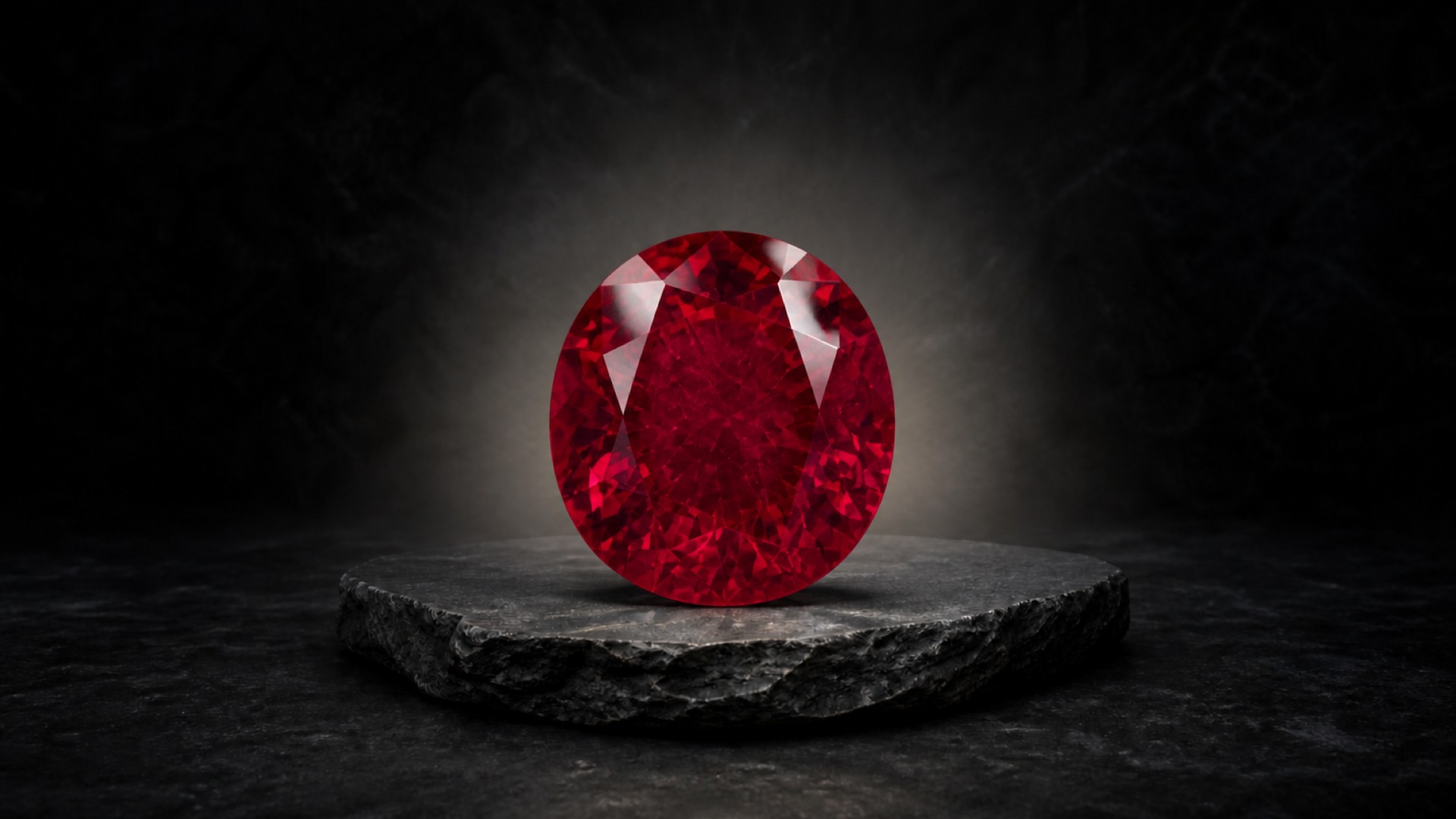
Cornerstone gemstone profile
Ruby
The red gem variety of corundum
Also known descriptively as Red corundum
AI-created master image · AI · Owned
Explore this profile
Definition
What is Ruby?
Ruby is the red gem variety of corundum (Al₂O₃). Chromium incorporated into the crystal structure is principally responsible for the red color. Sapphire names gem corundum of other colors. [1]
Also described asRed corundum
At a glance
Gemological properties
Measured values and species-level properties are linked to their evidence. “Pending” means the value has not cleared review.
| Gemstone | Ruby | Mineral species | Corundum |
|---|---|---|---|
| Mineral group | Oxides | Family | Corundum |
| Chemical formula | Al₂O₃[1] | Crystal system | Trigonal[2] |
| Mohs hardnessMohs hardnessA comparative scale of scratch resistance from 1 to 10; it does not measure toughness.Learn more | 9[1,3,2] | Specific gravitySpecific gravityThe ratio of a material’s density to the density of water under defined conditions.Learn more | 3.95–4.05[1,2] |
| Refractive indexRefractive indexA measurement describing how light changes speed and direction as it enters a material.Learn more | 1.762–1.77[1] | BirefringenceBirefringenceThe numerical difference between a doubly refractive material’s principal refractive indices.Learn more | 0.008–0.01[1] |
| Optic character | Uniaxial (–)[2] | DispersionDispersionThe separation of white light into spectral colors because refractive index varies with wavelength.Learn more | Pending verification |
| Primary color | Red[1] | PleochroismPleochroismDifferent body colors seen in some anisotropic gems when viewed along different crystallographic directions.Learn more | Typically red to purplish red and orangy red[4] |
| LusterLusterThe character of light reflected from a material’s surface.Learn more | Adamantine to vitreous[2] | Transparency | Transparent to translucent[2] |
| CleavageCleavageA mineral’s tendency to split along specific crystallographic planes.Learn more | None; parting may occur[3] | Fracture | Uneven to conchoidal[2] |
| TenacityTenacityA material’s response to bending, breaking, crushing, or tearing.Learn more | Brittle; tough when compact[2] | Fluorescence | Pending verification |
| Streak | White[2] | Availability | Natural · Laboratory-grown |
| Jewelry suitability | Excellent for daily wear when treatment-related durability concerns are absent[3] | ||
Scope note: some physical properties describe corundum as a mineral species; ruby-specific claims are identified separately in the citations.
Visual evidence
Documented media & editorial visuals
Every image is labeled by visual class. Documentary identity statements describe the source record and review status—not facts inferred from appearance alone.
Ruby
- Identity
- Not applicable
AI · Owned
Ruby crystal — GeoDIL 1026
Ruby (corundum) crystal, about 7 cm across, photographed for the Geoscience Digital Image Library. The source describes the specimen as from near Mysore, India; identity and locality wording follow that source record.
- Identity
- Claimed by source
- Specimen
- Ruby Crystal — GeoDIL 1026
Photograph: Darla Sondrol / GeoDIL. Dedicated to the public domain under CC0 1.0. · CC0 1.0 · Original source
.jpg)
Mineralogy
Mineralogy & classification
Ruby is the red gem variety of corundum, an aluminum-oxide mineral in the hematite group.
Corundum is the species. Ruby and sapphire are gem-variety names within that species, so they share the same basic chemistry and hardness while differing in color identity. This hierarchy is a classification relationship, not a visual similarity score.
Sources [1]
Mineral species
CorundumRuby and sapphire are color varieties of the mineral corundum. [1]
Compare evidenceMineral group
Hematite groupCorundum is classified in the hematite mineral group. [2]
Family relationship
Ruby ↔ corundum ↔ sapphireRuby is red corundum; sapphire names gem corundum in other colors. [1]
Compare evidenceChemistry
Chemistry & composition
Corundum is Al₂O₃; chromium incorporated into that structure is principally responsible for ruby’s red color.
Aluminum and oxygen form the major composition. Trace chromium changes how the crystal absorbs and emits light. Chemistry explains color, but a trace-element reading alone does not replace a complete gemological identification or establish geographic origin.
Sources [1]
Color
Color science
Ruby color results principally from chromium in corundum and may range through orangy, purplish, darker, and lighter red appearances.
Transparent color changes with illumination, viewing direction, tone, saturation, cut, and the observer. The swatches on this page are deliberately labeled as screen approximations. They are teaching aids, not trade grades and not substitutes for examining the stone under controlled conditions.
Sources [4]
#8F1738One commonly described ruby color direction. [4]
#B91F3DA screen approximation representing saturated red, not a trade grade. [4]
#C63C2EThe warmer pleochroic direction described for ruby. [4]
Screen color is an educational approximation only; transparent gems change with lighting, cut, tone, saturation, and display calibration.
Why ruby is red
Chromium absorption and emissionColor is a material response to light, not a fixed screen swatch. [1]
The displayed colors are educational UI approximations, never color grades.
Pleochroism
Red to purplish red / orangy redRuby can show different colors in different crystal directions, which also influences cutting decisions. [4]
Optics
Optical properties
Ruby’s refractive index, birefringence, optic character, pleochroism, and fluorescence response are evidence used with other observations.
These properties explain why trained gemologists use multiple instruments and directions of observation. A refractometer, polariscope, dichroscope, spectroscope, microscope, and ultraviolet sources answer different questions. Advanced spectroscopy and chemistry may be required for treatment, growth-origin, or locality conclusions.
Sources [2]
Refractive index
1.762–1.770A refractometer reading helps distinguish ruby from look-alike materials when the stone and testing conditions permit. [1]
A single reading is not a complete identification.
Birefringence
0.008–0.010The difference between principal refractive indices contributes to ruby’s doubly refractive behavior. [1]
Optic character
Uniaxial negativeCorundum is generally uniaxial negative; this is a species-level optical classification. [2]
Anomalous behavior can occur and requires trained interpretation.
Durability
Hardness & durability
Ruby ranks 9 on the Mohs scale, which measures scratch resistance rather than toughness.
Mohs numbers are comparative and the intervals are not equal. Ruby’s high hardness supports wear resistance, while excellent toughness and lack of cleavage reduce other risks. Surface-reaching fractures, fillings, setting design, impact, and care practices still matter.
Sources [3]
Untreated and heat-treated ruby are generally durable, but filling, fractures, chemicals, heat, and cleaning method can change the recommendation.
Never reduce durability to one universal score. Scratch resistance, toughness, cleavage, fracture tendency, stability, treatment condition, and use setting belong in separate rows. The care card follows the most conservative documented treatment condition.
Sources [3]
Hardness means scratch resistance. It is not a universal durability score and does not equal toughness.
Mohs hardness
9Hardness measures resistance to scratching. The Mohs intervals are not evenly spaced. [3]
Hardness does not equal toughness and does not predict every kind of damage.
Toughness
Excellent when treatment-related concerns are absentCorundum has excellent toughness and no cleavage, supporting use in rings and other daily-wear settings. [3]
Fracture filling and surface-reaching fractures can change the durability picture.
Cleavage
NoneNo cleavage reduces one directional breakage risk, but ruby can still chip or fracture. [3]
Normal wear
Stable under ordinary wearCorundum is stable under ordinary wearing conditions and resists common heat, light, and chemicals. [3]
Boric acid and treatment fillers create important exceptions.
Formation
Geology & formation
Ruby-bearing corundum occurs in multiple metamorphic, metasomatic, and magmatic geological settings.
Some ruby deposits formed in marble during major tectonic events; other high-iron rubies have different geological associations. Weathering can liberate durable crystals from primary host rock and transport them into secondary deposits. The formation diagram is educational and does not claim to depict a specific mine.
Sources [5]
Geologic origin
Metamorphic and magmatic settingsGem corundum can form in more than one geologic setting; ruby deposits are not explained by one universal formation story. [5]
Metamorphic deposits
Aluminum-rich, silica-poor rocksMetamorphic corundum occurs in rocks including marble, gneiss, quartzite, and metapelite complexes. [5]
Alluvial concentration
Weathering → transport → placerDurable corundum can be released from host rock and concentrated in secondary deposits. [2]
This is an educational process model, not a diagram of a specific mine.
Locations
Where Ruby occurs
Mogok Stone Tract
Centuries of production are documented. Current operating status is intentionally not inferred from older sources. [14,9]
- Production
- Current status uncertain
- Coordinates
- Approximate locality position
Montepuez Ruby Mining Area
Current production is supported by a dated July 2026 operator report and contextualized by GIA field research. [15,16,17]
- Production
- Current production verified
- Coordinates
- Approximate regional position
Origin caution: locality relationships do not by themselves prove geographic origin for an individual stone.
Inclusions
Inclusions & internal features
Ruby can contain rutile silk, mineral crystals, color zoning, and fingerprint-like internal features.
Inclusions may affect transparency, brightness, durability, asterism, treatment interpretation, and laboratory origin work. A feature that supports one conclusion is rarely conclusive by itself. Reliable identification combines microscopy with reference collections and appropriate analytical data.
Sources [4]
Rutile silk
Intersecting rutile needles that can scatter light and, when suitably oriented and cut, contribute to asterism. [4]
- Identification
- Silk is a recognized microscopic feature; intersecting needles can create a star in cabochon-cut material.
- Treatment context
- Intact silk can indicate the stone was not exposed to very high-temperature treatment, while lower-temperature heating may still have occurred.
- Origin caution
- Inclusion scenes can contribute to laboratory origin work but must be evaluated with other evidence.
Mineral crystals
Solid inclusions requiring identification and contextual interpretation. [4]
- Identification
- Crystals are one category of internal feature examined by gemologists.
- Treatment context
- Heat may alter some included crystals; interpretation belongs to trained gemologists.
- Origin caution
- Specific mineral assemblages may support origin work when compared with reference data.
Fingerprint-like inclusions
Networks of healed or partially healed fissures that may resemble fingerprints. [4]
- Identification
- Fingerprint-like inclusions are among the internal features described in ruby.
- Treatment context
- Some healed fissure features can be altered or mimicked; laboratory context matters.
- Origin caution
- Not diagnostic of a locality by itself.
Color zoning
Compositional and color boundaries formed as growth conditions changed. [4]
- Identification
- Color zoning is an observable internal color distribution feature.
- Treatment context
- Treatment can change color appearance; zoning alone is not a treatment conclusion.
- Origin caution
- Zoning can contribute to a wider origin dataset but is not conclusive alone.
Treatments
Treatments & disclosure
Heating and fracture filling answer different treatment questions and require different disclosure and care language.
Heat treatment can change color and internal features. Lead-glass fracture filling reduces the visibility of fractures but introduces a material less durable than corundum. Prevalence and price effects are not asserted here without specific market evidence.
Sources [6]
Heat treatment
- Purpose
- Used to modify color or clarity characteristics.
- Detection
- Detection can require microscopic and advanced laboratory analysis.
- Permanence
- Heat treatment is generally considered stable under normal handling.
- Care effect
- Warm soapy water is safe; ultrasonic and steam cleaning are usually safe for untreated and heat-treated ruby.
- Disclosure
- Ask whether heating was detected and obtain an independent laboratory report for a consequential purchase. [3]
Lead-glass fracture filling
- Purpose
- Filling reduces the visual prominence of fractures.
- Detection
- Magnification and laboratory testing can detect filling features.
- Permanence
- The glass filler is less durable than corundum and can be affected by chemicals.
- Care effect
- Use only a damp cloth; avoid ultrasonic, steam, acids, heat, and chemicals.
- Disclosure
- Ask specifically about fracture or cavity filling and obtain documentation. [6]
Natural vs synthetic
Natural, laboratory-grown & simulant
A laboratory-grown ruby has ruby’s identity but artificial growth origin; a simulant only imitates appearance.
Growth origin and treatment are separate fields. A natural ruby may be treated, a laboratory-grown ruby may be treated, and a red simulant may not be ruby at all. An independent laboratory report is the appropriate tool for a consequential identification question.
Sources [7]
Three different questions
Natural / laboratory-grown / simulantA laboratory-grown ruby has essentially the same identity as ruby but an artificial growth origin. A simulant only imitates appearance. [7]
Appearance alone cannot establish origin category.
Independent report
Identity, growth origin, detectable treatmentFor a consequential purchase, an independent gemological report should state whether material is natural or laboratory-grown and describe detectable treatments. [12]
Identification
How gemologists identify Ruby
Identification begins with observation and standard instruments, then escalates to laboratory analysis when the question demands it.
Color is not enough. Gemologists evaluate luster, transparency, optic character, refractive index, pleochroism, spectrum, fluorescence, inclusions, growth structures, and treatment features. Advanced spectroscopy and trace-element analysis may be needed. Home observation cannot replace a laboratory report for a high-value stone.
Sources [8]
Visual examination
Color, transparency, luster, cut, heft, fractures, phenomenaObservation is the first layer, not the final conclusion. [11]
Color alone is not identification.
Magnification
Inclusions, growth features, treatment evidenceA microscope or loupe reveals internal and surface features that support identification. [8]
Refractometer
Refractive indexRefractive index and optic behavior help separate ruby from red spinel and garnet. [11]
Instrument limitations and stone condition matter.
Compare evidencePolariscope, dichroscope, spectroscope
Optic character, pleochroism, absorptionGemologists combine observations from multiple tools rather than relying on one response. [8]
Spectroscopy and trace-element analysis
Origin and treatment evidenceAdvanced analysis may be necessary to separate natural and laboratory-grown material, detect treatment, or assess geographic origin. [9]
Home observation cannot replace laboratory testing for a high-value stone.
Value factors
Value factors
Color receives critical editorial emphasis; clarity, cut, size, treatment, origin evidence, and documentation also matter.
The emphasis labels on this page explain common evaluation priorities. They are not scientific measurements, grades, appraisals, or a price model. Importance can vary with the particular stone, market, intended use, and quality of supporting documentation.
Sources [4]
Color
CriticalHue, tone, saturation, and evenness are central evaluation factors for ruby. [4]
This emphasis is editorial guidance, not a numerical grade or appraisal.
Clarity
Very importantVisibility and placement of inclusions affect transparency, brightness, durability, and evaluation. [4]
Inclusions are expected in ruby and should not be judged by diamond clarity conventions.
Cut
ImportantShape, proportions, orientation, windowing, and weight retention influence appearance. [4]
Carat weight
ImportantFine-quality ruby becomes much less available as size increases. [4]
Size alone does not establish quality or value.
Treatment status
Very importantTreatment type, extent, detectability, durability, and disclosure affect evaluation. [6]
No universal price adjustment is asserted.
Geographic origin
VariableA laboratory origin opinion can matter for some exceptional rubies, but origin is not determined from appearance or a seller claim alone. [9]
Origin claims require appropriate laboratory evidence.
Independent report
ImportantA respected laboratory report can document identity, growth origin, detectable treatment, and, when possible, geographic origin. [12]
A report is not the same as an appraisal.
Buying guide
How to buy Ruby
Ask about natural or laboratory growth, treatments, report issuer, origin claims, return terms, and treatment-specific care before purchase.
Match the laboratory report to the stone and read the result rather than relying on a seller summary. Request material facts in writing. The Gem Index evaluates information architecture and evidence; it does not endorse a seller or guarantee a transaction.
Sources [7]
Collector guide
Collector’s guide to Ruby
Documented provenance, natural features, unusual crystal form, asterism, and a reliable laboratory record can all add collector interest.
Collector interest is broader than jewelry quality. A crystal specimen, included stone, star ruby, historic object, or well-documented reference sample may be valuable for different reasons. Preserve labels, reports, invoices, prior collection information, and treatment disclosures.
Sources [9]
Documentation
Source history, laboratory report, prior ownershipWell-preserved documentation can make a specimen more useful for study and future identification. [9]
Documentation quality does not prove every claim; verify material facts.
Natural internal features
Silk, crystals, zoning, growth featuresDocumented internal features can add educational and visual interest when interpreted responsibly. [4]
No single inclusion proves geographic origin.
Asterism
Oriented needles + cabochon cutIntersecting needles can produce a star effect when the material is cut with a curved upper surface. [4]
Care
Ruby care card
Warm soapy water is safe; filled, cavity-filled, or dyed ruby should receive much more conservative care.
Ultrasonic and steam cleaning are usually appropriate only for untreated, heat-treated, and lattice-diffusion-treated ruby. A damp cloth is the conservative method for fracture-filled, cavity-filled, or dyed material. Avoid acids, harsh chemicals, heat, and bench procedures until treatment status is known.
Sources [3]
Warm soapy water
Always safeUse a soft approach and rinse thoroughly. [3]
Ultrasonic and steam
Usually safe only for untreated, heat-treated, and lattice-diffusion-treated rubyTreatment status must be known first. [3]
Do not use for fracture-filled, cavity-filled, or dyed material.
Filled or dyed ruby
Damp cloth onlyGlass filling can be damaged by heat and even mild acids. [3]
Avoid steam, ultrasonic cleaning, chemicals, acids, and bench-jeweler heat.
History
History & etymology
The name ruby derives from the Latin ruber, meaning red; the material has been prized and documented across many cultures.
Historical references do not always map cleanly to modern mineral identity. Red spinel was long confused with ruby before scientific distinctions became established. History on this page is separated from folklore so documented events and traditional beliefs remain legible on their own terms.
Sources [10]
Name origin
Latin ruber, “red”The modern name refers directly to the gem’s defining color. [10]
Ruby vs spinel
Scientifically separated in the eighteenth centurySome historically famous “rubies” were later identified as red spinel.
Compare evidenceFolklore
Folklore & cultural traditions
Historical cultures associated ruby with life, protection, power, passion, and prosperity.
These accounts document what communities believed or symbolized. They are not claims that ruby prevents disease, changes physiology, or produces a medically measurable effect. Cultural traditions are labeled by context and never presented as modern scientific evidence.
Sources [10]
Traditional beliefs
Power, protection, passion, and vitalityHistorical cultures associated ruby with life, power, protection, and other symbolic meanings. [10]
These are historically recorded beliefs, not medical or scientific effects.
Short answers
Ruby questions, answered
What is ruby?+
Ruby is the red gem variety of corundum. [1]
Its composition is aluminum oxide, Al₂O₃. Chromium incorporated into the structure is principally responsible for the red color; sapphire names gem corundum of other colors.
Why is ruby red?+
Chromium is principally responsible for ruby’s red color. [1]
Trace chromium changes how corundum interacts with light. Actual appearance also depends on concentration, tone, saturation, lighting, cut, and viewing direction.
Is ruby a sapphire?+
Ruby and sapphire are gem varieties of the same mineral, corundum. [1]
The name ruby is reserved for red gem corundum; sapphire applies to gem corundum in other colors. The relationship is mineralogical, even though the variety names differ.
How hard is ruby?+
Ruby is 9 on the Mohs hardness scale. [3]
Mohs hardness measures scratch resistance and its steps are not evenly spaced. Ruby also has excellent toughness and no cleavage, but treatment-related fractures or fillers can change durability and care.
Are rubies heat treated?+
Heating is a documented ruby treatment, but treatment status must be determined for the individual stone. [6]
Heating can modify color and internal features. Do not infer treatment from appearance or publish an unsourced prevalence claim; an appropriate laboratory report should describe detectable treatment.
Can ruby be laboratory-grown?+
Yes. Laboratory-grown ruby has ruby’s material identity but an artificial growth origin. [7]
Natural, laboratory-grown, and simulant are separate categories. Identification of growth origin can require microscopy and advanced laboratory analysis.
How should ruby be cleaned?+
Warm soapy water is safe; other methods depend on treatment status. [3]
Ultrasonic and steam cleaning are usually safe for untreated, heat-treated, and lattice-diffusion-treated stones. Fracture-filled, cavity-filled, or dyed material should receive only damp-cloth cleaning.
What is the difference between ruby and red spinel?+
Ruby is doubly refractive corundum; spinel is a different, singly refractive mineral. [11]
Color can overlap, so identification uses refractive behavior, optic character, chemistry, and other observations. Several historically famous “rubies” were later identified as spinel.
Does GIA grade ruby?+
GIA evaluates ruby but does not issue a ruby quality grade. [12]
A GIA colored-stone report can document identity, natural or laboratory growth, detectable treatments, and—when requested and possible—an opinion on geographic origin.
What factors influence ruby evaluation?+
Color, clarity, cut, size, treatment, origin evidence, and documentation can all matter. [4]
The relative importance varies by stone and market. The Gem Index explains the factors but does not provide a fixed price, appraisal, or universal numerical grade.
What is star ruby?+
Star ruby displays asterism caused by oriented needle-like inclusions in suitably cut material. [4]
When intersecting needles are present and the stone is cut as a cabochon, reflected light can form a star. The quality of the phenomenon depends on the particular stone.
Evidence
References & further reading
Citation numbers are deduplicated across properties, claims, sections, structured modules, treatments, inclusions, FAQs, and related educational records.
- [1]Ruby Gemstone Overview.
Gemological Institute of America
- [2]Corundum.
Mineral Data Publishing · 2005 · pp. 1
- [3]Ruby Care and Cleaning Guide.
Gemological Institute of America
- [4]Ruby Quality Factors.
Gemological Institute of America
- [5]Giuliani, Groat, Marshall, Fallick, Branquet and Pardieu. Geology of Corundum and Emerald Gem Deposits.
Gems & Gemology · 2019
- [6]An Introduction to Gem Treatments.
Gemological Institute of America
- [7]GIA Ruby Buying Guide.
Gemological Institute of America
- [8]Phoebe Shang. How GIA Analyzes Colored Stones from Start to Finish.
Gemological Institute of America · 2025
- [9]Palke et al.. Geographic Origin Determination of Ruby.
Gems & Gemology · 2019
- [10]Ruby History and Lore.
Gemological Institute of America
- [11]A Case of Mistaken Identity?.
Gemological Institute of America
- [12]Does GIA grade ruby?.
Gemological Institute of America
- [13]What Does Fluorescence Tell Us?.
Gems & Gemology · 2024
- [14]Peter C. Keller. The Rubies of Burma: A Review of the Mogok Stone Tract.
Gems & Gemology · 1983 · Vol. 19 (4)
- [15]Tao Hsu, Andrew Lucas, and Vincent Pardieu. Mozambique: A Ruby Discovery for the 21st Century.
Gems & Gemology · 2015 · Vol. 51 (1)
- [16]Gemfields Group Limited. Operational update to 30 June 2026.
Gemfields Group Limited · 2026
- [17]Wim Vertriest, Sudarat Saeseaw, and Kevin Schumacher. Update from Mozambique’s Ruby Mines.
Gems & Gemology · 2022 · Vol. 58 (3)