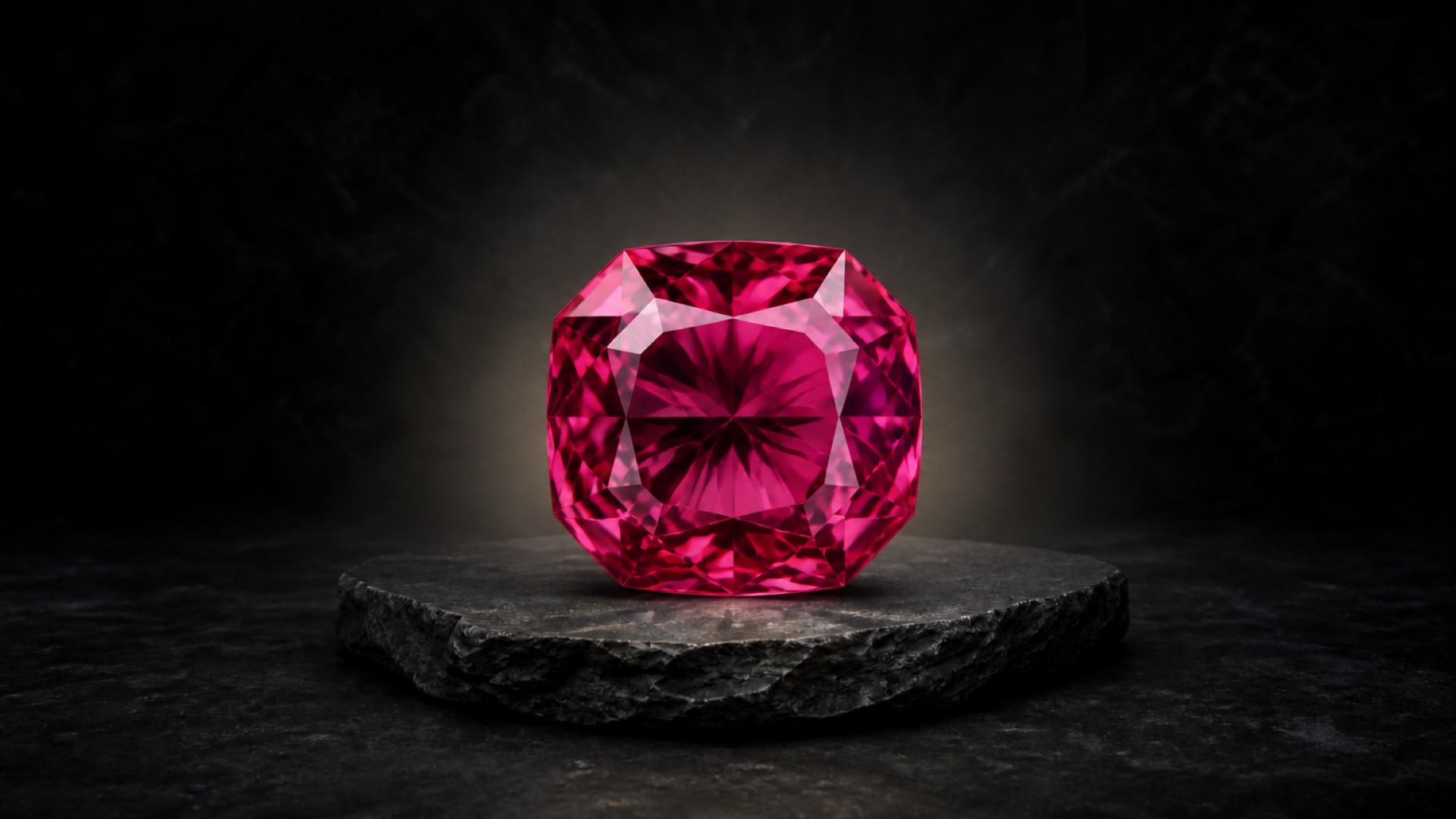
Cornerstone gemstone profile
Spinel
A distinct mineral found in a broad range of gem colors
- Species
- Spinel
AI-created master image · AI · Owned
Explore this profile
Definition
What is Spinel?
Spinel is the cubic mineral species MgAl₂O₄. Gem spinel is singly refractive and has no normal birefringence or pleochroism. Chromium, cobalt, iron, vanadium, their valence states, and their interactions can produce different colors; no single trace element explains every spinel. [1,2]
At a glance
Gemological properties
Measured values and species-level properties are linked to their evidence. “Pending” means the value has not cleared review.
| Gemstone | Spinel | Mineral species | Spinel |
|---|---|---|---|
| Mineral group | Silicates | Family | Pending verification |
| Chemical formula | MgAl₂O₄[1,2] | Crystal system | Cubic[2,1] |
| Mohs hardnessMohs hardnessA comparative scale of scratch resistance from 1 to 10; it does not measure toughness.Learn more | 8[1,2,3] | Specific gravitySpecific gravityThe ratio of a material’s density to the density of water under defined conditions.Learn more | 3.6[1,2] |
| Refractive indexRefractive indexA measurement describing how light changes speed and direction as it enters a material.Learn more | 1.718[1,2] | BirefringenceBirefringenceThe numerical difference between a doubly refractive material’s principal refractive indices.Learn more | 0[1] |
| Optic character | Isotropic (singly refractive)[1,2] | DispersionDispersionThe separation of white light into spectral colors because refractive index varies with wavelength.Learn more | 0.02[2] |
| Primary color | Multicolor[1] | PleochroismPleochroismDifferent body colors seen in some anisotropic gems when viewed along different crystallographic directions.Learn more | None[1] |
| LusterLusterThe character of light reflected from a material’s surface.Learn more | Vitreous[2] | Transparency | Transparent to nearly opaque[2] |
| CleavageCleavageA mineral’s tendency to split along specific crystallographic planes.Learn more | No true cleavage; parting may occur on {111}[2] | Fracture | Conchoidal to uneven[2] |
| TenacityTenacityA material’s response to bending, breaking, crushing, or tearing.Learn more | Brittle; good toughness as a gem[2,3] | Fluorescence | Variable; chromium-bearing material may fluoresce red, but response is not diagnostic[1] |
| Streak | White[2] | Availability | Natural · Laboratory-grown |
| Jewelry suitability | Durable for many jewelry uses; fractures, treatments, high heat, and setting still affect care[3] | ||
Scope note: some physical properties describe corundum as a mineral species; ruby-specific claims are identified separately in the citations.
Mineralogy
Mineralogy & classification
The mineral species spinel is MgAl₂O₄ and crystallizes in the cubic system. It belongs to the broader spinel group, whose members share a structural pattern but can have different compositions and properties. Gem spinel should not be confused with every spinel-group mineral.
Cubic symmetry makes ordinary gem spinel isotropic, or singly refractive. Well-formed rough crystals are often octahedral. Natural gem material can be transparent, translucent, or opaque, and iron-rich compositions can become dark.
Species identity is a chemical and structural determination. Color names such as red spinel or cobalt-bearing blue spinel describe particular appearances or chemistry within the species.
Mineral species
Spinel (MgAl₂O₄)Gem spinel is one mineral species within the broader spinel structural group. [2]
Do not apply species-level gem properties to every spinel-group mineral.
Chemistry
Chemistry & composition
Spinel’s ideal composition is magnesium aluminum oxide, MgAl₂O₄. Trace chromium, cobalt, iron, vanadium, and combinations of ions can affect color. Their effect depends on concentration, valence, lattice site, competing absorptions, and interactions; one element does not explain every sample.
Chromium commonly contributes to red and pink material. Cobalt can produce vivid blue, while iron can contribute blue, violet, greenish, gray, or dark appearances depending on valence and site. Purple spinel may combine chromium, cobalt, iron, vanadium, or other contributions in different proportions.
Detecting a trace element does not prove it dominates visible color. Spectroscopy and quantitative chemistry are needed for a defensible color-cause statement.
Magnesium is a major component of ideal MgAl₂O₄ spinel. [2]
Aluminum is a major component of ideal MgAl₂O₄ spinel. [2]
Oxygen forms the oxide framework of spinel. [2]
Chromium commonly contributes red and pink coloration. [5]
Cobalt can produce vivid blue coloration, subject to concentration and competing absorptions. [4]
Ferrous and ferric iron can produce or modify blue, violet, gray, greenish, and dark colors. [4]
Vanadium may contribute to orange or mixed-color mechanisms in some spinels. [5]
Color
Color science
Natural spinel occurs in red, pink, orange, purple, violet, blue, gray, black, and other colors. Red spinel is commonly chromium-related. Vivid blue may involve cobalt, while iron-related absorptions can produce darker or grayer blue. Different mechanisms can mix, especially in purple material.
“Cobalt spinel” should not be assigned merely because a laboratory detects some cobalt: very low concentrations may not visibly affect a faceted stone. Iron concentration and valence can modify saturation and hue even when cobalt is present.
Color is a value factor, not an identity test. Synthetic spinel can be grown in convincing colors, and treated blue-to-green material has also been documented.
Common color contributor
Cr³⁺Chromium commonly contributes red to pink coloration in gem spinel. [5,1]
Color does not distinguish spinel from ruby without mineral testing.
Cobalt and iron contributions
Co²⁺, Fe²⁺ and Fe³⁺ can interactCobalt can produce vivid blue, while iron commonly modifies hue, grayness and saturation. [4]
Detectable cobalt at trace level does not automatically justify a “cobalt spinel” label.
Mixed chromophores
Chromium, cobalt, iron and vanadium may contributePurple material demonstrates why one color name cannot be assigned one universal chemical cause. [5]
Individual color-cause claims require sample-specific evidence.
Optics
Optical properties
Spinel is cubic and ordinarily singly refractive, with a refractive index near 1.718 and no normal birefringence or pleochroism. Ruby and sapphire are doubly refractive corundum. These differences are central to gemological separation, although no single reading resolves every mounted or unusual stone.
A refractometer and polariscope can quickly distinguish many spinels from corundum. Specific gravity, spectrum, fluorescence, microscopy, and chemistry provide additional evidence. Anomalous strain reactions can occur and should not be mistaken for normal birefringence.
Professional identification uses agreement among tests. Color alone, a phone photograph, or a scratch test cannot establish spinel identity.
Optical character
Isotropic; singly refractiveCubic spinel normally lacks birefringence and pleochroism, distinguishing it from corundum. [2]
Anomalous strain reactions and mounted stones can complicate quick testing.
Durability
Hardness & durability
Spinel has Mohs hardness about 8, no true cleavage, and generally good toughness for a faceted gemstone. It suits many rings, earrings, pendants, and bracelets, but sharp impacts can chip edges and existing fractures or fillings can change care requirements.
Hardness measures scratch resistance, not resistance to breakage. Spinel is less scratch resistant than corundum but remains durable for many jewelry uses when well cut, securely set, and protected from hard knocks.
High heat can alter color in some material, and fracture fillings may be vulnerable. Warm soapy water is the safest routine cleaning choice when treatment and condition are uncertain.
Hardness means scratch resistance. It is not a universal durability score and does not equal toughness.
Formation
Geology & formation
Gem spinel commonly forms in metamorphic environments, including magnesium-rich marbles affected by contact or regional metamorphism. Weathering can release durable crystals into secondary gravels. The species also occurs in other geologic settings, so one formation story does not cover every spinel.
Host-rock chemistry helps explain why spinel, ruby, and sapphire can occur within the same broad gem district without occupying the same exact deposit. District-level association must not be converted into a claim of mine-level co-occurrence.
Inclusions such as carbonate or apatite crystals and negative crystals can record aspects of formation, but they must be interpreted as an assemblage rather than a universal locality checklist.
Locations
Where Spinel occurs
Documented spinel sources include Myanmar, Sri Lanka, Tanzania, Vietnam, Tajikistan, Afghanistan, and Pakistan. Different deposits are known for different colors, geology, and production histories. A locality relationship does not prove origin for an individual gemstone.
Mogok and Namya in Myanmar, Luc Yen in Vietnam, Mahenge in Tanzania, and the Badakhshan–Kuh-i-Lal region of Central Asia are important in gemological or historical literature. Some locality names cover districts with many workings rather than one deposit.
Current mining status changes and requires recent evidence. This profile distinguishes documented occurrence and historical importance from a claim that a mine is active today.
Shared district is not shared mine
Keep location precision explicitMogok contains ruby, sapphire and spinel occurrences, but district association does not prove mine-level co-occurrence. [7]
Do not infer exact deposit relationships without deposit-level evidence.
Luc Yen Gem District
Luc Yen is documented for cobalt-bearing blue and purple spinel in placer deposits. [5]
- Production
- Production not assessed
- Coordinates
- Not published
Mahenge Spinel District
Mahenge is documented as a notable Tanzanian spinel source. [6]
- Production
- Production not assessed
- Coordinates
- Not published
Kuh-i-Lal Spinel Region
Kuh-i-Lal is historically important for fine red spinel; current production is not asserted. [7]
- Production
- Historic production documented
- Coordinates
- Not published
Badakhshan Spinel Region
Badakhshan has a long documented spinel history; modern-border precision is retained. [7]
- Production
- Historic production documented
- Coordinates
- Not published
Sri Lanka Sapphire and Spinel Gravels
Sri Lanka is a documented spinel source; current production is not assessed here. [6]
- Production
- Production not assessed
- Coordinates
- Not published
Mogok Stone Tract
GIA field reporting documents spinel mining in the Mogok Stone Tract. [14]
- Production
- Historic production documented
- Coordinates
- Approximate locality position
Origin caution: locality relationships do not by themselves prove geographic origin for an individual stone.
Inclusions
Inclusions & internal features
Natural spinel can contain carbonate and apatite crystals, octahedral negative crystals, fluids, sulfides, and rutile- or sphene-like needles or platelets. These features can support conclusions about growth, treatment, or origin, but no short checklist substitutes for complete microscopic and analytical examination.
Natural, treated, and synthetic spinels each show a range of features. A spinel crystal enclosed in spinel may have very low relief because host and inclusion share similar refractive index; its unchanged appearance after heating is not universal proof that the host is unheated.
Microscopy is most useful when combined with spectra, luminescence, and chemistry.
Octahedral negative crystals
Solid-, fluid-, or mixed-filled internal formsNegative crystals and mineral inclusions can record growth conditions and assist identification. [6]
No single inclusion is a universal natural-origin or locality test.
Mineral crystals
Solid inclusions requiring identification and contextual interpretation. [6]
- Identification
- Mineral assemblages can support natural-growth interpretation.
- Treatment context
- Some included crystals react to heat; absence of reaction is not universal proof of no heat.
- Origin caution
- Assemblages can support but not independently prove locality.
Negative crystals
Crystal-shaped cavities that may contain fluids, solids, or a mixture. [6]
- Identification
- Octahedral negative crystals are a useful part of the spinel inclusion scene.
- Treatment context
- Heat or filling interpretation requires associated evidence.
- Origin caution
- Negative crystals occur across sources and are not a country test.
Carbonate and apatite crystals
Mineral inclusions associated with some metamorphic spinel growth environments. [6]
- Identification
- Carbonate and apatite inclusions are consistent with several metamorphic spinel environments.
- Treatment context
- Included minerals can respond differently to treatment.
- Origin caution
- Mineral assemblages may support geology but still overlap geographically.
Needles and platelets
Elongate or platy inclusions that may contribute to chatoyancy when oriented. [6]
- Identification
- Rutile- or sphene-like intergrowths can affect transparency and optical effects.
- Treatment context
- Heat may alter some features; interpretation is sample-specific.
- Origin caution
- They do not independently prove locality.
- Identification
- Healed fractures contribute to the internal record of growth or later alteration.
- Treatment context
- Flux-assisted healing can be evidence of high-temperature diffusion or other treatment.
- Origin caution
- Not a stand-alone origin marker.
Treatments
Treatments & disclosure
Treatment is less pervasive in spinel than in some other colored stones, but it is documented. Heat treatment, fracture filling, and high-temperature diffusion that modifies blue-to-green color have all been reported. “Usually untreated” must never be interpreted as “treatment impossible.”
Heat may improve clarity or alter color and can require photoluminescence or visible spectroscopy for detection. Fracture filling reduces the visibility of surface-reaching fractures. GIA researchers have documented nickel diffusion in material represented as cobalt-diffused spinel.
Buyers should request explicit disclosure. A laboratory report may be valuable when color, treatment, or natural origin materially affects price.
Treatments are documented
Heat, filling and diffusionSpinel is often less treated than corundum, but treatment cannot be ruled out by reputation. [6,8,9]
“Usually untreated” is not equivalent to “untreated.”
Nickel diffusion
Documented high-temperature color modificationGIA researchers identified nickel-diffused stones represented as cobalt diffused. [9]
Advanced chemistry and spectroscopy may be required for defensible detection.
Heat treatment
- Purpose
- Improve clarity or alter appearance in selected material.
- Detection
- Photoluminescence, visible spectroscopy, microscopy and chemistry may contribute.
- Permanence
- Stability depends on material and treatment; avoid assuming all heated material behaves identically.
- Care effect
- Avoid high repair heat unless treatment and condition are understood.
- Disclosure
- Do not market spinel as untreated solely because treatment is uncommon. [8]
Fracture filling
- Purpose
- Clarity enhancement of surface-reaching fractures.
- Detection
- Microscopy and inspection of surface-reaching features can reveal filling.
- Permanence
- Filler durability may differ from the host spinel.
- Care effect
- Use conservative cleaning and avoid high heat or chemicals when filling is possible.
- Disclosure
- Disclose filling explicitly. [6]
Diffusion treatment
- Purpose
- Modify color in faceted or partly faceted material.
- Detection
- Chemistry profiles, spectroscopy, facet-junction concentrations and flux-healed textures can support detection.
- Permanence
- Treatment penetrates from the surface and is not equivalent to natural cobalt coloration.
- Care effect
- Avoid repolishing or heat until treatment is understood.
- Disclosure
- State diffusion treatment and laboratory findings clearly. [9]
Natural vs synthetic
Natural, laboratory-grown & simulant
Laboratory-grown spinel has spinel structure but a human-controlled growth history. Flame fusion is widely available; flux-grown material also exists, and other growth methods are technically possible. Synthetic spinel can imitate other gems in color, but its use as a simulant is a role, not its mineral identity.
A blue flame-fusion spinel may be synthetic spinel and may also be used to imitate sapphire. Those are two separate statements: one describes how the material grew, the other describes how it is represented or used.
Curved growth, chemistry, inclusions, fluorescence, and spectroscopy can help separate natural and synthetic material. Professional testing is appropriate when routine observations remain ambiguous.
Flame-fusion synthetic Spinel
Widely availableFlame fusion produces synthetic spinel in a broad range of colors. [10,6]
Synthetic spinel may also be used as a simulant for another gem; identity and use are separate facts.
Flux-grown synthetic Spinel
Technically sophisticated and less commonFlux-grown material can show inclusions and growth features unlike flame-fusion products. [10,6]
Natural-looking features require full laboratory interpretation.
Identification
How gemologists identify Spinel
Gemologists identify spinel by combining refractive index, singly refractive behavior, specific gravity, spectrum, fluorescence, microscopy, and—when needed—advanced chemical or spectroscopic testing. Those observations can also help separate natural, synthetic, and treated material.
The lack of normal birefringence and pleochroism is useful when comparing spinel with ruby or sapphire, but anomalous strain and mounting limitations can complicate a quick test. Color and fluorescence overlap among materials.
Origin determination requires comparison with reliable reference collections and is not available or conclusive for every stone. Home tests cannot prove identity or treatment.
Ruby vs Spinel
Different mineral speciesRuby is doubly refractive corundum; spinel is singly refractive magnesium aluminum oxide. [2,1]
Color alone cannot separate them.
Converging evidence
RI, polariscope, spectrum, microscopy and chemistryMultiple observations distinguish identity, synthesis and treatment more reliably than one test. [6,8]
Fluorescence is a clue, not proof.
Value factors
Value factors
Spinel value reflects color, tone, saturation, transparency, inclusions, cut, size, treatment, natural or synthetic origin, locality evidence where relevant, and provenance. Fine red, pink, blue, or other material cannot be priced responsibly from color name and carat weight alone.
Vivid color with balanced tone and an effective cut can be desirable, while overly dark tone, windowing, severe extinction, damage, or durability-threatening fractures can reduce appeal. Some cobalt-bearing blue and historically significant red material receives collector attention, but chemical presence alone does not establish a premium.
There is no universal spinel grading scale or guaranteed investment outcome.
Buying guide
How to buy Spinel
Confirm that the seller means natural spinel, laboratory-grown spinel, or a spinel used as a simulant. Examine color in several lights, transparency, inclusions, cut, damage, and face-up performance. Ask about heating, fracture filling, diffusion, locality claims, and independent laboratory documentation.
For red spinel, do not accept appearance as proof that the stone is ruby or spinel. For blue spinel, a cobalt description should be supported by meaningful spectroscopy and chemistry rather than a trace detection alone.
Match the setting to the stone’s condition and intended wear. Obtain written treatment and return terms, and consider an independent report when the transaction depends on natural origin, treatment status, or locality.
Collector guide
Collector’s guide to Spinel
Collectors may focus on historic red spinel, vivid pink or blue material, documented localities, unusual color mechanisms, crystal form, untreated stones, or strong provenance. Each claim needs context: “rare,” “Jedi,” and “cobalt” can be used loosely unless the criteria and evidence are stated.
Historic documentation is particularly important because famous red spinels were once recorded as rubies. Modern laboratory reports, prior collection labels, invoices, and photographs should be preserved together.
Locality, color, size, and natural crystal form can all matter, but collector desirability is not a scientific score and does not guarantee future value.
Care
Spinel care card
Warm water, mild soap, and a soft brush are safe general choices for spinel. Ultrasonic and steam cleaning may be acceptable for sound, untreated stones, but should be avoided when fractures, filling, treatment, or condition are uncertain. High heat can alter some spinel.
Inspect prongs and exposed facet edges before cleaning. Avoid hard blows, rapid temperature changes, and bench heat unless a jeweler has assessed the stone and any treatment.
Store spinel separately from harder gems such as ruby, sapphire, and diamond, which can scratch it. Tell the jeweler about laboratory reports and disclosed treatments before repair.
Safest general method
Warm water, mild soap and a soft brushConservative cleaning is appropriate when treatment or condition is uncertain. [3]
Avoid high heat and machine cleaning for filled, fractured or uncertain material.
History
History & etymology
Before modern mineralogy and optical testing, transparent red stones could be grouped by appearance rather than species. Famous historic “rubies” were later recognized as spinel. The Black Prince’s Ruby in the Imperial State Crown is a documented red spinel, not corundum ruby.
Historical names such as “Balas ruby” preserve a trade history but should not be used as modern species identification. The correction illustrates a central gemological principle: color and reputation cannot replace mineral testing.
Spinel’s independent identity is now well established, and its own colors, localities, chemistry, and crystal forms support a collector market separate from ruby.
Short answers
Spinel questions, answered
What is Spinel?+
Spinel is a cubic magnesium aluminum oxide mineral with the ideal formula MgAl₂O₄. Gem spinel occurs in many colors and is a distinct mineral species. It is not a ruby, although red spinel and ruby were historically confused. [1,2]
Spinel is a cubic magnesium aluminum oxide mineral with the ideal formula MgAl₂O₄. Gem spinel occurs in many colors and is a distinct mineral species. It is not a ruby, although red spinel and ruby were historically confused.
Is Spinel a Ruby?+
No. Ruby is red corundum, Al₂O₃, while spinel is MgAl₂O₄ with cubic structure and singly refractive optical behavior. Their colors can overlap, but their chemistry, structure, refractive index, density, hardness, and optics differ. [2,1]
No. Ruby is red corundum, Al₂O₃, while spinel is MgAl₂O₄ with cubic structure and singly refractive optical behavior. Their colors can overlap, but their chemistry, structure, refractive index, density, hardness, and optics differ.
Why was Spinel mistaken for Ruby?+
Before modern mineralogical and optical testing, transparent red stones were often grouped by appearance and source. Spinel and ruby can share convincing red colors and occur in the same broad districts. Modern tests separate their species identities. [12,7]
Before modern mineralogical and optical testing, transparent red stones were often grouped by appearance and source. Spinel and ruby can share convincing red colors and occur in the same broad districts. Modern tests separate their species identities.
How hard is Spinel?+
Spinel is about 8 on the Mohs scale. It has no true cleavage and generally performs well in jewelry, but it can chip or fracture under impact. Hardness describes scratch resistance and should not be treated as a complete durability score. [2,3]
Spinel is about 8 on the Mohs scale. It has no true cleavage and generally performs well in jewelry, but it can chip or fracture under impact. Hardness describes scratch resistance and should not be treated as a complete durability score.
What colors does Spinel occur in?+
Natural gem spinel occurs in red, pink, purple, violet, blue, orange, gray, black, and other colors. Different trace elements and interactions produce different hues. A color name alone does not establish identity, natural origin, or treatment. [1,6]
Natural gem spinel occurs in red, pink, purple, violet, blue, orange, gray, black, and other colors. Different trace elements and interactions produce different hues. A color name alone does not establish identity, natural origin, or treatment.
What causes red Spinel?+
Chromium commonly contributes red and pink coloration in spinel. Concentration, lattice environment, iron content, cutting, and light all affect the visible result. The same red appearance can occur in other materials, so color cannot identify spinel. [5,1]
Chromium commonly contributes red and pink coloration in spinel. Concentration, lattice environment, iron content, cutting, and light all affect the visible result. The same red appearance can occur in other materials, so color cannot identify spinel.
What causes blue Spinel?+
Cobalt can produce vivid blue spinel, while iron-related absorptions can produce or modify blue, violet, gray, and greenish appearances. Cobalt, ferrous iron, ferric iron, concentration, and competing absorptions can interact in one stone. [4]
Cobalt can produce vivid blue spinel, while iron-related absorptions can produce or modify blue, violet, gray, and greenish appearances. Cobalt, ferrous iron, ferric iron, concentration, and competing absorptions can interact in one stone.
Is Spinel treated?+
Treatments are less pervasive than in some colored stones but are documented. Heat, fracture filling, and high-temperature diffusion that modifies blue-to-green color have been reported. A reputation for being untreated is not proof for an individual stone. [6,8,9]
Treatments are less pervasive than in some colored stones but are documented. Heat, fracture filling, and high-temperature diffusion that modifies blue-to-green color have been reported. A reputation for being untreated is not proof for an individual stone.
Can Spinel be laboratory-grown?+
Yes. Flame-fusion synthetic spinel is widely available, and flux-grown material also exists. Synthetic spinel has a laboratory growth history and may also be used to imitate another gem; those are separate descriptions. [10,6]
Yes. Flame-fusion synthetic spinel is widely available, and flux-grown material also exists. Synthetic spinel has a laboratory growth history and may also be used to imitate another gem; those are separate descriptions.
Where is Spinel found?+
Documented sources include Myanmar, Sri Lanka, Tanzania, Vietnam, Tajikistan, Afghanistan, and Pakistan. Different localities produce different colors and geological associations. A locality listed for the species does not prove origin for an individual stone. [6,7]
Documented sources include Myanmar, Sri Lanka, Tanzania, Vietnam, Tajikistan, Afghanistan, and Pakistan. Different localities produce different colors and geological associations. A locality listed for the species does not prove origin for an individual stone.
How can Spinel be identified?+
Gemologists combine refractive index, singly refractive behavior, specific gravity, spectrum, fluorescence, microscopy, and sometimes advanced chemistry or spectroscopy. The same evidence can help distinguish natural, synthetic, and treated material. [2,6]
Gemologists combine refractive index, singly refractive behavior, specific gravity, spectrum, fluorescence, microscopy, and sometimes advanced chemistry or spectroscopy. The same evidence can help distinguish natural, synthetic, and treated material.
Is Spinel suitable for everyday jewelry?+
Many spinels are durable enough for frequent wear because hardness is about 8 and true cleavage is absent. Suitability still depends on fractures, filling, cut, setting protection, exposed edges, and the wearer’s activities. [3,2]
Many spinels are durable enough for frequent wear because hardness is about 8 and true cleavage is absent. Suitability still depends on fractures, filling, cut, setting protection, exposed edges, and the wearer’s activities.
Is Spinel rare?+
Rarity depends on the population being discussed: species occurrence, transparent gem quality, a particular color, size, locality, treatment status, or provenance. A seller’s unqualified “rare” label is not a scientific measurement and should be clarified. [1,7]
Rarity depends on the population being discussed: species occurrence, transparent gem quality, a particular color, size, locality, treatment status, or provenance. A seller’s unqualified “rare” label is not a scientific measurement and should be clarified.
How should Spinel be cleaned?+
Warm water, mild soap, and a soft brush are safest. Avoid steam, ultrasonic cleaning, and repair heat when filling, fractures, treatment, or condition are uncertain. Store spinel away from harder ruby, sapphire, and diamond. [3]
Warm water, mild soap, and a soft brush are safest. Avoid steam, ultrasonic cleaning, and repair heat when filling, fractures, treatment, or condition are uncertain. Store spinel away from harder ruby, sapphire, and diamond.
What is the difference between Ruby and Spinel?+
Ruby is trigonal, doubly refractive corundum with Mohs hardness 9. Spinel is cubic, ordinarily singly refractive magnesium aluminum oxide with hardness about 8. Refractive index, birefringence, specific gravity, spectra, and microscopy separate them professionally. [2,1]
Ruby is trigonal, doubly refractive corundum with Mohs hardness 9. Spinel is cubic, ordinarily singly refractive magnesium aluminum oxide with hardness about 8. Refractive index, birefringence, specific gravity, spectra, and microscopy separate them professionally.
Evidence
References & further reading
Citation numbers are deduplicated across properties, claims, sections, structured modules, treatments, inclusions, FAQs, and related educational records.
- [1]Spinel Gemstone Overview.
Gemological Institute of America
- [2]Spinel.
Mineralogical Society of America · 2021
- [3]Spinel Care and Cleaning Guide.
Gemological Institute of America
- [4]Aaron C. Palke and Ziyin Sun. What Is Cobalt Spinel? Unraveling the Causes of Color in Blue Spinels.
Gems & Gemology · 2018 · Vol. 54 (3)
- [5]Philippe M. Belley and Aaron C. Palke. Purple Gem Spinel from Vietnam and Afghanistan: Comparison of Trace Element Chemistry, Cause of Color, and Inclusions.
Gems & Gemology · 2021 · Vol. 57 (3)
- [6]Nathan Renfro, John I. Koivula, Shane F. McClure, Kevin Schumacher, and James E. Shigley. Micro-Features of Spinel.
Gems & Gemology · 2021 · Vol. 57 (1)
- [7]Wim Vertriest, Aaron C. Palke, and Nathan D. Renfro. Field Gemology: Building a Research Collection and Understanding the Development of Gem Deposits.
Gems & Gemology · 2019 · Vol. 55 (4)
- [8]Sudarat Saeseaw, Wuyi Wang, Kenneth Scarratt, John L. Emmett, and Troy R. Douthit. Distinguishing Heated Spinels from Unheated Natural Spinels and from Synthetic Spinels.
Gemological Institute of America · 2009
- [9]Michael Jollands, Abadie Ludlam, Aaron C. Palke, Wim Vertriest, Shiyun Jin, Pamela Cevallos, Sarah Arden, Elina Myagkaya, Ulrika D’Haenens-Johannson, Vararut Weeramongkhonlert, and Ziyin Sun. Color Modification of Spinel by Nickel Diffusion: A New Treatment.
Gems & Gemology · 2023 · Vol. 59 (2)
- [10]An Introduction to Synthetic Gem Materials.
Gemological Institute of America
- [11]Colored Stones Unearthed: Synthetic Opal.
Gems & Gemology · 2024 · Vol. 60 (2)
- [12]A History of State Portraits.
Royal Collection Trust · 2026
- [13]Spinel Inclusion in Spinel.
Gemological Institute of America · 2014
- [14]Vincent Pardieu, Andrew Lucas, and GIA field team. Mogok Expedition Series, Part 1: The Valley of Rubies.
Gemological Institute of America · 2014